Viewpoint and traditional district
Yanahuara Viewpoint Audio Guide (Mirador de Yanahuara)
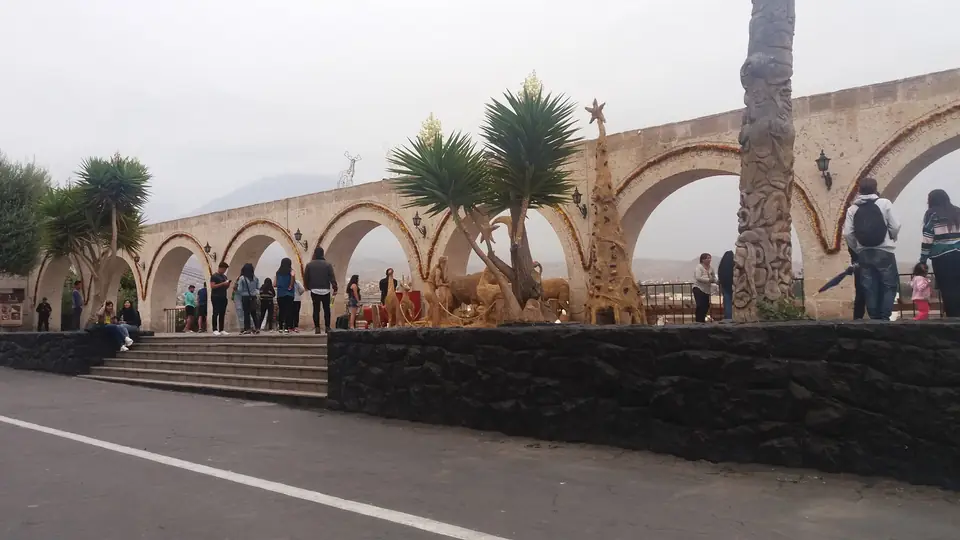
Ten white ashlar arches look at Arequipa from the other bank of the Chili, with Misti in front. Each one carries a verse by an Arequipa writer carved on it, and together they make a small manifesto of the rebel city.
- 30 min of audio
- Ashlar, verses and volcanoes
Yanahuara was the old Indigenous town of the Chimba, «the other bank» of the Chili River. In 1576, with Viceroy Francisco de Toledo in the city, the cacique Pedro Meca Vilca ceded to the community the lands of the Viewpoint, the church and the square. The present arcade was built for the centenary of the Villa Hermosa de Yanahuara, in 1970, beside a church of San Juan Bautista dated 1750 with a mestizo portal in carved ashlar.
The balcony where couples now take their photo with the volcano was, according to a neighbourhood tradition, a dump for leftover ashlar full of lizards that guarded a love amulet. And among the verses on the arches signs Francisco Mostajo, the freethinker whom devout Arequipa considered it a sin to greet.
Highlights
- Arcade of 10 round ashlar arches, from the town's centenary in 1970
- Carved verses by Bustamante y Rivero, Jorge Polar, Benito Bonifaz and Francisco Mostajo
- View of Misti, Chachani and Pichu Pichu over the historic centre
- Mestizo portal of San Juan Bautista, with the ashlar San Juan Ccalato
- Feast of San Juan Bautista every 24 June
From the centre of Arequipa, Yanahuara lies on the other side of the Chili River, on the bank that for centuries was called the Chimba, «the other bank». There stood the Indigenous town of the Yanaguaras, and there, in 1576, the cacique Pedro Meca Vilca ceded to the community, with Viceroy Francisco de Toledo present in the city, the lands of the Viewpoint, of the church of San Juan Bautista, of the council house, of two schools, of the old cemetery and of the square. The Spaniards who settled on that bank tried to rename it «Nueva Segovia», but the name never took.
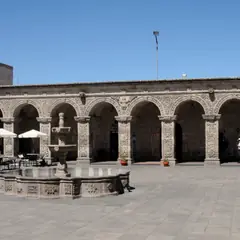
What attracts visitors today is an arcade of white ashlar that closes the eastern side of the square and frames the city with Misti, Chachani and Pichu Pichu behind. Most sources place it in 1970, within the project with which mayor Guillermo Ballón Landa celebrated the town’s centenary; others move it to 1972 or to the nineteenth century, and one speaks of an older viewpoint of only three arches. On each arch a verse is carved, and the history of the Yanahuara Viewpoint is read in those stones: rebelliousness, nostalgia, faith and the odd goblin. The audio guide walks the arches one by one and ends at the portal of San Juan Bautista, with a narration that is documented and checked against historical sources.
The mestizo portal of San Juan Bautista is a relative of that of the Church of the Company of Jesus, the model of that Baroque, and the volcanoes that peer out behind the arches are the same high sanctuaries explained by the Andean Sanctuaries Museum.
A president and a goblin at the first arch
Cuesta del Ángel arch
Summary of this stop
Whoever climbs from the centre by the Cuesta del Ángel enters the square under a large arch with a cornice, accompanied by a small one for the pavement. It is the door of the arcade, and it is no accident that it exists: on 8 November 1870 a law of Congress granted Yanahuara, then written «Yanaguara», the title of Villa Hermosa, which makes it one of the oldest legally created districts of Arequipa. For the centenary, the Provincial Council voted an allocation of S/. 807,000, the municipality bought two terraces to enlarge the old viewpoint and the ten round arches were raised.
The verse that opens the route is not epic but nostalgic: «The alley that no one walks, the streetlamp that is never lit…». It is signed by José Luis Bustamante y Rivero, president of Peru between 1945 and 1948 and judge of the International Court of Justice from 1961 to 1970, and it speaks of unlit alleys and of the good folk who tremble at the story of a goblin. On the back face, mayor Ballón Landa chose a phrase from Virgil. What that goblin has to do with a district said to have no house without its ghost is something the narration reveals at the foot of the arch.
The other bank looks at the city
Yanahuara Viewpoint
Summary of this stop
From the parapet, Misti rises in front above the city, with Chachani and Pichu Pichu to the sides and, below, the Chili valley and the historic centre. The postcard is familiar, but the vantage point also tells a story: this balcony belongs to the opposite bank, to the Chimba that took in Yanahuara, Antiquilla, Umacollo, Sachaca, Tiabaya and Uchumayo, and that looks at the Spanish city from the land a cacique donated to his people.
The caciques of Yanahuara were not always on the side of their own. In 1780 Esteban Condorpusa opposed his people, the Crown rewarded him with the title of lieutenant colonel of Militias and the Spaniards themselves mocked him with a quatrain ending «for toady and for traitor».
A documented tradition explains why the Viewpoint is a place for lovers. It is said that the leftover ashlar from the church works was dumped on this land and that the site filled with lizards, some of which guarded a small multicoloured stone with the power of a love amulet. Getting it required a ruse with wine and quick legs; how the chase ended is part of the tale the audio guide reserves for this parapet.
Bells turned into cannons and a wall in every chest
Verses of the sixth and seventh arches
Summary of this stop
Along the arcade, the carved verses bring together Alberto Guillén, Percy Gibson, Francisco Mostajo, Benito Bonifaz, Jorge Polar, Belisario Calle, César «Atahualpa» Rodríguez and Alberto Hidalgo, besides Bustamante y Rivero. Jorge Polar’s ends «no one is born in vain at the foot of a volcano», and César Atahualpa Rodríguez’s boasts that here the metal of the bells was made into cannons to channel the overflows of republican lavas. Read in a row, the arches draw the portrait of a rebel Arequipa.
The sixth arch carries «That the people who defend their right carry an invincible wall in every chest», attributed to Benito Bonifaz, ideologue of the Arequipa rebellion of 1856, although one transcription shares it with César Atahualpa Rodríguez. Bonifaz died from a gunshot on 7 March 1858, in command of Fort Malakoff, during Ramón Castilla’s assault on the city.
The seventh arch, the one that proclaims Arequipa a sturdy land, is signed by Francisco Mostajo, agnostic and libertarian, whom the devout city called «the devil» and «the priest-eater». In 1905, with bubonic plague arriving from Mollendo, he called an anticlerical rally in the Plaza de Armas. The anecdote that best portrays him, that of a frightened child in a dark alley beside Santa Catalina, is heard in full in front of his verse.
The naked San Juan of the ashlar embroidery
San Juan Bautista Church of Yanahuara
Summary of this stop
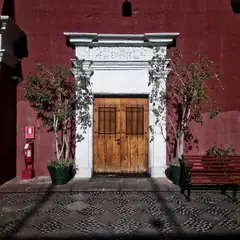
Facing the square rises the church of San Juan Bautista de Yanahuara, with a single nave and a square-plan bell tower, a work of the middle phase of the Arequipa Baroque. One source dates it to 29 January 1750; others speak only of a work finished or already active that year, and in 1788 it was described as rebuilt at the expense of its parish priest. The ashlar portal reads from bottom to top like a stone tapestry: San Juan Bautista at the centre with two angels above the arch, Saint Francis and Saint Dominic in their niches, the shields of both orders with the Virgin of the Rosary between them and, at the top, a cross between Saint Vincent Ferrer and Saint Anthony of Padua.
The people of Arequipa call the central figure «San Juan Ccalato», from the Quechua qala, «naked», surrounded by an «ashlar embroidery». The contrast comes on crossing the door: a severe, dark interior that keeps an eighteenth-century mural of the Baptism of Christ. The town is still in festival every 24 June, with Mass, procession, serenades, dances and fireworks, as it already was in 1788, when the caciques of the main ayllus paid for the celebration without charging the parishioners.
The old people of Yanahuara also tell a story about the tower’s bells, cast, they say, on the very ground of the Viewpoint. What the neighbourhood women gave so that they would ring better is the last secret the audio guide reveals in front of the portal.