Historic market
San Camilo Market Audio Guide (Mercado San Camilo)
Arequipa's oldest food market occupies the site of a church that the earthquake of 1868 wiped off the map. On top rose a hall of iron and pink ashlar that withstood the quakes the temple could not.
- 40 min of audio
- Iron and ashlar, 1910-1938
On this site the Order of San Camilo raised in 1801 a church with the largest vault of its time in Arequipa, whose dome the poet Mariano Melgar helped to complete. The earthquake of 1868 brought it down and traders occupied the ruins; in 1881 the Provincial Council assigned them to the central market, which opened in the open air. The first stone of the present building was laid in 1910 and, for lack of money, the work advanced in stages for almost three decades until its inauguration on 1 May 1938, although other sources place it in 1939.
Local press and guidebooks repeat that the iron structure is the work of Gustave Eiffel, but the Arequipa historian Eusebio Quiroz denies there is any documentary basis and places the work with a local twentieth-century firm. The original plans of 1912, believed lost, turned up in April 2022 in boxes in the basement of the Portal Municipal: they bear six names and no identified principal author.
Highlights
- Hall of iron pillars, arches and tie rods — over 7,500 m² roofed under a metal cover with natural light
- Attribution to Eiffel without documents — and plans of 1912 found in a basement in 2022
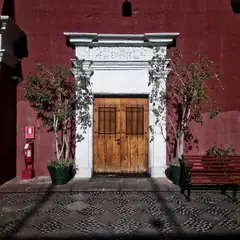
- Pink ashlar walls and neo-Renaissance façade on Alto de la Luna Street
- Artisan queso helado churned in tubs over ice, in the second-floor eateries
- Los Agachaditos and images of San Camilo, San Pedro and the Señor del Perdón
Before 1881 Arequipa had no market of its own: the city shopped in corner stores and under the awnings set up on Sundays in the Plaza Mayor. That year the Provincial Council assigned to the central market the grounds of the church and hospital of San Camilo, razed by the earthquake of 1868, and on 6 January 1881 the supply centre opened in the open air among the ruins. The hall that now covers the site began to be raised in 1910 and was inaugurated on 1 May 1938, although some sources give 1939. It occupies some 12,650 m², combines iron and pink ashlar and, since 2000, forms part of the Historic Centre inscribed by UNESCO.
The history of San Camilo is that of a church that fell, an iron that did not fall and a city that keeps eating, shopping and praying in the same place. In March 1987 the National Technical Qualifying Commission recognised that the market had the merits to be a National Monument. The tour with the audio guide, documented and checked against historical sources, runs from the Alto de la Luna façade to the second-floor eateries, passing through the iron hall and the fruit and juice aisles.
The earthquake of 1868 that brought down the church of San Camilo also toppled the towers of the Arequipa Cathedral, which rises a few blocks to the northwest, on the north side of the Plaza de Armas.
A façade where two towers once stood
Alto de la Luna Street façade
Summary of this stop
The façade on Alto de la Luna Street is the market’s oldest. Its neo-Renaissance style marks the shift from nineteenth- to twentieth-century construction, but the most eloquent thing at this point is what is no longer there. Here stood the church of San Camilo, with two towers and a dome whose drum the poet Mariano Melgar helped to complete thanks to his knowledge of mathematics. Around the 1850s the convent served as a barracks, and Marshal Ramón Castilla used one of its towers to attack Vivanco’s forces.
The earthquake of 1868 brought down church and convent, and of the complex no visible trace remains. Traders occupied the ruined site, which little by little became Arequipa’s commercial axis. For half a century this corner was also the hub of urban transport: the electric tram, between 1913 and 1966, linked the market with Miraflores, Yanahuara, Paucarpata or Tingo, and the coloured gondolas, each line with its nickname, unloaded here the lonccos from the countryside with their produce. What name the white gondolas with black stripes received is one of the details the narration reserves for this place.
The iron Eiffel did not sign
San Camilo Market
Summary of this stop
Inside, the main hall rests on a skeleton of tall iron columns, arches and tie rods. For decades it has been repeated that it is the work of Gustave Eiffel, but the structure was built in the twentieth century, years after the engineer had left his signature, and the historian Eusebio Quiroz rejects that authorship. The design has also been attributed to the architect Emilio Hart Terré, and another version names as structural engineers Julio Ángulo Arce and Óscar López Aúja, with the Compañía Metalúrgica del Sena.
The mystery grew in April 2022, when the original plans of 1912, believed lost, turned up in boxes in the basement of the Portal Municipal. Their inscriptions list six names and none has been identified as principal author. Meanwhile, the metal has done its job: it withstood the quakes of 1950, 1960, 1979 and 1985 with minimal damage compared with other historic buildings in the city, on the same site where the stone vault came down in 1868.
Fruit where the train might have whistled
Fruit and juice section
Summary of this stop
The fruit section is the market’s most colourful and most photographed, with produce from the region’s valleys, and beside it line up the counters where mixed juice is prepared amid the hum of blenders. All of it beneath a metal roof designed to give natural light and ventilate the food, resting on iron pillars, arches and tie rods and wrapped by pink ashlar walls: in all, over 7,500 m² roofed.
The site might have had another destiny. When the Arequipa–Mollendo railway opened in 1871, some proposed building the station on the ruins of the convent, abandoned by the fathers of the Order of the Good Death and then at the edge of the city. The station ended up elsewhere, and that decision pushed Arequipa’s first urban expansion southward since colonial times. Ten years later, among this rubble, the open-air market opened. The story of one of the juice stalls, renamed in memory of a daughter, is told in the audio guide.
Queso helado and a calendar of saints
Eateries and Los Agachaditos
Summary of this stop
On the second floor are the eateries, with adobo, stuffed rocoto and queso helado, and the area called Los Agachaditos, named for the diners who ate in a hurry with their heads bent over the plate. Queso helado is still made by hand in tubs that spin over ice: that of the Vargas family since 1948, now in its third generation, and that of Angélica Machuca at stall 2 of Eatery 2, inherited from her grandmother Josefa Juárez.
The convent origin of the site remains present in the images of San Camilo, San Pedro and the Señor del Perdón. On the Saturday of Holy Week the Señor del Perdón goes out in procession through the inner aisles, and every 14 July San Camilo is celebrated with band and dances. The market’s year is measured in saints and pots: on 29 June the feast of Saints Peter and Paul is run by the fish section, and on Holy Thursday and Good Friday dozens of stalls cook chupe de viernes, fried fish and more than ten kinds of mazamorra. What is served on Easter Sunday to close the cycle is the finale the narration keeps.