The loveliest temple in Bagan
Ananda Temple Audio Guide (Ananda Phaya)
A king of Pagan wanted to copy in brick a snowy Himalayan cave that, according to tradition, he had seen only in an apparition. The result is a white cross of golden spires with four 9.5-metre Buddhas lit from above.
- 60 min of audio
- 11th-century cave temple
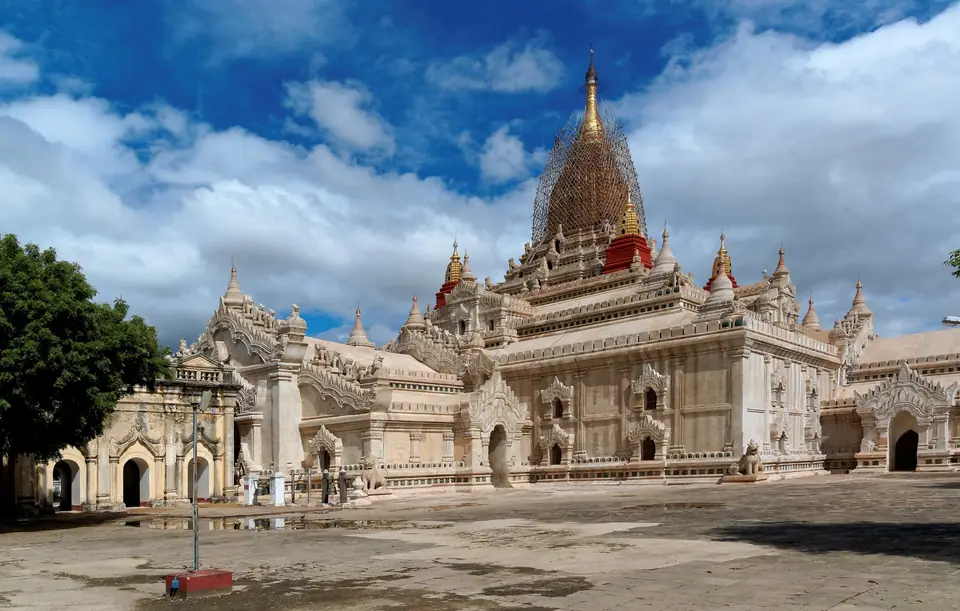
The Ananda Temple was built in the reign of King Kyansittha, who ruled Pagan from 1084 to 1112: work began around 1090 and was finished by 1105 at the latest. It is a gu-type temple, from guhā, “cave”: around a solid central cube open four niches holding four standing Buddhas, one for each cardinal direction, on a Greek-cross plan about 88 metres from tip to tip.
A Bagan saying shares the titles among three temples: the tallest is Thatbyinnyu, the largest is Dhammayangyi and the loveliest is Ananda. This temple of serene beauty also has a history of wounds: statues burned or damaged and remade, murals whitewashed for decades, and earthquakes in 1975 and 2016. Even so, every month of Pyatho thousands of villagers arrive in ox carts to camp around it.
Highlights
- Four standing Buddhas — 9.5 m tall, gilded in gold leaf, one for each cardinal direction
- Greek-cross plan — a 53 m square with four porches and about 88 m from tip to tip
- 1,472 glazed plaques — Mara's army and the jatakas, with captions in Mon and Pali
- Kneeling Kyansittha — a lacquer statue of the founding king beside the monk Shin Arahan
- Pyatho festival — 72 hours of recitation by 1,000 monks, with villagers camped outside
Among the thousands of temples on the Bagan plain, Ananda is the one the locals themselves call the loveliest, and it has also been called the “Westminster Abbey of Burma”. Its story begins, according to the chronicles, with eight monks from India who described to King Kyansittha the Nandamula cave where they lived. The king commissioned a temple to reproduce it, and tradition adds a better scene: the monks, through their powers, made the cave and its snowy Himalayan landscape appear before him, and the temple would be the attempt to copy that vision.
The dates are still debated. The most widely repeated figure is 1105, but Burmese chronology and the archaeologist Duroiselle place the consecration in 1090, and no inscription in the temple settles the question. Nor is there an inscription in situ proving Kyansittha’s authorship, which rests on the chronicles; Duroiselle attributes the design and the sculptures to Indian artists. Even the name has several readings: the disciple Ananda, the Buddha’s cousin; Ananta-pañña, “infinite wisdom”; or a corruption of Nandamula. There is also the legend of the architects who were executed so they could never repeat the work, an oral tradition with no documentary support.
What to see in the Ananda Temple goes well beyond a photo of its golden spires: a façade that was once a royal entrance, a lacquer king kneeling, four Buddhas with very different biographies and a festival that every year returns the temple to village life. The audio guide walks it from the outside in, from the old west gate and around the central cube, with narration that is documented and checked against historical sources.
A Burmese saying shares out Bagan’s superlatives among four monuments: delicacy for Ananda, bulk for the Dhammayangyi Temple, height for the Thatbyinnyu Temple, its neighbour beside the city wall, and power for the Shwezigon Pagoda, Kyansittha’s other great work.
The royal gate that faced the river
Ananda Temple
Summary of this stop
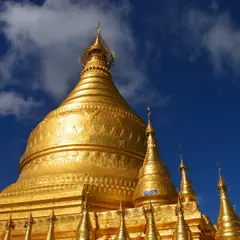
The tour begins before the west façade, the side from which the architecture of the Ananda Temple reads best. The plan starts from a square 53 metres on a side, with four gabled porches 17 metres long projecting from each face; above them, stepped terraces rise to 51 metres and end in a curvilinear Indian-style shikhara, gilded in 1990, with its small stupa and its parasol, the hti.
Today almost all visitors enter from the north, which faces the village and the road from Nyaung-U, but at the height of Pagan the main door was this one, oriented toward the old city and the sacred hill of Tan-Kyi, across the Irrawaddy. Along the plinth runs a row of terracotta plaques glazed green: here Mara’s army marches against the Buddha, scene by scene, each with its caption in Mon. They are only the beginning of the 1,472 plaques that climb to the highest terrace, with the 537 short jatakas and almost 400 reliefs of the ten great jatakas, although the count varies depending on who is counting.
In 1855 the photographer Linnaeus Tripe, attached to the British embassy to the court of Ava, set up his camera here with paper negatives and left one of the oldest surviving photographs of Burma. What he wrote beneath that print changes the way the façade is seen, and the narration tells it right in front of it.
A king kneeling at the Buddha’s feet
Gautama Buddha with Kyansittha and Shin Arahan
Summary of this stop
In the west hall waits the Gautama Buddha, a teak image with its hand in the gesture of fearlessness, and at its feet a scene rarely seen in a temple: two life-size lacquer statues. One is Kyansittha, crowned and kneeling in prayer; the other is Shin Arahan, the Mon monk who converted the king to Theravada Buddhism and crowned him.
The Mon inscriptions found near Bagan say that Kyansittha, with his title Tribhuvanāditya-dhammarājā, personally presided over the consecration of the great building and arrived on an elephant, among Brahmin astrologers and Buddhist monks. Beneath the small image of the king, an inscription presents him at once as a bodhisattva, as a cakkavattin, the universal monarch, and as an incarnation of Vishnu. In the west porch two footprints of the Buddha are also preserved on pedestals.
In this way the temple works as a political portrait of the king who paid for it. How Buddhism, power and a Hindu god fit together in a single figure is what the audio guide unpacks before the statue.
The dreamed-of cave and its original Buddha
Kakusandha Buddha of the north hall
Summary of this stop
On leaving the hall, the outer corridor wraps the visitor in cave-like half-light. It is the idea of the gu temple carried into brick: instead of a single chamber, a solid cube with four niches, cool passages and openings that let in the light drop by drop. Along the corridor, eighty stone reliefs in two rows of niches narrate the life of the Buddha up to enlightenment, and at the entrances open large carved teak doors from the Konbaung period.
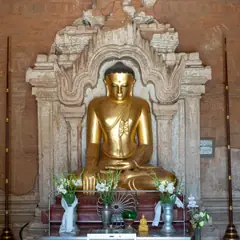
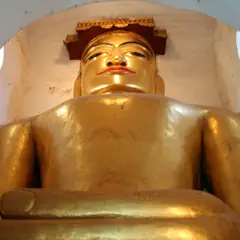
Documented tradition places its best tale here: eight holy men who begged for alms before the palace, a king who fed them through the three months of the monsoon and a snowy cave that, so it is told, appeared before his eyes. The corridor ends at the north hall, facing the Kakusandha Buddha, one of the four 9.5-metre images covered in gold leaf. Several sources consider it, along with the one in the south, one of the original images in the Bagan style, with its hands in the gesture of the first sermon.
The effect is kept for the end: the shaft of natural light that falls from above onto the Buddha’s head is best seen by looking up from the corridor, and the narration accompanies it on the exact spot.
The Buddha who prescribes a remedy
Konagamana Buddha of the east hall
Summary of this stop
The Konagamana Buddha of the east hall is a replacement. The original, carved in sandalwood brought from Malayu, burned in a fire, and King Mindon had it remade in champaka wood around 1856, from the same model. Something similar happened to the Buddha in the west: it was made of pañcaloha, an alloy of five metals, suffered damage at enemy hands around 1745 and again around 1885, and was remade in teak following the old model.
The wounds do not end with the images. From 1975, a restoration campaign by the military government whitewashed the temple’s murals; in 2015, a joint Myanmar–India project was halfway through removing the lime, and in the north and east halls recovered fragments already show through, while the rest of the walls remain white.
This Konbaung-style Buddha has, however, a detail not repeated in the other three: it lets its arms hang and holds between thumb and middle finger a small ball the size of a walnut. What that ball is and how Burmese tradition reads it, a gesture almost unknown in other Buddhist countries, is what the audio guide reveals in front of it.
The smile that changes with distance
Kassapa Buddha of the south hall
Summary of this stop
The Kassapa Buddha of the south hall is the original that all sources accept, although it is debated whether it is solid teak or a bronze alloy. It also has an optical trick that turns the visit into an experiment: seen up close its expression seems sad, and from afar it becomes cheerful. Stepping toward and away from an image more than nine hundred years old is part of the tour.
Its survival is an achievement. The 1975 earthquake had already damaged the temple, and that of 24 August 2016 damaged it along with other Bagan monuments, 449 in all; the Archaeological Survey of India restored it with Indian funding and handed the pagoda over to Myanmar on 13 December 2024.
And the temple is still alive: every year, in the Burmese month of Pyatho, between December and January, 1,000 monks recite scriptures without pause for 72 hours while thousands of villagers arrive in ox carts and camp around it. What happens on the morning of the full moon closes the narration before the Buddha who smiles at those who walk away.