Temple of the captive king
Manuha Temple Audio Guide (Manuha Paya)
A defeated, deported king raised in Myinkaba four colossal Buddhas that barely fit in their chambers. Below, a stern face; from a high window, an enormous smile.
- 40 min of audio
- Colossal Buddhas
The Manuha Temple is the merit-making work of Manuha, last king of Thaton, brought to Bagan by Anawrahta in 1057. Its inscription dates it to 1067 and places it in the village of Myinkaba, south of the old precinct. It is the reference example of a four-image-chamber temple of early Pagan: three seated Buddhas at the front and a reclining Buddha behind.
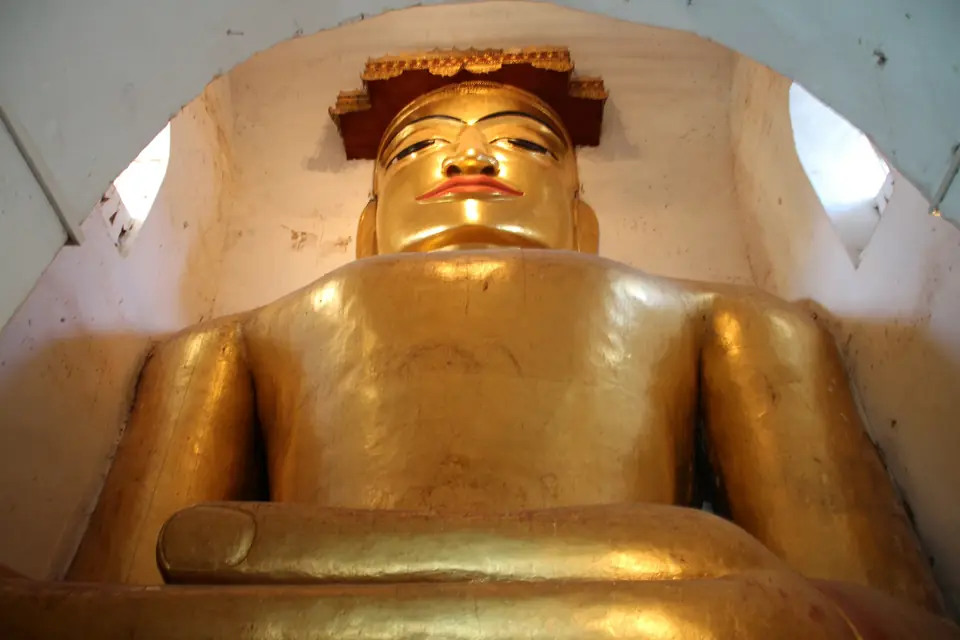
According to tradition, the four images were made first and only then was the building raised around them. The result is giants pressed against walls and ceilings, with barely room for a worshipper to sit and pray, and a central 14-metre Buddha whose stern expression turns into a smile when seen from the upper floor.
Highlights
- Central seated Buddha — 14 metres, touching the earth with his right hand
- Reclining Buddha — 27 metres in the parinibbana posture, in a narrow hall
- Upper-floor window — the colossus's stern face, seen head-on, smiles
- The captive king's jewel — according to tradition, six cartloads of silver paid for the temple
- A living precinct — a giant alms bowl and a corner for the nats of Mount Popa
In 1057 King Anawrahta of Pagan defeated Manuha, last king of Thaton, and moved him to Bagan with the whole Mon royal family and some 30,000 inhabitants of his kingdom, among them monks and craftsmen. Ten years later, according to the king’s own inscription, the captive raised in Myinkaba his great work of merit: the Manuha Temple, a whitewashed block that holds four colossal Buddhas. Other versions move the construction back to 1059, and some studies maintain that the narrow image house visited today is not the king’s original structure; the history of the Manuha Temple is made of traditions and doubts as much as of stone.
The architecture of the Manuha Temple is understood from the inside. The images fill the chambers almost completely, the neck bends to reach their faces, and a rear stairway leads to a point from which the great central face changes expression. The audio guide tour, documented and checked against historical sources, arranges in four stops what is seen and what is told, from the east porch to the outer precinct, where the temple is still in full use.
Its story begins with Anawrahta, the king who began the Shwezigon Pagoda in Nyaung-U; following the Irrawaddy north, in Old Bagan, the Bupaya Pagoda gleams over a bend in the river.
Six cartloads of silver for a king without a kingdom
Manuha Temple
Summary of this stop
Facing the east porch rises a white two-storey block, the upper one much smaller, crowned by a great multi-tiered hti and with smaller htis at the corners of the terraces. Few façades in Bagan carry so personal a story. In the city of his conqueror, Manuha kept a palace of his own with servants, but he had lost his freedom and was forbidden to return to Thaton.
Without cash, tradition says, the king sold the royal jewel Manaw Maya to a rich merchant of Myinkaba for six cartloads of pure silver and paid for the work with it. Sources disagree on the detail: some speak of a ruby or of the royal ring of his lineage, and some place the buyer among the rich of Pagan.
Darker is the question of his condition. It is said he arrived in Bagan in golden shackles, but another version makes him, together with his family, a slave dedicated to the Shwezigon pagoda. A Burmese chronicler rejected that version with a genealogical argument that the narration reveals right there, before the façade.
Giants squeezed between walls
Central seated Buddha
Summary of this stop
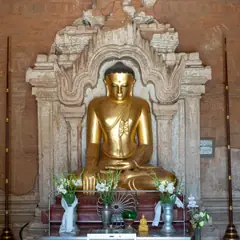
Beyond the main entrance waits the central seated Buddha, a golden colossus of 46 feet, some 14 metres, touching the earth with his right hand. On either side, in their own chambers, sit two Buddhas of about 10 metres each. According to tradition, the images were made before the building, the first with relics inside, and the walls were raised afterwards around them.
The effect is physical: the figures occupy almost all the space and barely leave room for the faithful to sit and pray. For a long time that tightness was read as the anguish of a captive king, an interpretation that is more tradition than proof, because Manuha was not imprisoned and the disproportion between image and chamber appears in other Bagan temples too.
The chamber also keeps the memory of the 1975 earthquake, which brought down part of the central roof and badly damaged the great Buddha, later restored.
The smile seen only from above
Reclining Buddha and face window
Summary of this stop
In the rear chamber, reached by steps and a narrow door, lies a 90-foot Buddha, some 27 metres, with his head to the north: the posture of the Buddha about to enter parinibbana. The hall is so long and narrow that the body cannot be taken in at a single glance.
Beside that chamber a stairway starts up to the upper floor, where a window opens in front of the face of the central seated Buddha. The expression that seems stern from the floor is revealed, at its level, as an enormous smile. According to tradition, Manuha asked through his foundation never to be conquered again in any rebirth of samsara, a vow tied to these images.
A documented tradition explains why the king raised them just then: a light that came from his mouth whenever he spoke and the stratagem by which his conqueror managed to extinguish it. The outcome of that episode is reserved for the narration, before the colossus itself.
A living temple among offerings and spirits
Giant alms bowl and nat corner
Summary of this stop
Outside, the precinct is far from a museum. A modern Burmese-style building houses the statues of Manuha and his queen Ningala Devi and a gigantic alms bowl, made to the scale of the colossi, with a stairway in front to reach its rim. Every year, from the eve of the full moon of Tawthalin, in September, the temple festival brings ox carts loaded with goods, processions of paper figures of the Buddha’s incarnations and dance and theatre at night; some guides place it instead at the full moon of Tabaung.
In an outer corner, brightly coloured images represent Mae Wunna and her sons Min Lay and Min Gyi, the nats who preside over Mount Popa, venerated beside the Buddhist temple. Legend has it that their story begins with the fall of Thaton, and that in this courtyard the family of a key figure in the defeat of the king who founded the temple is honoured. Who he was and what links these spirits to Manuha is the last twist of the tour.