Tallest temple in Bagan
Thatbyinnyu Temple Audio Guide
Bagan's tallest tower bears the name of the Omniscient and was at once temple, monastery and library. Its story, however, is best told through what it lacks: a lost bell, some five hundred empty recesses and cracks that are still being stitched.
- 40 min of audio
- Two-storey temple
King Alaungsithu founded Thatbyinnyu around 1144 beside the southeast corner of the wall of old Pagan and considered it finished around 1151. At 61 metres of architectural height and 66 to the pinnacle, it is the tallest temple in Bagan and one of the first with two storeys: a transitional building between the early style of the Ananda and the late style of the Gawdawpalin, whose elongated east porch Sulamani and Gawdawpalin later copied.
From outside it looks like a solid white mass, but inside very different functions were spread out: cells for monks on the lower floors, images of the Buddha, a library of sacred texts and, at the very top, relics. And on its terraces more than 500 recesses still wait, prepared for glazed plaques with Jataka scenes that were never put in place.
Highlights
- Record height — 66 metres to the pinnacle, the tallest temple in Bagan
- Temple and monastery — monks' cells, library and reliquary spread across the floors
- Unfinished terraces — more than 500 recesses for Jataka plaques that never arrived
- West porch — Buddha footprints painted on the ceiling, among centuries of lime
- Bell pillars — the support of Alaungsithu's great copper bell, now lost
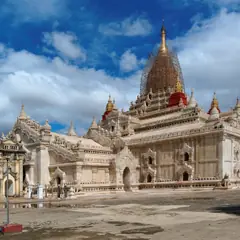
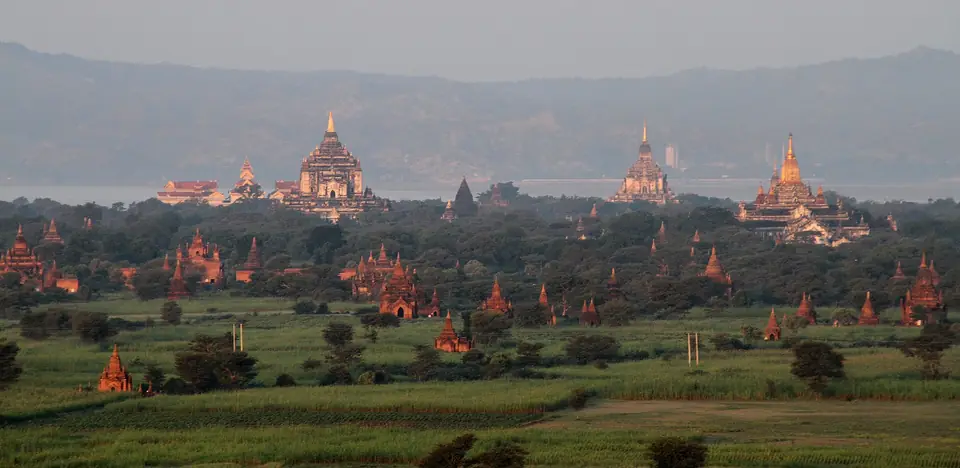
On the Bagan plain, strewn with thousands of stupas and brick temples, one silhouette stands out above all: two great white cubes stacked one on the other, each with its stepped terraces, and above them a curvilinear tower topped by a golden hti. It is Thatbyinnyu, the second great religious work of King Sithu I, Alaungsithu, after the Shwegugyi temple. Modern historiography places its foundation in 1144/45 and its completion in 1150/51, although a Burmese chronicle account moves the construction back to around 1124/25; the date remains a matter of debate.
The history of Thatbyinnyu is that of an architectural experiment: one of the first two-storey temples in Bagan, halfway between the Ananda (1105) and the Gawdawpalin, which left its successors the model of the elongated east porch. It was also temple, monastery, library and reliquary in a single building. But what best explains it is its absences: a gigantic bell of which only the pillars remain, more than 500 recesses without the plaques meant to fill them, and the scars of two earthquakes. The audio guide walks the temple from east to west, outside and in, with narration that is documented and checked against historical sources and heard on the spot.
To the southeast, the Dhammayangyi Temple is the work of Narathu, the son whom the chronicles blame for Alaungsithu’s death; a few steps away stands the Ananda Temple, of the early style from which this experiment started, and later the Htilominlo Temple took up the two-storey formula.
Bagan’s watchtower, seen from the east façade
Thatbyinnyu Temple
Summary of this stop
Facing the east façade, the scale of the temple is measured with the body: 61.3 metres of architectural height and 66 to the pinnacle make it the tallest temple in Bagan, although the tallest structure on the site is a stupa, the Shwesandaw. A Burmese saying shares out the city’s superlatives: bulk for Dhammayangyi, artistic refinement for Ananda and height for Thatbyinnyu, which is also nicknamed the “watchtower of Bagan”.
The name suits that lookout vocation. It comes from the Pali Sabbaññu, “the Omniscient”, and alludes to the Buddha’s omniscience, which inscriptions from the Bagan era gloss as “knowing thoroughly and seeing far”. Chronicle tradition adds an unsettling role: when King Uzana died at Dala in 1256, struck by a wild elephant, smoke is said to have risen from the Thatbyinnyu pagoda, as had already been seen at Shwegu at the death of another king.
To the northeast, attached to the great temple, a tiny shrine offers a human counterpoint to so much height. According to tradition, it was built with the bricks set aside to keep count of the work, one for every 10,000 laid. What other omens accompany that legend of the smoke is something the narration saves for when the tower is in front of you.
A monastery inside the temple
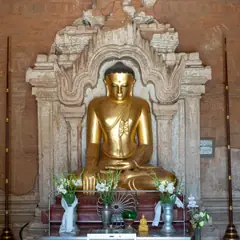
Seated Buddhas of the ground floor
Summary of this stop
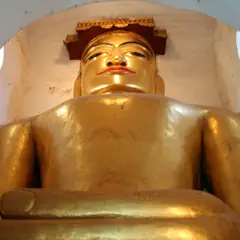
The main entrance, the east porch, projects further than the other three and breaks the symmetry of the cross plan; its stairway is flanked by two standing door guardians. That entrance, designed to impress, became a model: Sulamani, in 1183, and Gawdawpalin later repeated the same plan. Inside, a cool, bright ambulatory, lit by two rows of windows, circles the solid core; a large seated image of the Buddha faces each of the doors on the north, south and west sides, and in the corridors more Buddhas appear in niches, along with a few figures of nats.
Thatbyinnyu was not only a place of worship. The first two floors housed the monks, the third kept the images, the fourth served as a library of sacred texts and the fifth guarded relics. According to tradition, Alaungsithu took inspiration from the Pubbarama monastery, which the benefactress Visakha donated at Savatthi in the Buddha’s lifetime, with 500 cells below and 500 above. Modern descriptions do not agree on how to count those floors or where to place the main image, which is usually put in the upper storey.
Among those relics, the tradition of the royal chronicles places a singular treasure: an entire ship of rubies gathered at the foot of Mount Mali, which the king is said to have enshrined in his two temples, Shwegu and Thatbyinnyu. How, according to the account, those stones were transformed is one of the episodes the audio guide tells in this corridor.
Lime, Buddha footprints and empty recesses
West porch
Summary of this stop
The whiteness of Thatbyinnyu is not original. Generations of donors have whitewashed the temple, almost entirely erasing the stucco decoration and the interior painting. Only the west porch keeps traces of what there was: stucco floral circles on its roof and, on the ceiling, original paintings with Buddha footprints.
In that whitewashed interior there also survives a well-known painted inscription: one of the queens of King Bodawpaya (1782–1819) left it to tell of her visit to Bagan, some six centuries after the temple was built.
From outside, raising the eyes to the terraces, another absence appears: more than 500 aligned recesses (539 in some counts), prepared for glazed ceramic plaques with scenes from the Jataka, the tales of the Buddha’s past lives, which were never placed. Why they were left empty has no firm answer, and the narration reviews the hypotheses without treating them as settled.
The pillars of a lost bell
Pillars of Alaungsithu's bell
Summary of this stop
Beside the temple, in the grounds of a monastery, rise two tall stone pillars with foliage carved in an inverted V. They held the great bell of pure copper that Alaungsithu donated to Thatbyinnyu, of 10,000 units of weight and larger than the five of his grandfather Kyansittha. The bell disappeared as early as the pre-colonial period; sources also do not fully agree on the exact position of the pillars in relation to the temple.
Seen from here, the tower shows its scars. The magnitude 6.8 earthquake of 8 July 1975 damaged the crown, the main image and the corner stupas, and opened vertical cracks of up to 23 cm in the walls of the third floor; it was repaired around 1979 and reinforced in the early nineties. The 2016 one, also 6.8, left new cracks above the third level.
In 2019, a team from the Shaanxi Institute led by Zhao Qiang shored up the temple in under two months, in extreme conditions: barefoot, on steps at 63 °C, they carried more than 100 tonnes of steel tubing to a height of over 60 metres. The full restoration, with Chinese help, began in January 2022 with a nine-year plan, and the scaffolding may still be part of the visit. The close of the audio guide, before these pillars, joins the lost bell and the wounded tower in a single story.