11th-century stupa
Shwezigon Pagoda Audio Guide (Shwezigon Paya)
A golden bell that one king began, his successor finished by writing him out of the inscriptions, and that Buddha and Burma's 37 spirits have shared for nine centuries.
- 60 min of audio
- Burmese golden stupa
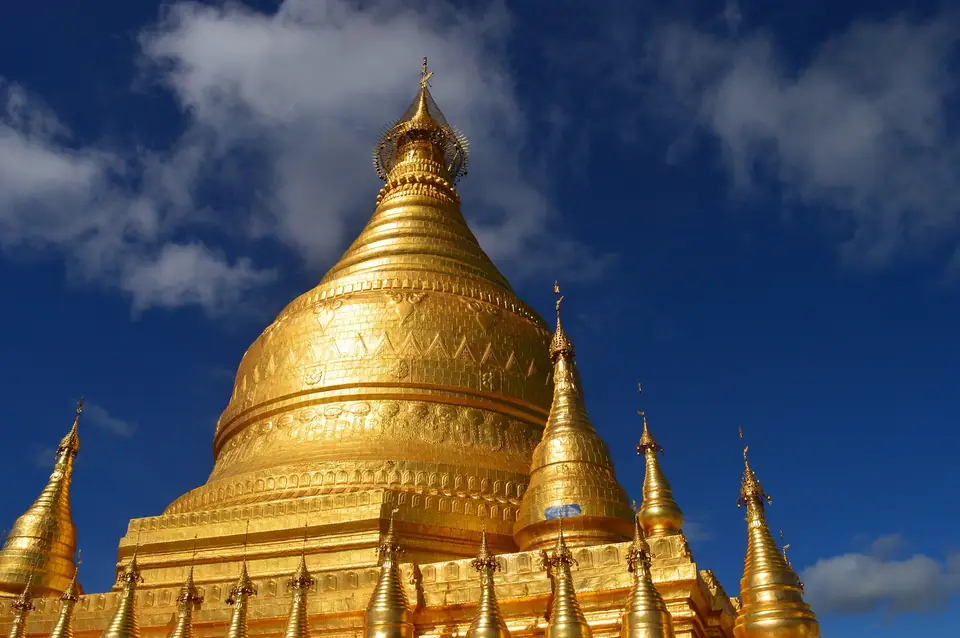
The Shwezigon Pagoda, in Nyaung-U, began to be built in 1059–1060 under Anawrahta, founder of the kingdom of Pagan, and was finished by Kyansittha, who scaled down the original plan and enclosed the stupa already under way. Its bell silhouette, fixed around 1090, served as the prototype for many later stupas in Myanmar. Beneath the gold lies a replica of the Buddha's Tooth obtained from Sri Lanka in exchange for a white elephant, and before its stairways stand four bronze Buddhas from around 1102, the largest original statues in Bagan.
Shwezigon is also a pact with the spirits. Anawrahta failed to ban the worship of the nats, so he fixed an official pantheon of 37 and brought them into the precinct shown worshipping the Buddha. Five centuries later, Bayinnaung gilded the stupa from base to pinnacle and left on a bronze bell the order to end animal sacrifices and the liquor offered to those same spirits. Today Buddhists and nat devotees pray on the same platform.
Highlights
- Four bronze Buddhas from about 1102 — 3.7 to 4 metres tall, the largest original statues in Bagan
- 11th-century terraces — glazed tiles of the Buddha's past lives, 550 of them preserved
- Bayinnaung's bell of 1557 — 3,423 kg and an inscription in three languages, UNESCO Memory of the World
- Hall of the 37 nats — Burma's spirits shown worshipping the Buddha
- Mirror pool at the east base — the whole stupa reflected in a handful of water
A Burmese saying shares Bagan’s superlatives among its great temples: delicacy for Ananda, mass for Dhammayangyi, height for Thatbyinnyu and spiritual power for Shwezigon. It is no coincidence. The great golden stupa of Nyaung-U began to be built in 1059–1060 on the orders of Anawrahta (r. 1044–1077), the king who founded the kingdom of Pagan, and was completed by his successor Kyansittha. Sources do not agree on the exact year of completion, which ranges between 1086 and 1102, but they do on the essentials: the bell silhouette adopted then survives today and served as the model for many later stupas in Myanmar.
The history of the Shwezigon Pagoda is also that of the kings who touched it: Bayinnaung gilded it entirely in the 16th century, Hsinbyushin placed a new hti on it in 1768 and, after the 1975 earthquake, thousands of devotees paid for the copper plates that now shine on the spire and the dome. Between its 11th-century terraces, its bronze Buddhas and its hall of spirits, the architecture of Shwezigon keeps layers of relic, power and popular faith that are best appreciated barefoot, walking the platform with an audio guide that is documented and checked against historical sources.
The stupa links to two other visits: the Ananda Temple, Kyansittha’s other great work, and the Manuha Temple, built by the king of Thaton whom Anawrahta brought captive to Bagan. On the way to Old Bagan stands the Htilominlo Temple.
A golden dune chosen by an elephant
Shwezigon Pagoda
Summary of this stop
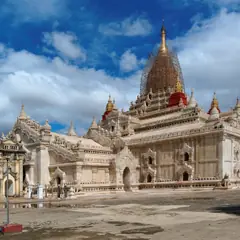
On leaving the west corridor, the golden bell appears suddenly above its terraces, with miniature stupas at the corners and a walled precinct around it. It is the first contact with the scale of Shwezigon, the stupa that, as the saying goes, concentrates the spiritual power of Bagan.
Tradition says that Anawrahta placed the casket with the relic on the back of a white elephant and let the animal choose where it should rest. The elephant lay down on a sandbank northeast of Pagan and, to the king’s displeasure, Thagyamin, king of the nats, appeared to him in a dream, turned that ground to rock and bound it with iron plates. The name comes from that dune: Shwe-zigon, the golden dune.
Behind the legend lies a documented episode. Anawrahta sent a mission to Sri Lanka with a white elephant as a gift to ask his ally Vijayabahu I for the Buddha’s Tooth, and received a replica in return, which was enshrined at Shwezigon. What happened afterwards to the pagoda’s relics is a story told in the narration, right there, in front of the bell.
A Buddha of 1102 beneath new gold
Gautama bronze Buddha
Summary of this stop
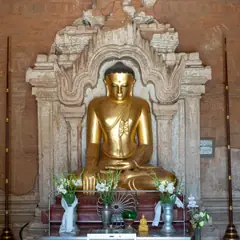
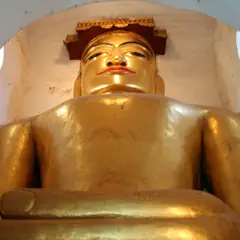
In the shrine at the west stairway stands Gautama, one of the four standing bronze Buddhas that guard the approaches: Kakusandha to the north, Konagamana to the east, Kassapa to the south and Gautama to the west. They measure between 3.7 and 4 metres, raise the right hand in the gesture of fearlessness and are dated to around 1102. They are considered the largest original statues in Bagan.
The contrast lies in what shines above. The 1975 earthquake badly damaged the spire and the dome, and the restoration covered them with more than 30,000 copper plates donated by devotees; the dome was regilded in 1983–1984. The gold that reflects the sun today is therefore almost recent, while the bronze below has stood in place for more than nine centuries.
According to popular belief, the pagoda also holds nine wonders, which Kinwun Mingyi U Kaung, prime minister to kings Mindon and Thibaw, put into verse: the hti that needs no iron chains, the shadow that never falls outside the wall, the gold leaf that never ends up outside the precinct, or the tree in the southeast corner that flowers all year. Some can be put to the test on the platform, and the audio guide unpacks them one by one.
Three terraces a buffalo left unfinished
Jataka tile terraces
Summary of this stop
From the northwest corner the three square, stepped terraces can be seen clearly, with stairways at the four cardinal points, miniature stupas with golden finials at each corner and a band of terracotta tiles glazed greyish green that narrate the Buddha’s past lives. Today 550 survive, out of an old count of 584.
These lower terraces preserve much of their 11th-century fabric, and in them the interrupted work of Anawrahta can be read: the king died in 1077, gored by a wild buffalo, when only the three low terraces had been raised. His project called for a base of 320 cubits. Kyansittha, after consulting the monk Shin Arahan, reduced it to a stupa with a base of 300 cubits and a height of 80, which encloses the inner stupa already begun. Some maintain, on the other hand, that Anawrahta’s stupa was finished and that Kyansittha covered it with a second layer; in any case, the form visible today is his.
That reduced, enveloping bell is the one many stupas in Myanmar later copied. At this stop the audio guide explains why a scaled-down project ended up as a model.
Pillars that stay silent on the founder’s name
Kyansittha's Mon pillars
Summary of this stop
Beside the eastern entrance stand two stone pillars with inscriptions in Old Mon that Kyansittha had set up, and in the northeast corner of the platform a pavilion holds six inscriptions from different periods. The pillars tell the story of the pagoda without naming its founder, Anawrahta, a striking omission whose relation to other testimony of the time remains not fully clear.
The text, from around 1102, also contains a promise of surprising humanity: Kyansittha pledges to bring back to Pagan the scattered captives, to wipe away their tears, to give them rice with his right hand and clothing with his left, and to comfort his subjects as a mother comforts her child.
Very close by, next to the eastern base, there is a small hollow in the ground that, filled with water, reflects the stupa. It is said that it let the kings look at the hti without throwing their heads back, a gesture by which they could lose the crown. Today it is visitors who kneel at that spot, and the narration tells what is sought in that tiny mirror.
The 37 nats kneeling before the Buddha
Hall of the 37 nats
Summary of this stop
In a small hall southeast of the platform stand the figures of the 37 nats, the spirits of the Burmese pantheon, headed by Thagyamin, their king, with the thunderbolt in his hand. The present figures are not the originals, which were removed from the terraces and ended up stolen, but the idea remains intact: Anawrahta, unable to enforce a ban on their worship, fixed an official pantheon of 37 and brought their images to Shwezigon shown worshipping the Buddha.
Five centuries later came the reply. Bayinnaung had the stupa gilded from base to pinnacle and on 23 May 1557 dedicated to it a bronze bell of 2,100 viss (3,423 kg), 165 cm high, with an inscription in Burmese, Mon and Pali. In it he proclaims that he had abolished, by royal order, animal sacrifices and offerings of liquor to the spirits. The bell is still where the king placed it and since 2016 it has been on UNESCO’s Memory of the World register.
The precinct has not chosen a side. At the great full-moon festival, which some sources place in the month of Nadaw (November–December) and others in Tazaungmon, pilgrims from all over Myanmar fill the platform, and Buddhists and nat devotees pray a few steps from one another. The close of the tour explains how that coexistence has kept the pagoda alive for nine centuries.