UNESCO heritage
Htilominlo Temple Audio Guide
Forty-six metres of red brick raised where, according to tradition, a white parasol leaned toward the youngest of five princes. Eight centuries later, another parasol, this one of metal, still draws those who seek power.
- 40 min of audio
- Late Bagan architecture
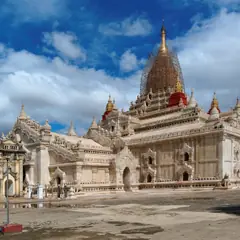
The temple was built by Nadaungmya, the last of the Pagan kings to raise temples, remembered as Htilominlo, who reigned from 1211 to 1235, copying the plan of the Sulamani, the temple his father Narapatisithu had built in 1181. The result is a building 46 metres high on a square base some 42 metres on a side, with stucco ogres and makaras on the walls, four golden Buddhas on the ground floor and a dim ambulatory whose vaults are covered with horoscopes.
Its name, “the parasol willed it, the king willed it”, tells of a miraculous choice, although another explanation derives it from a misreading of the Old Mon Tiloka Mangala, “blessing of the three worlds”. And the parasol has not gone away: the metal hti at the summit was brought down by the 2016 earthquake and in 2020 was put back by Commander Min Aung Hlaing, months before the elections that preceded his coup.
Highlights
- The white parasol — according to tradition, it picked the heir here from among five brothers
- 46 metres of red brick — a plan copied from the Sulamani, the father's temple
- Four golden Buddhas — two in Burmese style and two in Mon style, one for each cardinal direction
- Horoscopes on the vaults — painted between the 15th and 18th centuries to protect the temple
- The generals' hti — brought down in 2016 and replaced in 2020 by Min Aung Hlaing
Beside the road linking Bagan with Nyaung U, a wall with its gates encloses a great red-brick temple. The Htilominlo Temple rises 46 metres and marks an ending: it was raised by the last of the Pagan kings to build temples. Its founder, Nadaungmya, also known as Zeya Theinkha Uzana and remembered by posterity as Htilominlo, reigned from 1211 to 1235. The exact date of the work is not settled: some sources give 1211 as the year of completion, others repeat 1218, and the chronicles themselves do not agree on when the reign began.
The history of Htilominlo, however, begins before its bricks. According to tradition, the temple occupies the exact spot where a white parasol decided who would be king. From there, the tour moves from the gate of the precinct to the half-light of the ambulatory, passing the stucco friezes and the summit where kings and generals have placed their metal parasols. The audio guide, documented and checked against historical sources, accompanies the visit in four stops and forty minutes, with the temple in front.
Its two storeys recall the Thatbyinnyu Temple, one of the first temples of that type in Bagan. On the road toward Nyaung-U waits the Shwezigon Pagoda, the golden stupa that Anawrahta began.
The parasol that picked the younger brother
Htilominlo Temple
Summary of this stop
At the gate of the precinct begins the story of how the building came to be. According to tradition, King Narapatisithu placed a white parasol in the midst of his five sons, and the parasol leaned toward Zeya Theinkha, the youngest. At that very spot the temple was later raised. The name Htilominlo is popularly read as “the parasol willed it, the king willed it”, although another explanation derives it from a misreading of the Old Mon Tiloka Mangala, “blessing of the three worlds”; in the inscriptions, the king appears as Nadaungmya, “Earrings”.
The chronicles also tell a much less solemn version of the miracle, a documented tradition set at night, in the palace, starring the prince’s mother and a favour the king could not refuse. Even his identity is not certain: the royal chronicles make the king the son of a woman of humble birth, while the inscriptions of the time give as his mother the chief queen Saw Mya Kan.
What happened that night, and why the parasol test may have come with the decision already made, is the part of the story revealed by listening to it before the wall.
A filial copy at the end of an era
Stucco friezes and glazed plaques
Summary of this stop
The side walls show the skin of the temple: stucco friezes with ogres holding garlands, makaras and plant motifs, two-bodied lions at the foot of the pilasters and, on the terraces, green glazed plaques with yellow details, many already lost. The outer circuit is made barefoot.
The architecture of Htilominlo is that of a son looking at his father. Nadaungmya copied the plan of the Sulamani, the great temple Narapatisithu had raised in 1181 and which opened Bagan’s late period: smaller bricks, radial-voussoir arches and bright interiors. On a square base some 42 metres on a side, the building rises in two cubic storeys with stepped terraces to 46 metres.
Those walls also speak of decline. Htilominlo was the last Pagan king to build temples, and most of his lay far from the capital because the royal treasury was already running dry. His 24-year reign opened the slow decline of the dynasty, and also left a political inheritance: the council of ministers to which he entrusted the army and day-to-day government is the forerunner of the hluttaw, the word now used for Myanmar’s parliament.
Kings, generals and a metal parasol
Shikhara and golden hti
Summary of this stop
Facing the east porch, the main and most projecting of the four entrances, the eye climbs the terraces with their small corner stupas to the ungilded shikhara and the golden hti that crowns it. The terraces and the upper floor are closed to the public, but the summit is the protagonist of this stop.
After the fall of Pagan, kings from the Ava period to the Konbaung dynasty came to this temple to pay homage and make donations, seeking the favour of the guardian spirits and long reigns. In the 20th and 21st centuries it was the favourite temple of General Ne Win, General Than Shwe and President Thein Sein. The hti placed in 1996 in the name of Than Shwe fell in the magnitude 6.8 earthquake of August 2016, which badly damaged the temple, already repaired with reinforced concrete after the 1975 quake. On 27 February 2020, Commander-in-Chief Min Aung Hlaing and his wife placed a new, lighter one, months before the November elections that preceded his 2021 coup.
The metal parasol still holds an irony: as long as temples had no metal htis, lightning did not damage them. In October 2023 the installation of lightning rods was announced at Htilominlo and nine other Bagan temples.
Prayers, Buddhas and empty niches
Inner ambulatory
Summary of this stop
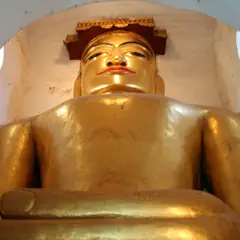
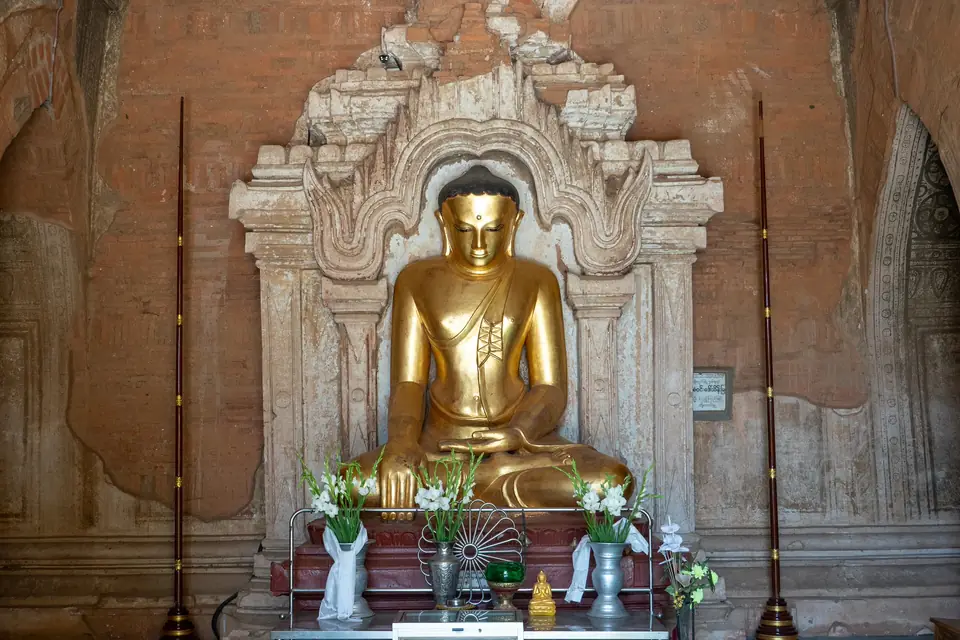
On crossing the east arch, the air turns cool and the light low. At the end of each of the four entrances waits a seated golden Buddha in the gesture of calling the earth to witness: two are in Burmese style and two in Mon style, with broad bodies, small heads and almost no neck, and they represent the four Buddhas who have already attained enlightenment in the present age. On the upper floor, closed to visitors, there are four more.
Those who came later also protected the temple in their own way. Between the 15th and 18th centuries horoscopes were painted on the walls to guard it from harm, and on the ceilings of the ambulatory they survive better than the wall murals, which are now very faded. On the south wall of the inner arch of the east entrance there is an ink inscription from the 15th century, described as the prayer of the monk Saddhammadivakara, of Queen Saw’s forest monastery, although one study interprets it as the record of a private individual’s good deed.
It is said that the niches of the ground-floor corridor held stone images of the Buddha and that today they are empty. The tower, on the other hand, is said to have kept another secret for a long time, until an earthquake left it in view: a contrast between what was stolen and what was hidden that the narration reveals in the ambulatory itself.