Pagoda on the Irrawaddy bank
Bupaya Pagoda Audio Guide
A golden gourd leaning over a bend of the Irrawaddy: tradition holds it to be the oldest pagoda in Bagan, although the one that shines today was raised in 1978, after the river swallowed the original.
- 40 min of audio
- Riverside stupa
Bupaya, from bu, gourd, and paya, pagoda, crowns the northern end of Bagan's old wall, just where the Irrawaddy traces a curve. Its foundation is attributed to the archer king Pyusawhti, to whom the Burmese chronicles give a reign from AD 168 to 243, and a sign at the entrance dates it to the year 300. Archaeologists propose much later dates, around 850 or the 11th century, and the debate remains open.
On 8 July 1975, at 18:34, an earthquake of magnitude close to 7 shattered the brick stupa, which fell into the river. In 1976–78 a new Bupaya of reinforced concrete, hollow and gilded from top to bottom, was raised on the same spot. The pagoda that tradition holds to be the oldest in Bagan is, materially, one of the newest.
Highlights
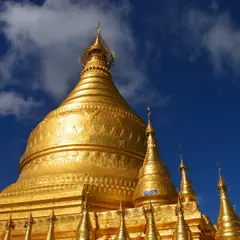
- Golden gourd-shaped dome, which gives the pagoda its name
- Semicircular crenellated terraces descending toward the Irrawaddy
- Legend of the archer Pyusawhti and the gourd-vine plague
- The 1975 earthquake: the brick stupa fell into the river
- A landing stage still in use at the foot of the pagoda
Bupaya looks at the water. It stands on the bank of the Irrawaddy, at the northern end of the old wall, about 200 metres northwest of the Mahabodhi temple, and its bulbous dome served as a landmark for those sailing the river. The history of the Bupaya Pagoda starts in legend: it is attributed to Pyusawhti, third king of Pagan according to the Burmese chronicles, and a sign at the entrance to the precinct dates it to the year 300. Scholars dispute that date and regard Pyusawhti as a legendary king, which makes this small golden stupa one of the city’s most curious puzzles.
What is seen today is not the stupa photographed in 1866. That one was of brick and vanished into the river in the 1975 earthquake; the present one is a reconstruction of 1976–78. What to see at the Bupaya Pagoda, then, also includes what is no longer there, and that absence is what makes it interesting to walk it with the audio guide, stop by stop, from the lion gate to the landing stage.
Downriver, in Myinkaba, the Manuha Temple keeps the memory of the Mon kingdom of Thaton; inland, barely a kilometre away, rises the Thatbyinnyu Temple, the tallest in Bagan.
The lion gate and the gourd archer
Bupaya Pagoda
Summary of this stop
The tour begins at the south gate of the precinct, guarded by two chinthe, the Burmese mythical lions, in white and gold. From here the dome explains its own name before any book does: bu means gourd and paya, pagoda, and the bulbous silhouette of the monument leaves no room for doubt.
The name carries a legend. According to a documented tradition, when Pagan was still a young city, a plague of climbing gourd vines overran the banks of the Irrawaddy. It was one of the threats that had beset the kingdom since the time of King Thamoddarit, along with a great tiger, a giant flying squirrel, a boar and a great bird. A young archer, Pyusawhti, cleared the riverbank with his magic bow and received as his reward the hand of the princess and the right to the throne. Once king, he is said to have raised a gourd-shaped pagoda on the exact spot where he tore out the plants. The official chronicle, it must be said, counts only four enemies and does not mention the gourd: the fifth belongs to local tradition.
Bupaya is not alone in that story either. According to tradition, it forms a series with other Bagan pagodas that mark where each enemy of Pagan fell, from the tiger to the great bird. The order of that series, and what earned the city its nickname “the one that tramples its enemies”, is left for the narration beside the gate.
A gold gourd on a brick one
Golden gourd-shaped dome
Summary of this stop
At the foot of the dome appears the great contrast of the place. The original stupa was of brick, with a bell-shaped dome on diminishing terraces and a finial at the top, and held relics of the Buddha. A photograph from 1866, from the collection of Sir Richard Carnac Temple and now in the British Library, portrays it under the title “The Pumpkin Pagoda”.
The one standing now is something else: a hollow reinforced-concrete structure, raised in 1976–78 on the traditional polygonal-base plan and entirely gilded, topped by a hti, the golden parasol that crowns Burmese pagodas. Generations of devotees have gone on adding mirror mosaic and gold leaf. Some consider it faithful to the original form and others see in it a freer reconstruction; the debate over the architecture of the Bupaya Pagoda is still there.
In Bagan there is also a popular belief: the rock on which the stupa sits would itself be gourd-shaped, a stone twin hidden beneath the golden one. What that idea says about how this pagoda is seen is told in the audio guide, beside the dome.
The battlements over the river that took the original
Crenellated terraces over the Irrawaddy
Summary of this stop
From the crenellated terraces, which descend in semicircles toward the water, the Irrawaddy fills the whole horizon. Here took place the episode that changed the history of the monument. The earthquake of 8 July 1975, of magnitude close to 7, shattered the brick stupa, which plunged into the river. It was one of almost a hundred major Bagan temples badly damaged in a quake that Burma’s director general of archaeology called the worst in 900 years of written history.
With the stupa sank also the evidence for dating it. Tradition places it in the 2nd or 3rd century; the archaeologist Pierre Pichard takes it to the 11th, and another hypothesis puts it around 850, when King Pyinbya fortified Pagan. The attribution to the Pyu period, based on similar stupas and on bricks with finger marks, has no conclusive proof.
The river also has its own legend. According to a tradition recorded in the chronicles, Pyusawhti arrived along these waters inside a white egg, the child of a sun spirit and a dragon princess. How that egg ended up at Nyaung-U, and why the royal chronicle of 1832 rejected the story, is the close of this stop in the narration.
The boatmen’s golden beacon
Bupaya landing stage
Summary of this stop
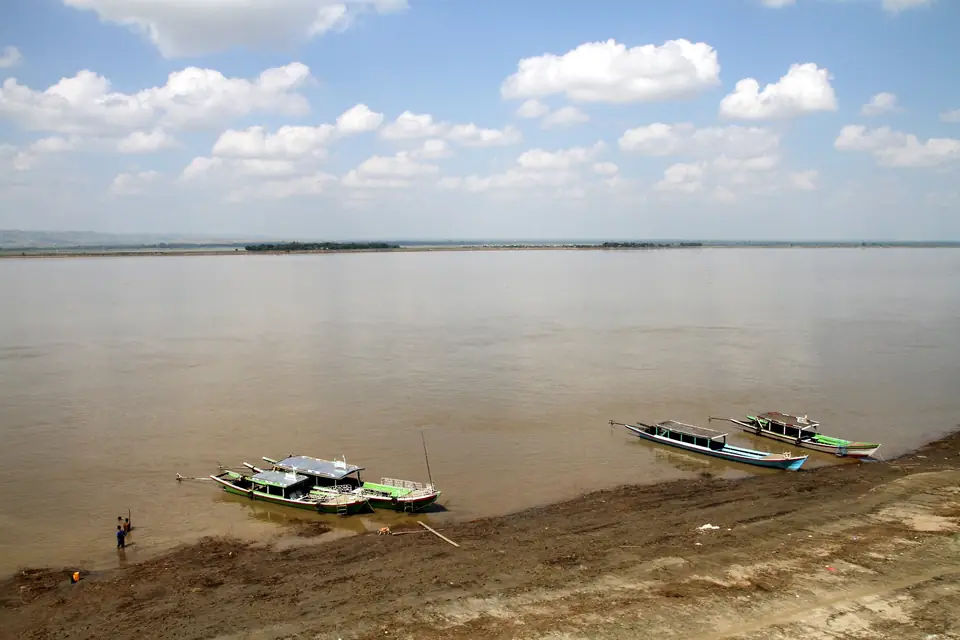
The last stop goes down to the landing stage, at the foot of the pagoda, and changes the point of view: from the river, above its crenellated terraces, Bupaya takes on the air of a fortress. Its position at the northern end of the wall, right at the bend, points to an ancient landing place, and the adjoining quay is still today an embarkation and disembarkation point for the boats going up and down the Irrawaddy, Myanmar’s greatest trade route.
The river has also been shaping the landscape. The walled core of Bagan, of 140 hectares, preserves only three walls; the western one disappeared, probably swept away by the Irrawaddy, which has swallowed buildings upstream and downstream and left Bupaya at the water’s edge. Even so, the gourd’s silhouette still guides those who sail, and what that means for the oldest and newest pagoda in Bagan is the last idea the audio guide leaves.