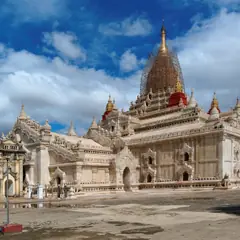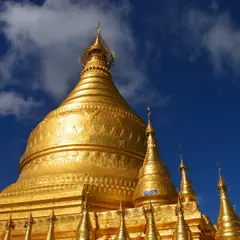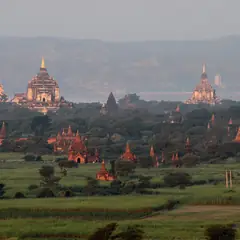
The largest temple in Bagan
Dhammayangyi Temple Audio Guide
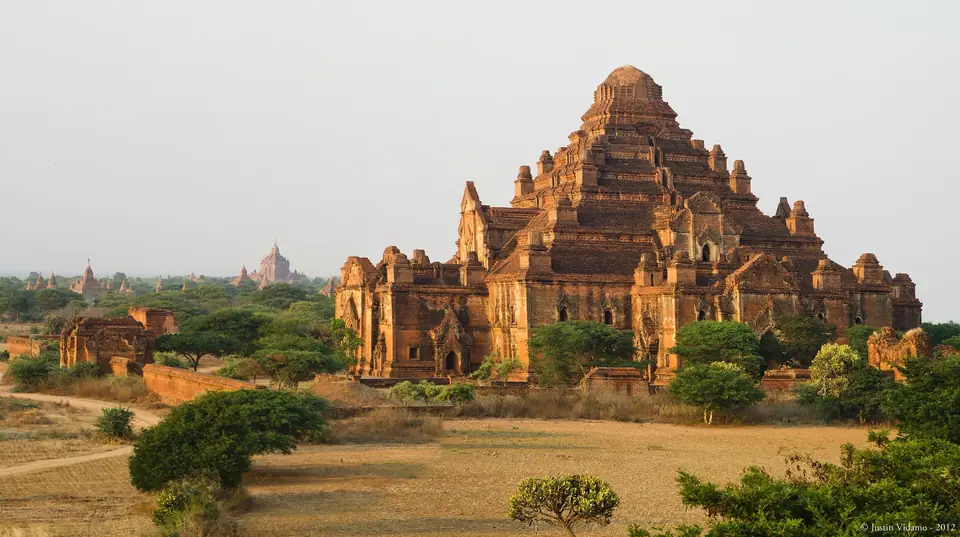
A red-brick pyramid without a summit, raised according to the chronicles by a king who killed his father and his brother to reign. It is the bulkiest temple in Bagan and also the one that says least about itself.
- 45 min of audio
- 12th-century brick architecture
Dhammayangyi is the largest of Bagan's temples: a base almost 78 metres on a side, a solid core 25 metres high and stepped terraces that from afar trace a pyramid. The chronicles attribute it to King Narathu (1167–1170), who supposedly built it as an act of atonement after reaching the throne by murdering his father Alaungsithu and his elder brother, although no inscription names him as builder and the dates remain debated. Its cross plan, with a sanctuary in each arm and a perimeter corridor, follows the model of the Ananda.
The great enigma is inside: the temple has two concentric corridors, but almost all of the inner one and three of its four sanctuaries were filled with brick rubble centuries ago. Nobody knows why or when. In Bagan it is called the ghost temple, and it is said that no villager dares enter after dark.
Highlights
- A base almost 78 metres on a side — the bulkiest temple in Bagan
- Inner corridor and three sanctuaries walled up — for a reason nobody knows
- Brick joints as fine as a hair — and the arm slab
- Gautama and Maitreya seated together — an unusual pair in Bagan
- Truncated summit — the only great cave temple without a modern spire
The story of Dhammayangyi begins with a crime. In 1167, with King Alaungsithu gravely ill, his son Narathu had him moved from the palace to the Shwegugyi temple and smothered him there with a blanket. He then presided over the coronation of his elder brother, Min Shin Saw, who died poisoned at his first meal as king. According to the chronicles, Bagan’s largest temple was born of that remorse: a work of atonement raised during Narathu’s brief reign (1167–1170). The attribution, however, is not settled. The chronicles disagree on the dates, an inscription from the temple itself is dated to around 1165–1166, another proposal places it at the end of Alaungsithu’s reign, and no stone names Narathu as builder.
That inscription, set into a pillar, lists what the temple received: serfs, slave singers and dancers, orchards, rice fields, a pond and cattle. The name came later: according to tradition, it comes from a monk of the same name who lived in the time of Narapatisithu in the brick monastery at the western corner of the precinct, whose ruined walls still stand; in Pali, Dhammaraṃsi means “radiance of the Dhamma”. The history of Dhammayangyi, its architecture and what its corridors hold are best understood by walking it with the audio guide, stop by stop, from the east façade to the west sanctuary.
The Dhammayangyi is best understood alongside the Thatbyinnyu Temple, the work of Alaungsithu, the father whom, according to the chronicles, Narathu killed in order to reign, and alongside the Ananda Temple, with which it shares the Burmese saying of superlatives: bulk for one, delicacy for the other. Toward the river, the Bupaya Pagoda completes the walk through Old Bagan.
A brick mass nobody wanted to crown
Dhammayangyi Temple
Summary of this stop
Facing the east façade, the building looms like a wall. The square base measures almost 78 metres on a side, some 255 feet, and the stepped terraces that top it give it, from afar, the profile of a pyramid. A Burmese saying shares out Bagan’s superlatives among four monuments: height for Thatbyinnyu, delicacy for Ananda, power for Shwezigon and bulk, htu, for Dhammayan. No other temple on the plain is so broad or so massive.
Something is missing at the top. A drawing by Colesworthy Grant from 1855 shows above the tower only a small finial, now collapsed, and unlike the other great cave temples of Bagan, Dhammayangyi has never received a modern spire on its truncated summit. What that immoderate size means, and that summit that remains broken, is the starting point of the narration at this first stop.
The dark corridor and the buried sanctuaries
Outer corridor with bricked-up openings
Summary of this stop
From the east porch, the tour enters a high, dim ambulatory. The cross plan, with a sanctuary in each arm joined by a perimeter corridor around a solid core, follows the model of the Ananda and anticipates that of the later Sulamani. But here there is an anomaly: along the inner wall, openings blocked with brick follow one another. The temple has a second, more inner corridor, and almost all of it, together with the passages leading to it and three of the four sanctuaries, was filled with rubble centuries ago.
Why and when it was walled up remains unanswered. Some sources place it at the start of the work, others just after its interruption or centuries later, and the popular explanations, from the revenge of mistreated workers to a wish to lock in the king’s spirit, have no documentary support. In Bagan it is called the ghost temple: popular belief holds that it is haunted by Narathu’s sins and that on new-moon nights the smell of blood can be caught inside. What is certain is that clusters of bats hang from the ceilings and the smell of guano drifts through.
Joints as fine as a hair
The arm slab
Summary of this stop
Up close, the unplastered red brick walls hardly show their joints. The walls display the dah-si-khok technique, with bricks trimmed with a knife before being laid, sandstone blocks interleaved in the vaults and bonding stones at the corners. Thanks to that construction, the temple has suffered little damage despite repeated earthquakes. On the arches survive remains of stucco capitals with plant relief.
Before one of the inner sanctuaries appears a stone slab with a hollow in the shape of a bent arm and a deeper groove at wrist height. It is said that Narathu supervised the work in person and tested the joints with a needle: if he managed to push it between two bricks, the mason paid for the mistake with his life or, in other versions, with his hand. The relation between that slab and the legend is one of the moments the audio guide reserves for this stop.
The twin Buddhas of the west sanctuary
Twin Buddhas of the west sanctuary
Summary of this stop
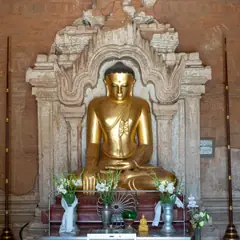
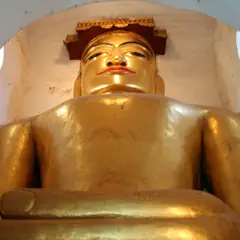
The western sanctuary keeps two original images seated side by side, Gautama, the historical Buddha, and Maitreya, the future Buddha, an unusual pair in Bagan. Their faces are covered in gold leaf, which devotees still stick on the images and their thrones, and behind, at the lower part, a niche holds a reclining Buddha. It is said that Narathu had them made as embodiments of his father and his brother, although the usual iconographic reading is of the two Buddhas.
Over the original ochre wash of the walls are layered Buddhas and scenes donated since the 14th century, among them two elephants from Jataka 541, of the 15th and 16th centuries. And the work was left unfinished by a last crime: in 1171, according to the Burmese chronicles, the chief of Pateikkaya, whose daughter had died at the king’s hands, sent eight assassins disguised as Brahmin astrologers who killed Narathu with a sword and then took their own lives. Who they really were and where the king fell is still debated, and there, before the golden Buddhas, the tale of the unfinished atonement closes.