Art and Botero's donation
Botero Museum Audio Guide (Museo Botero)
A former archbishop's palace in La Candelaria that burned in the Bogotazo and was reborn from photographs now holds, free and forever, Fernando Botero's paintings beside Picasso, Monet and Dalí, hung by the painter himself.
- 60 min audio
- Free admission
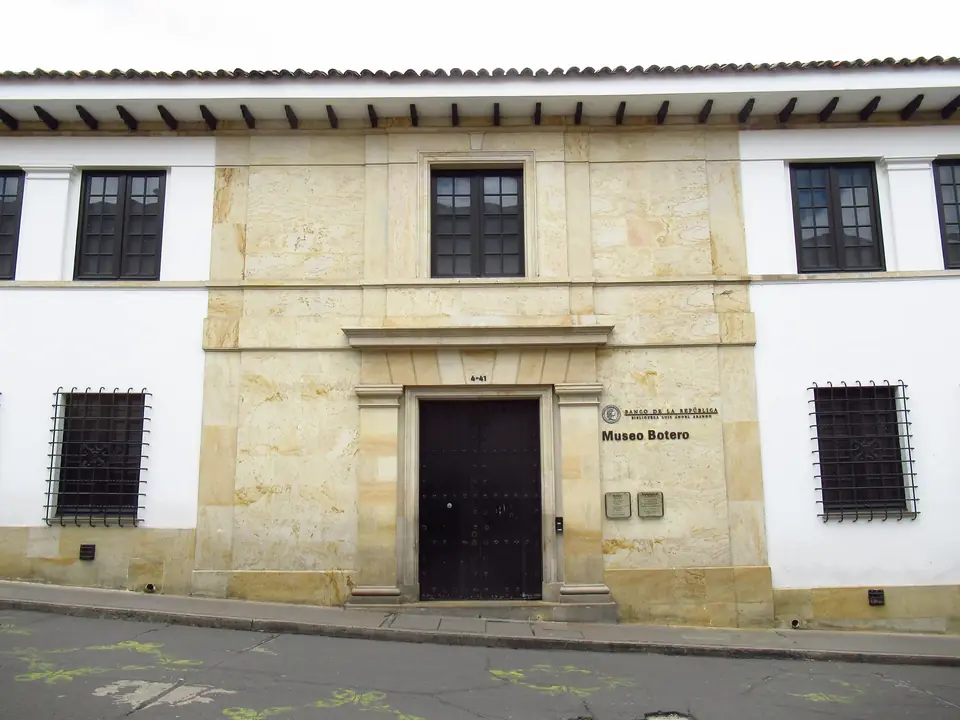
The big house on Calle 11 was built between 1724 and 1733 as the Archbishop's Palace of Santafé and extended between 1788 and 1790 to house the library and art collection of Archbishop Antonio Caballero y Góngora. On 9 April 1948, during the Bogotazo, it was burned and completely demolished; the Banco de la República rebuilt it from aerial photographs and images of the original facade. In 2000 it became the museum of Fernando Botero's donation.
Botero curated it himself and left a clause that forbids lending or moving any work once hung: the display seen today is exactly the one the artist decided on in 2000. And he wanted admission to be free, so that nobody would have to pay to see a Picasso in Bogotá.
Highlights
- Bronze hand at the entrance — the only work the public may touch, at Botero's own wish
- Fountain courtyard — the heart of the old archbishop's palace, with the hills peeking between the rooftops
- Impressionist room — Corot, two Renoirs, Pissarro, Degas, Toulouse-Lautrec and Monet's view of Amsterdam in winter
- 1933 Dalí bust — the bread on the head and two late Picassos in the avant-garde room
- Botero's Mona Lisa (1978) — the voluminous Gioconda with a volcano behind, beside his series on violence
In May 2000, announcing that he was giving his collection to the country, Fernando Botero stressed one fact: Bogotá had never had a Picasso or a Monet. That same year he donated to the Banco de la República 208 works, 123 of his own and 85 by international artists of the 19th and 20th centuries, according to the Bank’s count (other sources say 87), a collection valued at up to 200 million dollars. On 1 November 2000 the Botero Museum opened, with free admission by the painter’s decision, and today it receives more than 500,000 visitors a year.
The collection might have ended up in Medellín. Botero offered it from the mid-1990s to the Museo de Antioquia in his hometown, but the slowness of the Antioquia authorities led him to accept the proposal of Bogotá’s mayor Enrique Peñalosa; Medellín later received another lot of its own and the sculptures of Plaza Botero. At the inauguration, the artist asked that the museum be an “oasis of peace”, a “small oasis of culture amid the frenzy of city life”.
The phrase carries more weight than it seems. The house that hosts it burned on 9 April 1948, the day of Jorge Eliécer Gaitán’s assassination, in the fire that razed the two blocks where the Banco de la República’s cultural complex now stands. The history of the Botero Museum, the architecture of a colonial house that is actually a reconstruction, and what to see in its rooms are the thread of the audio guide, documented and checked against historical sources, that accompanies the route from the street to the wing devoted to the painter.
The revolt of that day had its epicentre a few streets away, at Plaza de Bolívar; uphill, La Candelaria continues to the Chorro de Quevedo, and another 91 works by the painter, almost all in storage, belong to the collection of the National Museum of Colombia.
A facade that came out of photographs
Botero Museum
Summary of this stop
On Calle 11, between Carreras 4 and 5, rises the front of a colonial house with the Mint next door. Many guides simply present it as an 18th-century house, but the Banco de la República’s encyclopaedia tells another story: after the attacks of 1862 and 1886, the Archbishop’s Palace was burned and completely demolished during the riots and looting of the Bogotazo. The Bank bought the plot and rebuilt the house from aerial photographs and images of the original facade. What is seen today is a house resurrected from fire.
At the entrance waits the first work, a large open left hand in bronze, part of the donation and belonging to a series cast from the same mould with sisters in Medellín and in Madrid. At first the directors did not let the public touch it; it was Botero who asked that people be able to shake its hand. Today visitors greet it, high-five it or lean on it for the photo, and the guards, who do not allow getting too close to the sculptures in the rooms, make an exception for it.
According to the museum’s tradition, the touch of thousands of hands has given it an identity of its own, different from that of its copies. Why this hand is no longer the same as its sisters is told in front of it.
The archbishop’s courtyard and justice in exile
Fountain courtyard
Summary of this stop
Beyond the door appears the inner courtyard, two storeys with a roof, flowers, benches and a fountain of water in the centre; the hills peek between the rooftops. It is the heart of the palace built between 1724 and 1733 for the Archbishopric of Santafé and extended by Archbishop Antonio Caballero y Góngora between 1788 and 1790 for his library and art collection. A fountain in the courtyard and a fireplace in the house were rarities in the colony: signs of luxury and power.
The rebuilt house later had very different lives. Around 1955 it was rented to the Supreme Court of Justice, in 1979 it was the Luis López de Mesa Newspaper Library and in the 1990s it became exhibition rooms and offices of the Bank. In between came the darkest episode: after the assault on and fire at the Palace of Justice, on 6 and 7 November 1985, in which eleven justices of the Supreme Court died, a presidential decree of 9 November made the Newspaper Library of this house the Court’s temporary seat.
The calm of the water gives no hint of what was decided between these walls, or how the surviving justices resolved to fill the seats of the colleagues they had lost. That account, with its dates and its voices, is one of the most intense moments of the narration.
Picasso, Monet and a Dalí he did not like
Dalí sculpture in the avant-garde room
Summary of this stop
The east wing gathers the international collection. The Impressionist room opens with Corot’s “Gypsy Girl with a Tambourine”, the oldest work in the set, and continues with two Renoirs, Claude Monet’s view of Amsterdam in winter, Pissarro, Caillebotte, a Degas sculpture and Toulouse-Lautrec’s “Absinthe Drinker in Grenelle”. Each piece hangs where Botero put it in 2000, and there it will stay: the donation forbids moving or lending them.
In the avant-garde room await two late Picassos, a 1953 Miró and Max Beckmann’s “Maternity” from 1936, which hung in the vestibule of the painter’s New York apartment. It is opened by a sculpture by Salvador Dalí dated 1933 that Botero bought while admitting he did not like Dalí, because it helped to “complete” the collection; by the same criterion he acquired a Tàpies after having spoken ill of Tàpies in an interview.
That sculpture is a woman’s bust with a loaf of bread on her head, one of Dalí’s first Surrealist objects, of which MoMA in New York holds another version. Dalí told an anecdote about the original bread and Picasso’s dog that, true or not, makes the piece the most mischievous in the museum; the outcome is left to the audio guide.
From the Mona Lisa with a volcano to wounded Colombia
Botero's Mona Lisa
Summary of this stop
The west wing is devoted to Botero. There hangs his 1978 Mona Lisa, which keeps Leonardo’s hand position, gaze and smile but adds a volcano and mountains in the background. It is the terrain of the figures the public calls Botero’s “fat people”, although he always maintained that he did not paint fat people but volume, to make it “more plastic, more monumental”. In another room, small and medium-format sculptures in bronze and marble complete the portrait of the sculptor.
Beside that gentle Botero hangs a much colder one: his first series on violence in Colombia, with “Car Bomb” (1999), painted in cold tones, “Manuel Marulanda Tirofijo” (1999), “Massacre at Mejor Esquina” (2000) and “Pablo Escobar”. The same brush that rounds out the Gioconda portrays the country of car bombs.
These rooms also hold a farewell. On 25 September 2023, ten days after his death in Monaco, Botero’s body was bid farewell at the museum with the National Choir and a quartet of the Colombian Symphony Orchestra, and the public could say their last goodbye between 2:30 and 4:30 in the afternoon. That tribute closes the route and changes the way of looking at everything before it.