Pilgrimage sanctuary
Monserrate Audio Guide
At 3,152 metres above Bogotá, the hill the Muisca watched the June sun rise over keeps a Christ bought for forty patacones that ended up displacing the Catalan Virgin who gave it its name.
- 120 min audio
- Pilgrimage and viewpoints
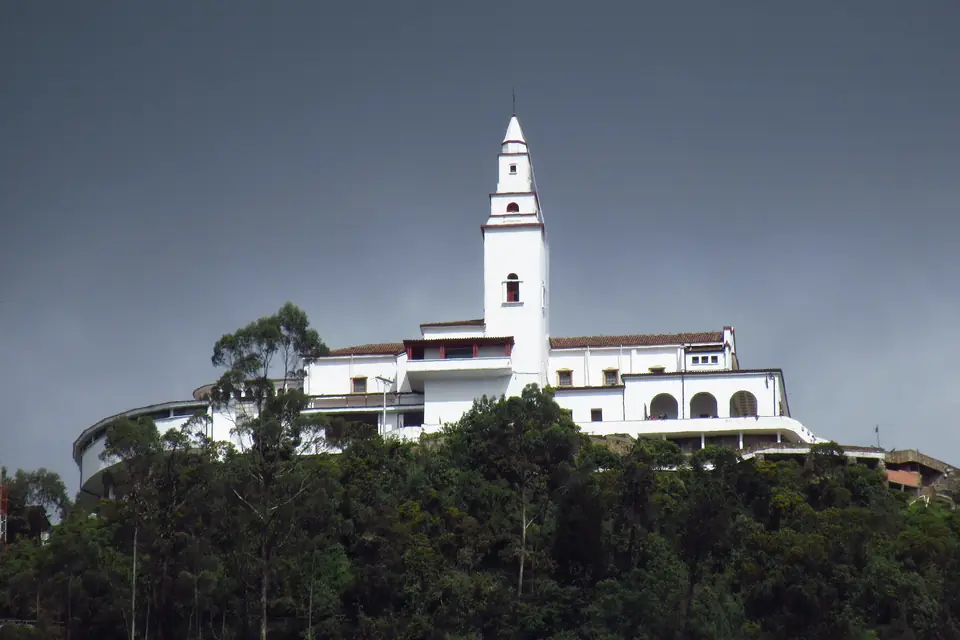
Until the mid-17th century the mountain was called the hill of Las Nieves. Around 1640 the first hermitage on the summit was authorised, dedicated to the Black Virgin of Montserrat, and in the 1650s a path dotted with chapels for pilgrims was opened from the church of Las Nieves. Today the Sanctuary of Monserrate is a minor basilica that Bogotá climbs on foot, by funicular or by cable car.
The church that crowns the hill was built by the pilgrims themselves, each carrying up at least one brick, after the 1917 earthquake. And the carving that presides over it, a Fallen Lord with glass eyes and natural hair, has come down to the city only in moments of need: a drought, war, a pandemic.
Highlights
- Fallen Lord — a 1656 carving by Pedro de Lugo Albarracín, with glass eyes and natural hair and eyelashes
- La Moreneta between two flags — a replica of the Virgin of Montserrat donated in 1996 by the Catalan monastery
- 1929 funicular and 1955 cable car — two works by the Swiss firm Von Roll, with a tunnel dug beneath the summit
- Casa Santa Clara — a wooden house dismantled into 33,000 pieces and reassembled at the cliff edge
- Lookout over the savanna — the historic centre, Guadalupe hill and, on clear days, the Cordillera Central
From almost any street in central Bogotá the white silhouette of the basilica can be seen high on the hill, at 3,152 metres according to most sources. It looks like a lookout with a church, but the history of Monserrate is another: that of a mountain the city has spent centuries climbing with vows, cables and bricks, and to which it still turns for help when things go badly.
Long before any hermitage, the Muisca called it quijicha caca, “the grandmother’s foot”. Seen from today’s Plaza de Bolívar, the sun of the June solstice, the god Sué, rises exactly behind the hill. The Spaniards knew it as the hill of Las Nieves, until around 1640 the president of the New Kingdom of Granada, Juan de Borja, authorised the bachelor Pedro Solís de Valenzuela to build a hermitage on the summit, finished in 1657 under the invocation of the Black Virgin of Montserrat, the one from Catalonia. The dates of that first work wobble between sources, from 1620 to 1650, although the most repeated version is 1640-1657.
From that Virgin comes the name; what nobody expected is that a Christ carved in 1656 would end up taking her place. The history of Monserrate, its architecture and the devotions that still climb the path today are told in a six-stop route around the summit, with a narration documented and checked against historical sources.
From the summit one commands the layout that was born around Plaza de Bolívar, and at the foot of the hills, in La Candelaria, tradition places the origin of the city at the Chorro de Quevedo.
A tightrope to Guadalupe
Upper cable car station
Summary of this stop
The upper cable car station is the arrival gate for many visitors. The line, the work of the Swiss firm Von Roll, began to be built in 1953 and entered service on 27 September 1955 for a million pesos. Its cabins have gone through white, yellow, red and green, and red, to today’s orange, with floor-to-ceiling windows since the 2018 renovation. The funicular, from the same Swiss firm, is older: it was inaugurated on 18 August 1929, required a tunnel to be dug beneath the summit and its first cars, for 60 people, reserved first-class seats for the shareholders of the Empresa Funicular de Bogotá.
But the boldest feat of crossing this void needed no motors. At the cable car ticket office, a photograph and a plaque recall that on 20 December 1895 the Canadian tightrope walker Harry Warner crossed on a tightrope the 890 metres separating Monserrate from Guadalupe hill, over the canyon of the San Francisco river. Opposite stands Guadalupe, crowned by a 15-metre Virgin with open arms.
Exactly how Warner crossed is a matter of versions: some chronicles speak of blindfolds and others of rests on the rope or jumps midway, and even of a lawsuit over the sale of the photos. What is true in each one is unpacked in the narration, with the canyon in view.
A house carried up in 33,000 pieces
Santa Clara restaurant house
Summary of this stop
At the cliff edge stands a white wooden house, with clay tiles and small windows of Parisian air, that seems to have always been there. It was not. The Santa Clara restaurant house stood below, at the Las Mercedes estate, beside Carrera Séptima. Around 1974, faced with the widening of the road, the manager Carlos Alberto Leyva had it dismantled into 33,000 marked pieces, which went up on the cable car day and night, and it was reassembled on the summit until the mid-1980s.
Its origin also has two versions. One holds that Carlos Navarro Menéndez bought it in Paris and brought it dismantled by ship to Puerto Colombia, up the Magdalena to Honda and by mule to Bogotá; the other, defended by Leyva himself, asserts that it was built in Bogotá inspired by Parisian architecture.
Those who work on the hill add their own chapter: they say that in the house’s windows two girls dressed for first communion appear and disappear. It is a workers’ legend, with no proof but the telling, and it forms part of the charm of this stop.
A church raised brick by brick
Sanctuary of Monserrate
Summary of this stop
The basilica’s smooth white facade may seem simple, but it hides a different church. The damage of the 1917 earthquake and the lack of space for pilgrims forced a new, neo-Gothic church to be built, designed by Arturo Jaramillo Concha and finished in 1925. It was built by pilgrims, each carrying up at least one brick. In the mid-20th century, at a date that sources place in 1949 or as late as the 1960s, the neo-Gothic facade and that of the funicular station were “ironed” into the false neo-colonial style seen today. In that period Pius XII raised the church to minor basilica, and in 1952 an altar carved in Florence arrived.
The climb on foot is still a serious matter. In Holy Week 2024, 182,815 people walked the path, 48,412 of them on Good Friday. Many climb on a vow: one of the most deep-rooted customs is that of the “seven Sundays to the Lord of Monserrate”, seven Sundays in a row of pilgrimage to ask for health or work, and some devotees make the path barefoot or on their knees.
So whoever reaches the stairway gasping may be on their third or their seventh Sunday. What this church says about that way of climbing, and about the four friars who in 2017 arrived from Buenaventura after seven days of travel, almost all on foot, appears in the narration in front of the facade.
The Moreneta that named the hill
Moreneta between two flags
Summary of this stop
Inside the sanctuary, flanked by the flags of Colombia and of Bogotá, is the image that gave its name to all this: a replica of the Moreneta, the Black Virgin of Montserrat. The hill of Las Nieves came to be called Monserrate when the 17th-century hermitage was placed under her invocation, and in the 1650s a path with small chapels for pilgrims was opened from the church of Las Nieves, in imitation of the Catalan sanctuary.
The current image is not the original. The replica the sanctuary kept from the 17th century disappeared in 1950, and the one that now takes its place was donated in 1996 by the Montserrat Monastery itself. A gift in return that closes a circle of more than three centuries.
How a Catalan Virgin came to name the most visible mountain in Bogotá, and why she now holds a discreet place in her own sanctuary, is clarified at this stop.
The Christ of forty patacones
Fallen Lord of the high altar
Summary of this stop
At the centre of the high altar is the Fallen Lord, a Christ fallen beneath the cross with polychrome skin and marks of blood. According to the documented contract, in 1656 the priest Bernardino de Rojas (de Rosas in some sources) commissioned the Santafé sculptor Pedro de Lugo Albarracín to make a “Holy Christ Fallen under the lashes and nailed to the cross”, and his accounts note that it cost forty patacones. The sculptor carved it in wood, gave it glass eyes, natural hair and eyelashes, and some lead and silver parts. The church also keeps two little angels by him, about 40 centimetres tall with lead hands.
That carving gradually ate into devotion to the Virgin who gave the hill its name, until in the 19th century the Moreneta ceased to be the sanctuary’s central piece and the Fallen Lord took her place. Miracles and healings are attributed to him, and popular beliefs circulate among devotees: that he comes down to the city only if he wishes, that carried back up he weighs much more, that his hair grows.
The real image weighs about 150 kilos, and in August 2020 it came down from the hill shut in a wooden box carried by a dozen men. What this carving truly weighs in the life of Bogotá is the core of the route.
The hill of the sun, the Christ and the false volcano
Lookout over the savanna
Summary of this stop
The lookout open to the west shows the historic centre, the south and part of the north of Bogotá, and on clear days the mountains of the Cordillera Central. From here the Muisca geometry is understood: if the June sun rises behind Monserrate seen from Plaza de Bolívar, the December one does so behind Guadalupe.
It is also understood why the city looks to the hill when it is in trouble. In the 20th century the Fallen Lord came down three times: in 1916 to ask for the end of a drought, in 1952 for peace and on 21 November 1998, again for the country’s peace. During the pandemic he toured Bogotá again from the Primate Cathedral. According to tradition, his first outing, in the 19th century and with no known date, was against a smallpox epidemic, and from that of 1916 written testimonies remained of an almost immediate downpour.
One fear remains that generations of Bogotá people heard as children: that Monserrate is a sleeping volcano and the church sits on the crater. In May 2023 the Servicio Geológico Colombiano denied it: its rocks are sedimentary, formed on the floor of Cretaceous seas about 70 million years ago. Beneath the lookout there is no crater, but an ancient seabed, and with that image the visit closes.