Colonial church
San Francisco Church Audio Guide (Iglesia de San Francisco)
On Bogotá's noisiest corner still stands the church that gave its name to a river: it lost its convent, its bridge and almost its own facade, but inside it keeps the capital's greatest gilded altarpiece.
- 30 min audio
- Colonial Baroque
The Franciscans settled in 1557 beside the Vicachá river, on land donated to them by Archbishop Juan de los Barrios, and built a church that keeps the oldest fabric in Bogotá. Behind its stone and brick facade await a 17th-century U-shaped altarpiece and a Mudéjar *par y nudillo* roof frame, one of the finest in the New Kingdom of Granada.
Everything that surrounded it has disappeared: the river was channelled beneath Avenida Jiménez, the three-cloister convent fell in 1917 to build the Palacio de San Francisco, and that year's project also contemplated demolishing the church. It survived that, the earthquakes and the night of the Bogotazo, and more than 450 years later the Franciscan Order still runs it.
Highlights
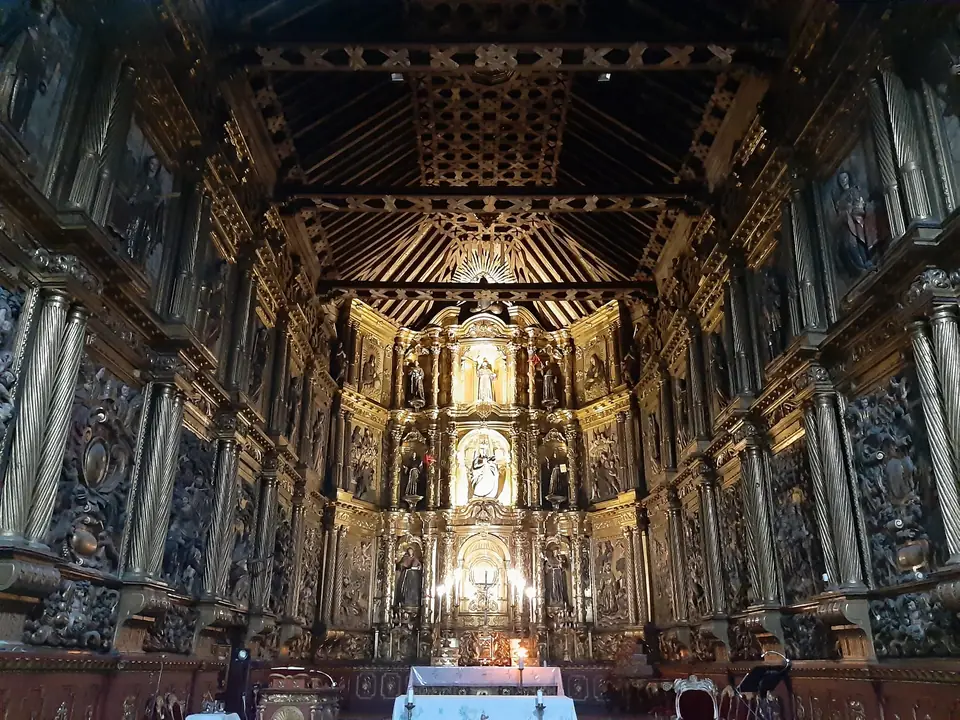
- Gilded high altarpiece — the largest and most elaborate in Bogotá, from the 17th century, U-shaped
- Eternal Father at the top — holds the world in one hand and points to the Franciscans with the other
- Mudéjar roof frame — a wooden par y nudillo ceiling over the nave
- Stone facade — without its white lime coating since 1988, with the inscription of the 1794 consecration
- Lord of the Agony — an image of Christ with natural hair, a focus of devotion in Holy Week
At the junction of Avenida Jiménez and Carrera Séptima, amid buses, street vendors and loudspeakers, a brown stone facade has held out since colonial times. It is the San Francisco Church, built by the Franciscans from 1557, when Archbishop Juan de los Barrios moved them to some houses in the Las Nieves district, beside the river, and donated the land to them. The dates of its construction wobble depending on the source: some give it as finished in 1566, others extend the work well into the 17th century.
Its title of oldest church in Bogotá is also disputed. La Veracruz traces its origin to 1546, although its current building was begun in 1631; San Francisco is credited with keeping the oldest fabric in the city. And that fabric has seen a lot: a river that changed its name because of it, an earthquake that damaged its tower, an expropriation, the demolition of its convent and the day in 1948 when its clock showed the hour of the shot at Jorge Eliécer Gaitán.
The history of San Francisco Church, its architecture and what keeps it alive are spread over four stops, from the bank of the vanished river to the gold of the presbytery, in a narration documented and checked against historical sources.
The revolt of 9 April 1948 had its epicentre a few blocks away, at Plaza de Bolívar, and across Parque Santander the Gold Museum holds some 34,000 pieces of Pre-Hispanic gold and tumbaga.
The river that took the church’s name
Eje Ambiental canal
Summary of this stop
The visit starts outside, beside the sheet of water of the Eje Ambiental that runs in front of the church. That canal recovers a stretch of the course of a river called Vicachá, “the glow of the night”, which ended up being called San Francisco after the church built on its bank. In the 1930s it was channelled and Avenida Jiménez was laid out over it.
The river split the city. In 1551, under the magistrate Juan de Montaño, the first bridge was thrown across it, that of San Miguel, made of wood, which joined the church with the rest of Santafé; the current carried it away and in 1602 a stone one replaced it. Beside the church, the neoclassical Palacio de San Francisco building occupies the site of the old convent, which came to extend over two blocks with three two-storey cloisters.
Everything of the convent was torn down in 1917 except the sacristy, which is still attached to the church. What remains on this corner is, in fact, the inventory of what was lost, and the narration rebuilds it piece by piece.
A facade that was to be demolished
San Francisco Church
Summary of this stop
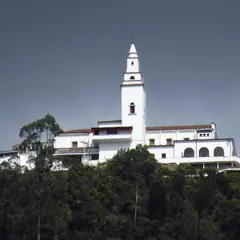
Facing the portal, on the Séptima, the stone and brick have been in view since the 1988-1990 restoration, which removed the white coating that covered them. The facade, with its Doric columns and the image of Saint Francis, and the tower are original parts that survive. An inscription records the new consecration of the church on 25 March 1794, by Archbishop Baltasar Jaime Martínez Compañón, after the reconstruction that followed the earthquake.
That survival was not written in advance. The 1917 project that widened the street beside the cloister and opened the way for the palace, with Gastón Lelarge, Arturo Jaramillo Concha and Alberto Manrique Martín, at first contemplated demolishing the church too. In the end it was left standing, alone, beside the building that had taken the place of its convent.
This same pavement holds the darkest episode of the place. According to accounts of the time, on 9 April 1948, at a quarter past one in the afternoon as the San Francisco clock showed, Juan Roa Sierra shot Gaitán some fifty paces from here, and the crowd lynched him in front of the church. The city burned that night; the church came out intact. What happened afterwards to the assassin’s body is told in front of the facade.
An Eternal Father who points at the friars
Gilded high altarpiece
Summary of this stop
On crossing the door, the gold takes the eye. The high altarpiece wraps the presbytery at the back and the sides, U-shaped, and is the largest and most elaborate of its type in Bogotá. It was built in 1623 and is the studied work of Ignacio García de Ascucha, carver, joiner and architect active in Santafé in the early decades of the 17th century, of whom contracts, payments, lawsuits and a will survive.
At the very top, the Eternal Father holds the world in one hand and with the other points at the Franciscans. Below are stepped grotesques, female saints with their attributes and the apostolate, and among the panels stands out a relief of the Baptism of Christ in gilded and polychrome wood, dated around 1625. Over the nave, a Mudéjar par y nudillo wooden roof frame closes the whole: one of the finest in the New Kingdom of Granada.
In the early 1850s, the American traveller Isaac F. Holton attended the saint’s feast here and left written a scene of Baroque theatre: friars climbing narrow galleries high on the walls to light candles, clinging to the saints so as not to fall. What he saw among the figures brought out for the feast, and what he thought of so much light, is part of the account before the altarpiece.
A Christ with real hair
Chapel of the Fallen Lord
Summary of this stop
The side aisle was born of a disaster. The 1785 earthquake, which most sources identify as the one that badly damaged the tower and a side wall, forced the church to be rebuilt under the direction of the engineer Domingo Esquiaqui, and the small chapels attached to the single nave were then joined into a second aisle. Today it holds gilded altarpieces such as that of Saint Benedict of Palermo and the chapel of the Fallen Lord, with Christ dressed in purple under the cross, between two angels and tables of candles.
Here too is the Lord of the Agony, an image of Christ with natural hair that draws hundreds of devotees and curious visitors each year, especially in Holy Week. A popular belief holds that its hair grows; others recall that a plaster image cannot make hair grow, and not even its origin is clear. The Franciscan Order still runs the church more than 450 years later, and in 2026 the Instituto Distrital de Patrimonio Cultural cleaned and conserved its facades in a joint plan with the friars.
Devotion has also returned to the street. In Holy Week 2024, the Hermandad San Antonio de Padua, born in this church, brought out processions of hooded penitents along Carrera Séptima again. What happened beside this door as the Risen Christ passed closes the route.