Founding square
Plaza de Bolívar Audio Guide
Beneath the Liberator's bronze there was once a pillory and then a fountain: the old Plaza Mayor of Santa Fe has been a market, a scaffold, a bullring and a rostrum, and every building around it carries the scar of one of those roles.
- 30 min audio
- Independence history
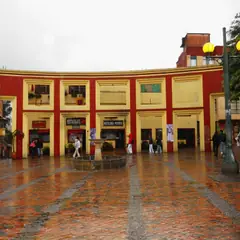
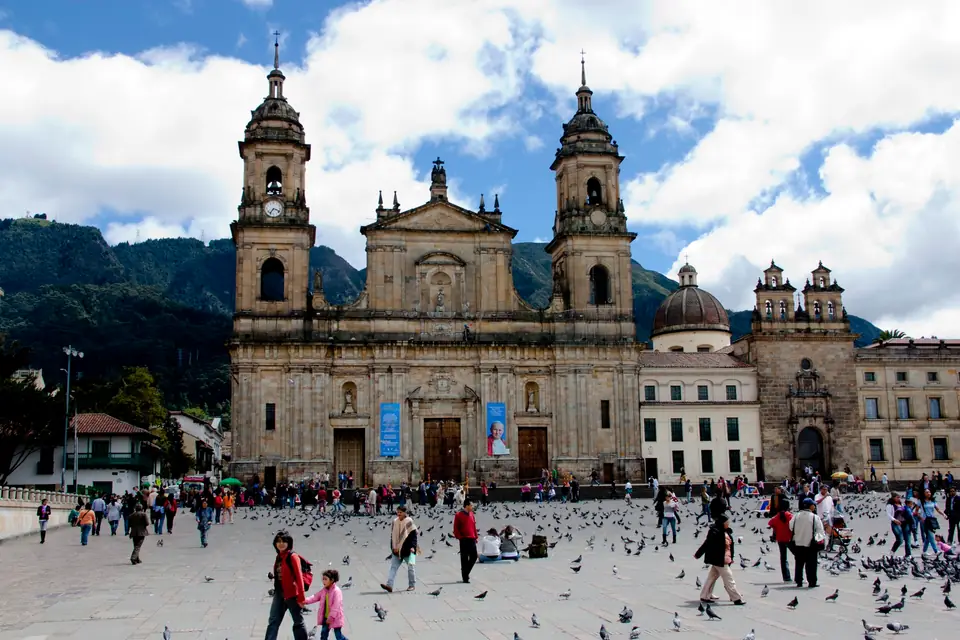
Plaza de Bolívar is the stone rectangle where the city was laid out in 1539, and around which Colombia's four powers now sit: the Primate Cathedral to the east, the National Capitol to the south, the Palace of Justice to the north and the Mayor's Office, in the Liévano Palace, to the west. At its centre stands Pietro Tenerani's statue of Simón Bolívar, Bogotá's first public monument, which gave the square its name when it was unveiled on 20 July 1846.
Today's quiet esplanade, with its sloping 1961 paving and its pigeons, hides a history of executions, fires and crowds: La Pola died here in 1817, a tram burned here during the Bogotazo and a hundred thousand people kept an absolute silence here before Jorge Eliécer Gaitán in 1948.
Highlights
- Bolívar statue — Pietro Tenerani's bronze, modelled in 1843, Bogotá's first public monument
- National Capitol — 78 years of construction and a planned dome that was never built
- Palace of Justice — the Santander plaque, the only piece to survive the destruction of 1985
- Casa del Florero — the corner where, on 20 July 1810, a quarrel over a flower vase set off Independence
- Liévano Palace — Gastón Lelarge's Mayor's Office, with plaques that tell the city's history
On 27 April 1539, with the captains Sebastián de Belalcázar and Nicolás de Federman present and some 264 men, the town of Santa Fe was legally confirmed: the first town council was formed, the urban plan was marked out and the first plots were shared around a Plaza Mayor. Where Gonzalo Jiménez de Quesada first set foot is another story, and is still debated: the plaques of the Liévano Palace speak of the old village of Teusaquillo in 1538, a National University study points to the Plaza de Hierbas, today’s Parque Santander, and the tradition of the Chorro de Quevedo claims the title too.
What is not debated is what came next. That Plaza Mayor, on ground that had been part of the Muisca territory of Bacatá, was a market, a bullring, a stage for proclamations and state funerals, and a scaffold. Today it is called Plaza de Bolívar, measures about 13,903 m² and holds some 55,600 people, and it remains the place where Bogotá goes when it has something to say: demonstrations, farmers’ fairs, concerts, the night protest of more than 100,000 people in July 1947 or the student camp of 2016.
For decades, too, it was the square of the pigeons: a dozen sellers of little bags of corn, some with thirty and even about fifty years in the trade, kept alive the ritual of being photographed with birds on one’s arms, and among them it was said that feeding them brought good luck. In 2018 the Mayor’s Office banned the sale of corn, and the flock, which numbered around 2,300 birds, has shrunk to a few hundred. What to see at Plaza de Bolívar, how its architecture is read and what history each side hides is what the audio guide unpacks along a walk around its perimeter, documented and checked against historical sources.
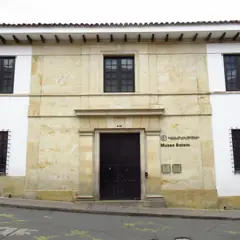
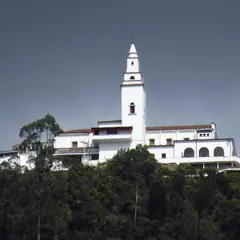
The dispute over the exact place of the founding continues a few streets away, at the Chorro de Quevedo; the Bogotazo of 1948 also reached the old archbishop’s palace now occupied by the Botero Museum, and over the eastern hills rises the sanctuary of Monserrate.
A pedestal where a pillory once stood
Tenerani's Bolívar statue
Summary of this stop
The route starts at the exact centre of the square, before the bronze figure of the Liberator. That spot has changed tenants three times. From the founding, the rollo or pillory of punishments stood there, the symbol of the king’s power. In 1583 the magistrate Alonso Pérez de Salazar, who had made ample and bloody use of that column, asked to replace it with a small public fountain to supply the city with water, and a tax on meat and wine was proposed to pay for it.
That first fountain gave way to a more ornate stone one, topped by a little figure and with four coats of arms, which the people nicknamed the “monkey of the basin”. From it came a saying, “go and complain to the Monkey of the Basin”, usually explained as a jibe at the uselessness of complaining to officials, although some attribute it to mothers who sent off children tired of carrying water. The fountain held the centre until 1846 and since 1942 has stood in the courtyard of the Museum of Colonial Art, a few streets away: nothing of it remains in the square.
It was replaced by the statue seen today, modelled in 1843 by the Italian Pietro Tenerani, cast in Munich by Ferdinand von Müller and donated by José Ignacio París. At first it faced east, towards the Cathedral; in 1880 it received a new pedestal and was turned, and in 1927 it was raised onto a taller one. Even the sword it grips has its own history, that of a blade lost several times that ended up kept in a museum, and what the one now held by the bronze is like is told in the narration, at the foot of the pedestal.
A 78-year Capitol without a dome
National Capitol
Summary of this stop
At the foot of the National Capitol’s staircase, it becomes clear why the ground of the whole square seems to tilt towards this spot. It is the work of Fernando Martínez, of the firm Martínez y Avendaño, who won a 1959 competition called for the sesquicentennial of Independence. Work began on 25 January 1960, removed car parks and fountains and solved the slope with warped planes that descend towards a flat triangular area whose base is these steps. President Alberto Lleras Camargo inaugurated it on 16 July 1961.
Behind rises the great neoclassical stone colonnade of Congress, built on the site of the old viceregal palace, burned in 1786. It was designed by the Dane Thomas Reed and continued by Mariano Sanz de Santamaría, Pietro Cantini and Gastón Lelarge. Work began in 1848, although sources do not all agree on the start date, and political instability dragged it out until 1926. Lelarge had planned an immense dome that would have dominated the skyline, but it was decided not to build it so as to finish on time.
These steps also lived through the square’s darkest day. On 9 April 1948, while the Pan-American Conference was in session in the Capitol, the assassination of Gaitán turned the square into the epicentre of the Bogotazo: a tram burned in front of the building, a mob entered to loot it and, according to the most widespread version, the body of the alleged assassin, Juan Roa Sierra, lay on this staircase. What the 1949 damage plan says about that day dismantles more than one inherited image.
Bulls, market and scaffold beneath City Hall
Liévano Palace
Summary of this stop
In front of the Liévano Palace, the French Renaissance-style building that Gastón Lelarge raised on the site of the Arrubla Galleries, burned in 1900, the colonial square reappears as a total stage. Here farmers brought their produce to market, here the four ends were closed off for bullfights, here there were circus shows and monarchs and viceroys were proclaimed. The market and the bull festivals were not suspended until 1861.
The same crowd that came to the bulls attended the executions. In 1782 the sentence against José Antonio Galán, captain of the Comuneros’ Revolt, was read here: to be dragged to the scaffold, hanged, quartered, with his head, hands and feet distributed among several towns, and his house torn down and sown with salt “so that his infamous name may be forgotten”. One of the plaques inside the Mayor’s Office, the one recalling that the square was then watered for the first time with the blood of martyrs of liberty, shows that this oblivion never came.
During Pablo Morillo’s Reconquest the square was again a place of execution: in 1816 the body of Camilo Torres was hung here and on 14 November 1817 Policarpa Salavarrieta, La Pola, was shot together with her fiancé Alejo Sabaraín and other patriots, before hundreds of spectators. A La Candelaria legend even haunts the square, that of a lawyer shot in 1851 whose shadow, they say, still proclaims his innocence at dawn.
The plaque that survived 1985
Palace of Justice
Summary of this stop
On the north side, the modern building of the high courts occupies the site of one of Colombia’s most recent wounds. The Palace of Justice designed by Roberto Londoño in the 1960s was destroyed on 6 November 1985 during the M-19 takeover and the Army’s counter-assault. Its ruins stayed untouched until 1989.
The current building, seat of the high courts since 2004, bears the name of Alfonso Reyes Echandía, the president of the Court who died in the takeover. Everything in it is new except one piece: at the entrance the plaque from the former palace is kept, with Santander’s words, “Colombians, arms have given you independence, laws will give you liberty”.
A sentence about arms and laws as the only survivor of a palace of justice razed by arms: the contrast reads itself, and the stop turns it into the gravest moment of the route.
The flower vase and the sun over Monserrate
Independence Museum - Casa del Florero
Summary of this stop
The visit ends at the northeast corner, where Carrera Séptima crosses Calle 11, before a low house with a balcony that is now the Independence Museum. On its ground floor the Spanish merchant José González Llorente kept his shop, and on the morning of 20 July 1810 his insulting refusal to lend a flower vase for a tribute to Antonio Villavicencio set off a popular movement that within hours replaced viceregal power with a Supreme Governing Junta.
From this same corner, above the Cathedral, the hills of Monserrate and Guadalupe peek out. According to research by Julio Bonilla Romero, from here the June solstice sun rises over Monserrate, the December one over Guadalupe and the equinoxes’ through the valley between them; another reading from the National University draws beams of light crossing the square. They are hypotheses from specific research groups, not an archaeological consensus, but they suggest that the geometry of the place is older than Santa Fe.
And the square remains the crowd’s rostrum. On 7 February 1948, a hundred thousand people, in a city of some four hundred thousand inhabitants, filled it in the Silent March called by Jorge Eliécer Gaitán, with black flags for the murdered farmers and without a single shout. What Gaitán said that day before that silence, two months before his death, is the close of the route.