Pre-Hispanic goldwork
Gold Museum Audio Guide (Museo del Oro)
A marble chest facing Parque Santander holds some 34,000 pieces of gold and tumbaga that could have ended up melted into ingots, and in its darkest room shines the 19.5-centimetre Muisca raft that evokes the myth of El Dorado.
- 90 min audio
- Pre-Hispanic gold
The Gold Museum of the Banco de la República was born of an unusual decision: that of the country's sole gold buyer, who instead of melting certain Indigenous pieces began to keep them. The collection moved from the Bank's boardroom to a room for special guests, opened to the public in 1959 and in 1968 gained its own building, the work of Germán Samper Gnecco and National Architecture Prize winner in 1970.
The two star pieces are survivors of very different stories. The Quimbaya poporo was bought in 1939 from the daughter of one of the richest men in 19th-century Colombia; the Muisca raft turned up in 1969 in a cave in Pasca, and its predecessor, found in 1856, burned on a ship in the port of Bremen on its way to Berlin.
Highlights
- Quimbaya poporo — a gold vessel of about 23.5 cm and 777.7 g, bought in 1939 to save it from the smelter
- Muisca raft — 19.5 cm cast in a single piece by the lost-wax method, radiocarbon-dated between 1295 and 1410
- La Ofrenda room — a circular third-floor room that starts in darkness and is revealed with light and sound
- Germán Samper's building — a white marble chest from 1968, National Architecture Prize in 1970
- Second-floor rooms — nose rings, pectorals and tunjos from the Calima, Quimbaya, Muisca, Zenú and Tairona
For decades, the natural fate of the Indigenous gold that turned up in Colombia was the crucible. In December 1939, the Banco de la República, then the country’s sole gold buyer, broke that routine with a vessel of about 23.5 centimetres: the Quimbaya poporo, an object for keeping the lime used when chewing the coca leaf. It paid 3,000 pesos for it and did not melt it down. From that gesture, and many similar ones, came a collection that by 1942 already totalled 1,987 pieces and today stands at around 34,000 of gold and tumbaga.
The story of the Gold Museum is not that of a treasure found all at once, but of a slow and somewhat accidental rescue: a boardroom, a room reserved for special guests, the opening to the public in 1959 and, at last, a building of its own in 1968. Many Colombians knew its pieces before crossing the door, because they carried them in their pockets: between 1972 and 1977 the Muisca raft appeared on the back of a 2-peso banknote, and in the 1980s the poporo was the face of the twenty-peso coin. A replica of the poporo even served as the trophy of the Tour Colombia cycling race in 2019 and 2020.
What to see at the Gold Museum, what its architecture says and why each display case holds a surviving piece are the questions the audio guide arranges, documented and checked against historical sources, across five stops through the building.
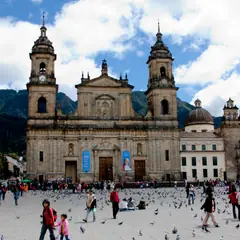
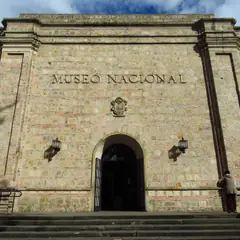
Across Parque Santander, at the junction of Avenida Jiménez and Carrera Séptima, stands the San Francisco Church, and the country’s other great collection fills the galleries of a former prison in the National Museum of Colombia.
A marble chest facing San Francisco
Gold Museum
Summary of this stop
The visit starts outside, in Parque Santander, before a white marble volume resting on a glazed lobby that makes it seem suspended. Shortly before 1961, the Banco de la República commissioned the firm Esguerra Sáenz Urdaneta Suárez y Cía. to design a building for its collection; the project was led by Germán Samper Gnecco between 1961 and 1968, inaugurated that last year on the east side of the park and awarded the National Architecture Prize in 1970.
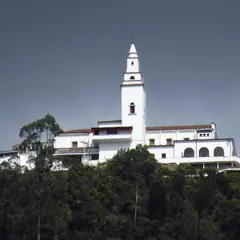
The architecture of the Gold Museum starts from a simple idea: a chest that keeps a treasure. Samper chose a smooth marble and gave up any ornament so that the facade would receive the shadows of the park’s trees and measure itself, in sobriety, against the San Francisco church, from 1567, across the street. What at first sight looks like banking coldness is in fact a design decision, and the narration in front of the facade explains exactly what that stone silence was after.
The poporo that escaped the crucible
Quimbaya poporo
Summary of this stop
Before the display case of the Quimbaya poporo appears a piece with a bulbous body and four spheres at the top, weighing about 777.7 grams of gold. It was found at Loma Pajarito, between Yarumal and Campamento, in Antioquia, and belonged to Coriolano Amador, one of the richest men in 19th-century Colombia. His daughter, Magdalena Amador, sold it to the Bank. Dozens of legends circulate around Amador: it is said that he printed banknotes with his own face and that he escaped the Titanic by arriving a day late at the port.
The usual account presents the poporo as the museum’s founding piece, but the institutional history published in the Boletín Museo del Oro holds otherwise: when it was bought, in 1939, it ranked 15th in an incipient archaeological collection, and it neither began the collection nor founded the museum. Even the exact date of the purchase has different versions.
Behind the display case there is also a disputed story. In 1893, President Carlos Holguín Mallarino gave Queen María Cristina of Spain the so-called Quimbaya Treasure, 122 gold pieces including 17 poporos, which remain in the Museo de América in Madrid. In 2017 the Constitutional Court ordered the Colombian government to make its best efforts to recover it; in 2022 Spain replied that the collection is an Asset of Cultural Interest and cannot leave the country. How that dispute fits with the poporo that did stay is told in front of the piece.
From the boardroom to 34,000 pieces
People and Gold room
Summary of this stop
On the second floor, the rooms Metalworking and People and Gold in Pre-Hispanic Colombia display nose rings, pectorals and tunjos from the Calima, Quimbaya, Muisca, Zenú, Tairona and other cultures. It is the stretch where the scale of the collection becomes clear: first shown in the Bank’s boardroom in 1940, moved in 1947 to a room for special guests and opened to the general public only in 1959.
The building also held surprises. The extension inaugurated in October 2008, again by Samper together with GX Samper Arquitectos, his daughter’s firm, added about 6,300 m² to the original building’s 6,600 and reorganised the exhibition into five archaeological rooms and one of exploration. During that work, boilers, storerooms and even entire apartments for the guards turned up; those lower levels became a temporary exhibition room, and the storerooms moved to upper floors, away from the damp.
The display cases, moreover, do not speak of an extinct world. In the Sierra Nevada de Santa Marta, the Arhuaco, Kogui, Wiwa and Kankuamo peoples still use the poporo in coca chewing, made of calabash instead of gold, and among the Arhuaco it is given to a young man as a sign that he is now a man. What the yellow crust that builds up on its neck means is left for the narration in the room.
El Dorado was a man, not a city
La Ofrenda room
Summary of this stop
On the third floor awaits La Ofrenda, a circular room that starts in darkness and reveals with light and sound the goldwork display cases tied to offering ceremonies. At the end of 2024 it closed for a few weeks to renew its museography, with the plan of showing the Muisca raft for the first time alongside the objects it was found with.
The room also dismantles a centuries-old misunderstanding. El Dorado was not born as a city, but as a man: the 16th-century Spaniards used the name for the Muisca chief covered in gold dust in the ceremony at Lake Guatavita, which they tried to drain in 1545 in search of offerings. In 1856, while partly emptying a lake at Siecha, the brothers Joaquín and Bernardino Tovar found a first gold raft; it passed to the collector Salomón Koppel, who sold it to a Berlin museum, and it vanished when the ship carrying it caught fire on arrival at Bremen.
The search had a British epilogue. In 1909 a company managed to drain Guatavita with a tunnel, but the mud set like cement in the sun and the lake filled up again. A century later, in 2013, some two hundred pieces from the museum travelled first class to London for the British Museum exhibition “Beyond El Dorado”. Which piece stayed in Bogotá, and why, is told right at the entrance to the room.
The Pasca raft that never left
Muisca raft
Summary of this stop
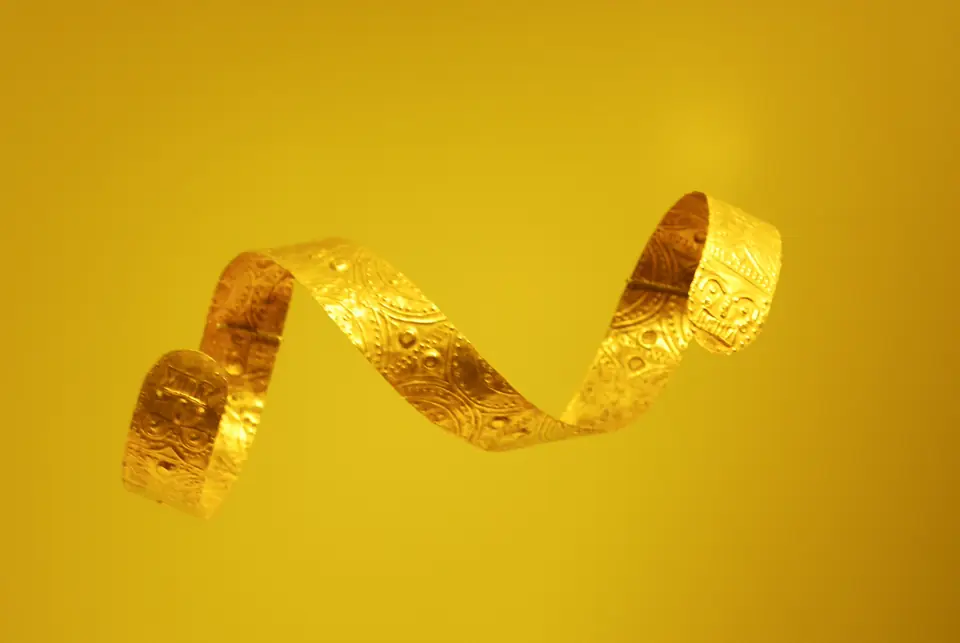
In its own display case, the Muisca raft shows a central figure surrounded by smaller ones on a reed raft: 19.5 × 10.1 × 10.2 centimetres cast in one go by the lost-wax method, in gold of more than 80% alloyed with silver and copper. The charcoal left by the mould, radiocarbon-dated, places it between 1295 and 1410, although some labels give wider ranges.
It appeared in early 1969 inside a ceramic vessel, in a cave in the Lázaro Fonte district of Pasca (Cundinamarca). The parish priest, Jaime Hincapié, protected it from sale and from the smelter, and to identify it he showed the peasant Cruz María Dimaté the drawing of the lost Siecha raft that Liborio Zerda had published in “El Dorado” (1883). Dimaté confirmed the resemblance. Since then the piece has not left Colombia, not even in the museum’s nearly 200 travelling exhibitions around the world.
The question of what it represents remains open. The museum has traditionally read it as the Guatavita ceremony, the origin of El Dorado; part of the researchers consider that reading Eurocentric, because the raft came from Pasca and may have been the offering of its own chief, and the Guatavita story comes from late Spanish sources. The two readings are set face to face at the last stop of the route.