Founding myth
Chorro de Quevedo Audio Guide
A tiny square at the top of La Candelaria that Bogotá points to as its birthplace, with a friar's fountain, a white chapel and far more reconstruction than it seems.
- 30 min audio
- Colonial and Muisca history
Before the Spaniards, this height was a leisure spot of the Zipa, the supreme Muisca ruler, for its view over the savanna. In 1538 Gonzalo Jiménez de Quesada settled his troops here, and in 1832 the Augustinian friar Francisco Quevedo installed the public fountain that gave it its name. The square also marks the border between the Spanish grid and the Indigenous Pueblo Viejo of crooked streets.
Almost everything that now looks old has a recent date: the square was rebuilt in 1969 from images and models, the chapel went up that same year imitating a church demolished elsewhere in the city, and water did not flow from the basin again until 2017, after 31 silent years. That is why the Chorro is the corner where Bogotá keeps inventing itself.
Highlights
- Friar Quevedo's basin — heir to the 1832 public fountain, with water again since 2017 after 31 years dry
- Hermitage of San Miguel del Príncipe — a white chapel from 1969 that imitates the Humilladero Chapel, Bogotá's first church
- Calle del Embudo — a cobbled alley at a sharp angle, with some 20 chicha taverns around it
- Jorge Olave's juggler — a life-size figure balancing on top of a facade
- Edge of the Pueblo Viejo — the point where the Spanish grid bends towards the old Muisca settlement
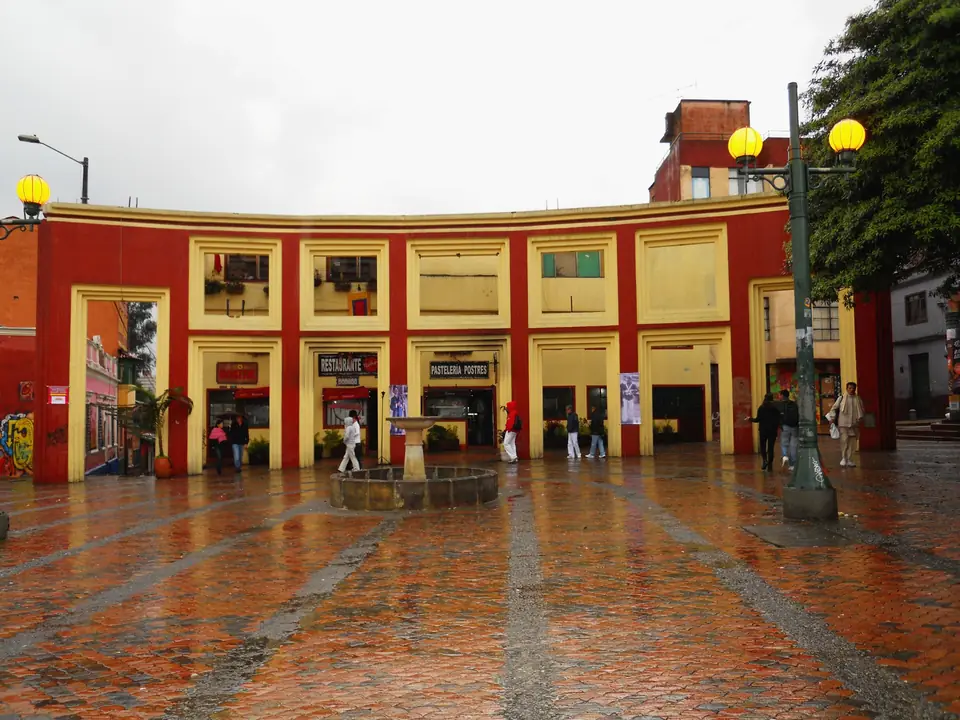
At the top of La Candelaria, at the end of a cobbled slope that smells of fermented corn, opens a square so small that it is hard to believe it carries the origin of a capital. Tourist tradition places the birth of Bogotá here: in 1538 Gonzalo Jiménez de Quesada settled his troops on this height, in a military camp called Nuestra Señora de la Esperanza, chosen for being protected from Indigenous attacks and for commanding the savanna with its view. Long before, the same place had been a leisure site of the Zipa, the supreme Muisca ruler.
The history of the Chorro de Quevedo, however, is full of layers and disputes. The director of the Instituto Distrital de Patrimonio Cultural has called the founding at this point a myth and places the Mass of 6 August 1538 in today’s Parque Santander; other historians reply that this park lay outside military protection, or distinguish the Chorro as a military settlement and not a founding site. What is on record is that the legal founding, with the creation of the town council, came on 27 April 1539. And the name of the square comes not from the conqueror, but from a friar and a jet of water.
What to see at the Chorro de Quevedo, how it was rebuilt and why a place largely remade in 1969 has become the city’s founding myth are the questions the audio guide works through in four stops, documented and checked against historical sources.
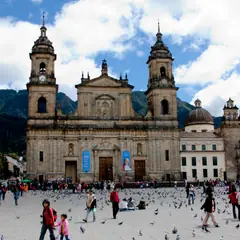
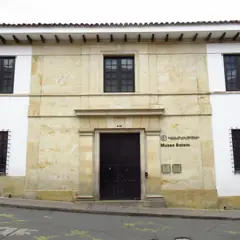
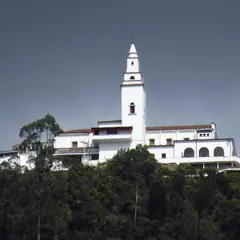
The legal founding of 1539 is placed, by contrast, in the old Plaza Mayor, today Plaza de Bolívar; down the street, La Candelaria leads to the Botero Museum, and above the square the hill of Monserrate stands out.
The slope of chicha and of the man who walks on air
Calle del Embudo
Summary of this stop
The main access to the square is Calle del Embudo, one of the few cobbled streets that Bogotá preserves. Its name is written in its own shape: the pavements close at a sharp angle with the vertex to the north, where the alley opens onto Calle 14. High up, over the void, a life-size shoeshine man walks, one of the figures that the Bogotá sculptor Jorge Olave began placing on rooftops and facades of La Candelaria in 1996, inspired by real characters of the neighbourhood.
The slope is also the territory of corn chicha, the Muisca drink that Bogotá persecuted after the Bogotazo of 1948 and that has never stopped being served here: around Calle del Embudo some 20 chicha taverns operate. In 1988 Doña Leo, a chicha maker of the Chorro, was the first national queen of chicha, a title later won also by her daughter, Ángela Alarcón.
On a corner beside the alley, the Chicha Museum of Alfredo Ortiz Huertas, “El Cachas”, recreates that legacy as a living ritual, with corn ground in the traditional way and a formula of serving that is always repeated the same. Among its pieces are the posters that, since 1889, warned that “chicha makes brutes of people”. What those ritual words say, and Ortiz’s theory about the origin of the nickname of Bogotá people, are told in the narration, at the foot of the slope.
A basin that fell silent for 31 years
Central stone basin
Summary of this stop
In the centre of the square waits a stone fountain, direct heir to the name of the place. In 1832 the barefoot Augustinian friar Francisco Quevedo bought a plot and installed a public fountain on it, so that neighbours would not have to climb with jugs up to the streams of the hills. In 1896 that jet was lost: according to the most widespread version, a wall collapsed and swept away the fountain and some neighbouring houses, although another source attributes the destruction to pipe damage caused by the fall of a bridge.
The current basin comes from the 1969 reconstruction, and even so the water stopped running. In the early 1980s the Chorro was an austere little square of white walls, almost deserted, with the stone basin as its only element and barely any shops around. In July 2017, after five months of work and some 600 million pesos, the water gushed again after 31 years, in the first restoration of the square since 1986, which also rehabilitated the wall of the arcade.
That same work protected a figure that looks down from the top of a facade: a life-size juggler by Jorge Olave. According to a documented tradition, it was not alone, but part of a tribute to the most beloved “madmen” of old Bogotá, fibreglass figures meant to disappear with time, like the people they portrayed. Who those characters were, among them a woman dressed in red and a boy who chased trams, is one of the stories the audio guide reserves for this point.
The chapel that copies the first church
Hermitage of San Miguel del Príncipe
Summary of this stop
Facing the stairway rises the Hermitage of San Miguel del Príncipe, a small white chapel that looks as if it had always been there. It was not: it was built in 1969 in the image of the Humilladero Chapel, Bogotá’s first church, raised in 1543 near today’s Parque Santander and demolished in 1887. Some sources claim the hermitage occupies the site of that first chapel; the Instituto Distrital de Patrimonio Cultural denies it, because the Humilladero stood elsewhere. That same year, the whole square was rebuilt from old images and models.
Written memory does not help either: the record of what happened on 6 August 1538 burned in one of the town council fires. According to tradition, Jiménez de Quesada built twelve huts and a church here in homage to the twelve apostles; the historian Juan Friede argued another reading, that of a homage to the twelve tribes of Israel because of the conqueror’s converso origin.
Even though so recent, the hermitage already has its ghosts. Legend has it that a soldier with armour and sword regularly comes out of it, patrols the square and goes back in, and the spirit of a Spanish marshal is also said to wander the square. To whom that knight is attributed, and the irony of his hiding place, are revealed in front of the chapel.
Where the Spanish grid bends
Crooked streets of the Pueblo Viejo
Summary of this stop
At the edge of the square that faces the hills, the geography of the place becomes clear. To the southwest stretches the Spanish city in a chessboard grid of straight streets; to the northeast, across the San Bruno stream, now channelled and out of sight, begins the old Indigenous Pueblo Viejo, with twisting streets that follow the topography. The Chorro was born as a suburb in the first half of the 19th century and consolidated as a neighbourhood in the early 20th, right on that seam.
Here stood, apparently, the Muisca settlement of Thibsaquillo, “land of rest” in Chibcha. In the colonial period the sector was called Pueblo Viejo, and from that Indigenous name comes the word Teusaquillo. The same view over the savanna that attracted the Zipa was what convinced Quesada’s troops to camp on this height.
Why two such different cities are still drawn in the street layout, and what that says about the true origin of Bogotá, is the close of the route, with the savanna at one’s feet.