The country's oldest museum
National Museum of Colombia Audio Guide (Museo Nacional de Colombia)
Colombia's oldest museum keeps the country's memory in the corridors of its most important prison: the Panopticon, a cross-shaped penitentiary where galleries now stand in place of cells.
- 90 min audio
- Prison history and architecture
Created by law in 1823 as the Museum of Natural History and School of Mining, the National Museum of Colombia spent more than a century moving from place to place until settling in 1948 in the former Central Penitentiary of Cundinamarca. The building, designed in the 1850s by the Danish architect Thomas Reed, who also designed the National Capitol, was for almost 72 years the country's most important prison.
The irony shows in its figures: the prison closed because of overcrowding of inmates and the museum now suffers overcrowding of objects. Of some 27,129 works and objects only 6.3% is on display, and almost everything else waits in storage behind the same stone and brick walls that an escape attempt could not pierce.
Highlights
- Cross-shaped Panopticon — Thomas Reed's former penitentiary, the country's main prison for almost 72 years
- Santa Rosa de Viterbo meteorite — 411 kg, the museum's first piece, which served for years as a blacksmith's anvil
- Solitary cells — punishment rooms at the central crossing, one with the flower a prisoner drew over a century ago
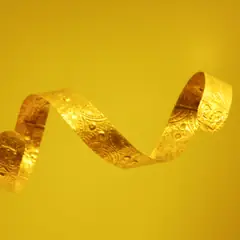
- Bolívar's gold garland — 47 laurel leaves, 60 diamond sparks and 49 baroque pearls
- The Rotunda — a circular third-floor room with large-format works
On 28 July 1823 Congress created by law a Museum of Natural History and School of Mining, and a year later, on 4 July 1824, Vice President Francisco de Paula Santander declared it open with barely two rooms. Its first director was the Peruvian mineralogist Mariano Eduardo de Rivero. That is how the National Museum of Colombia, the oldest in the country, was born, and that is how a life as a tenant also began that would last more than a century.
The history of the National Museum of Colombia is, above all, a history of moves. It passed through the Casa Botánica, now gone; through the Las Aulas building, from 1845 to 1913, which now houses the Museum of Colonial Art; through the Pasaje Rufino Cuervo, also gone, and through the fourth floor of the López building, on Avenida Jiménez, where it lived almost twenty years as a sublet next to the offices of the newly created Banco de la República. From 1934 it even shared a floor with the economics library that the bank opened to the public, the collection that in 1957 would have its own building as the Luis Ángel Arango Library. In those years, with Gerardo Arrubla as director, the museum stopped being mainly about natural history and botany and began to tell a broader history of the country.
The final destination was the most unexpected: a prison. Since 1948 the museum has occupied the Panopticon, the former Central Penitentiary of Cundinamarca, and the architecture of the National Museum of Colombia remains that of a prison, with its corridors, its bars and its punishment cells. What to see at the National Museum of Colombia, how life was lived within those walls and what happened on the day it was due to open are the threads of a five-stop route, documented and checked against historical sources, best listened to while walking the same passages the guards once watched.
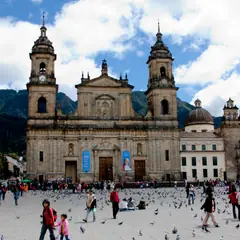
The city’s other great collection, some 34,000 pieces of Pre-Hispanic goldwork, is at the Gold Museum; the paintings the artist himself hung in La Candelaria await at the Botero Museum, and at the junction of Avenida Jiménez and Carrera Séptima stands the San Francisco Church.
A prison the city caught up with
National Museum of Colombia
Summary of this stop
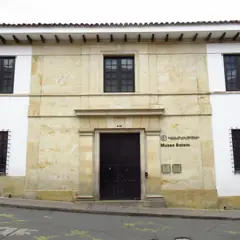
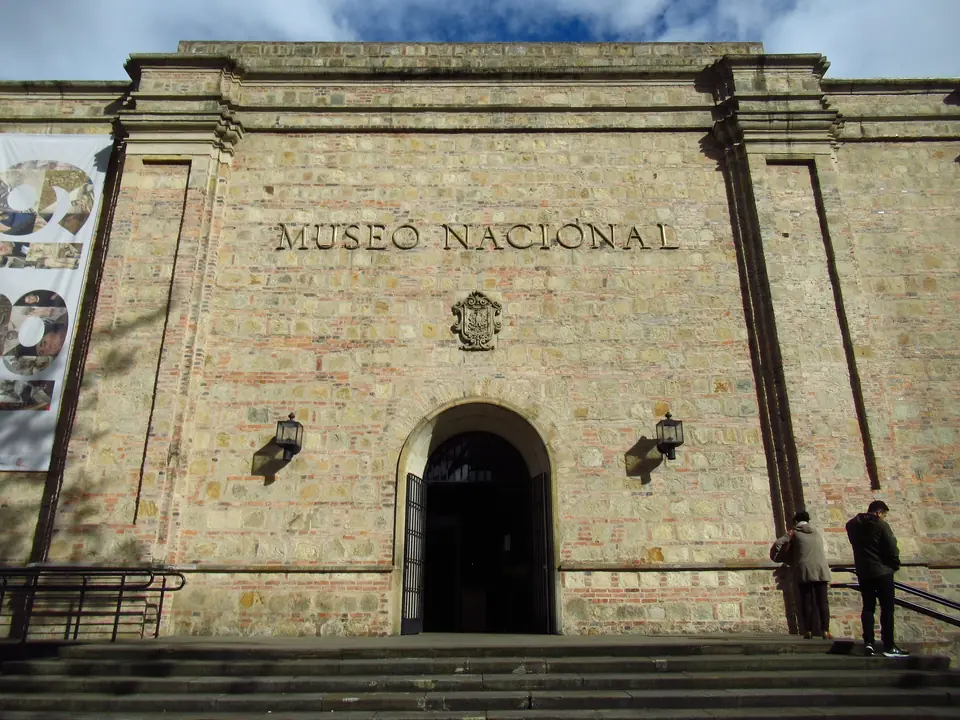
On Carrera Séptima, the stone facade looks like that of a ministry: twelve columns, an arch with black railings, the coat of arms of Bogotá and the sign “Museo Nacional” in golden capitals. Beside the corner with Calle 28, the bust of the painter Epifanio Garay serves as a meeting point. Nothing in that solemn front betrays that behind it stood the country’s most important prison for almost 72 years.
The building was designed in the 1850s by the Danish architect Thomas Reed, the same as the National Capitol, and according to most sources work began on 1 October 1874, although some put it back to 1872 or push it to 1875. It was built on the outskirts, as befitted a penitentiary. But Bogotá grew until it surrounded it, and that closeness to the centre, together with overcrowding, ended it: in March 1946 the Government assigned the building to the museum and on 12 April of that year the prisoners were transferred to the new La Picota prison.
Reading as a prison a facade that looks like a State office is the first surprise of the route, and the key to why it now stands in the very centre is told right there, in front of the stone.
An anvil fallen from the sky, watched by guards
Santa Rosa de Viterbo meteorite
Summary of this stop
Past the busts of Bolívar and Santander, which face each other on either side of the entrance corridor, the building’s plan opens into a cross. At the centre of the first floor, where the arms meet, the visitor takes the guard’s post: from there the rakes were commanded, the long corridors where the cells were and where the galleries now are. Despite its name, it is not the circular panopticon with a central tower imagined by Jeremy Bentham, but a radial panopticon; in 19th-century Colombia, “panopticon” was a synonym for a modern prison.
The penitentiary had 204 cells according to most sources (others say 207), eight dungeons and a large guardroom. On the first floor the carpentry, weaving, spinning and printing workshops operated; on the second and third the individual cells lined up, and in the shortest arm of the cross there was a chapel. The walls are of mixed stone and brick masonry, and the high arched corridors that were workshops are now exhibition rooms.
At that crossing waits the first piece the museum ever had: the Santa Rosa de Viterbo meteorite, a fragment of 411 kilos. It was found by Cecilia Corredor at Tocavita, in Boyacá, in 1810, and before being bought on 20 May 1823 for 20 piastres it served for years as an anvil in the village blacksmith’s. How a rock from space went from the blacksmith’s hammer to the watch of the guards is one of the stories the narration unpacks at this point.
A flower on the punishment wall
Flower drawn by a prisoner
Summary of this stop
At the four corners of the central crossing on the first floor are the “Solitarios”, punishment cells for state prisoners now turned into small thematic vaults. In the goldwork one, the drawing of a flower traced by a prisoner over a century ago is still on the wall, the most intimate trace of those who lived there.
The prison had its worst years during the Thousand Days’ War (1899-1902), when some 5,000 Liberal political prisoners arrived for only 207 cells; the overcrowding and damp earned it the nickname “La Gusanera”, the Worm Pit. The jurist and journalist Adolfo León Gómez, a prisoner then, described in “Secretos del Panóptico” a patio “dirty, long, badly bricked and extremely damp”. His testimony paints an unhealthy place; the curator Santiago Robledo adds nuance, noting that the archives show that the prison model with reform spaces was indeed applied, albeit with harsh punishments, above all for political prisoners. In the early 20th century, in an escape attempt in which Colonel Martiniano Arenas took part, the prisoner Jorge Pombo tore two bars from a grille; the inmates turned them into chisels and for several days attacked the stone of the wall, without managing to open it.
The wound of the prison also has an unexpected reading. When the Mamos, spiritual authorities of the Sierra Nevada de Santa Marta, visited the museum’s storerooms, they asked why those spirits were in prison. For them, the pieces were not objects but mediators with sacred places, separated from their meaning and shut in what had been a prison for men. That question changes the way of looking at every Indigenous object in the collection, and in the audio guide it takes on its full weight.
The garland that rode in a taxi on 9 April
Bolívar's gold garland
Summary of this stop
Turning the prison into a museum was the way to save it from demolition, an idea of Matoño Arboleda. Between 1946 and 1948 the architects Manuel de Vengoechea and Hernando Vargas Rubiano directed the adaptation: they added staircases and knocked down about 210 walls. On 11 August 1975 the building was declared a National Monument.
The inauguration was set for 9 April 1948, in the middle of the IX Pan-American Conference. That day, the assassination of Jorge Eliécer Gaitán set off the Bogotazo. Amid the chaos, the director Teresa Cuervo Borda carried Bolívar’s gold garland by taxi, wrapped in a newspaper, from the Banco de la República to the museum. The opening was postponed to 2 May 1948, the date given by most sources, with three museums in one: archaeology and ethnography on the first floor, history on the second and fine arts on the third.
In a second-floor display case shines that garland which the people of Cuzco offered Simón Bolívar in June 1825: a gold laurel crown with 47 leaves, a sun with 60 diamond sparks and 49 baroque pearls. Bolívar never put it on. What he did with it, and the road that brought it here, closes one of the most novelistic stops of the visit.
The Rotunda and the new overcrowding
The Rotunda
Summary of this stop
On the third floor, the Rotunda is a circular room with large-format works. From there the great irony of the building is understood: it closed for an excess of prisoners and today cannot hold its own pieces. Of some 27,129 works and objects only 6.3% is on display, and most of the collection’s 91 works by Fernando Botero remain in storage. Since 1994 an extension into the neighbouring grounds of the Colegio Mayor de Cundinamarca and the Instituto Policarpa Salavarrieta has been pending.
To this room returned in July 2026 “The Dove of Peace”, a Botero bronze of about 70 centimetres, painted white with a golden beak, which the artist donated to the country in 2016, in the middle of the peace process with the Farc. The piece had gone back and forth between the Casa de Nariño and the museum. On 6 October 2026, a student who leaned on the pedestal to take a photo knocked it over, and the dove fell from the third floor to the second. Nobody was hurt; the sculpture was left with a dented beak and scratched paint, and was removed to storage awaiting restoration.
A bronze dove that really flew is the finish of a route that begins in a prison and ends in a museum still looking for space. What that fall says about the building is told in the narration, at the very spot it fell from.