Citadel of the emirs
Ark of Bukhara Audio Guide (Buxoro arki)
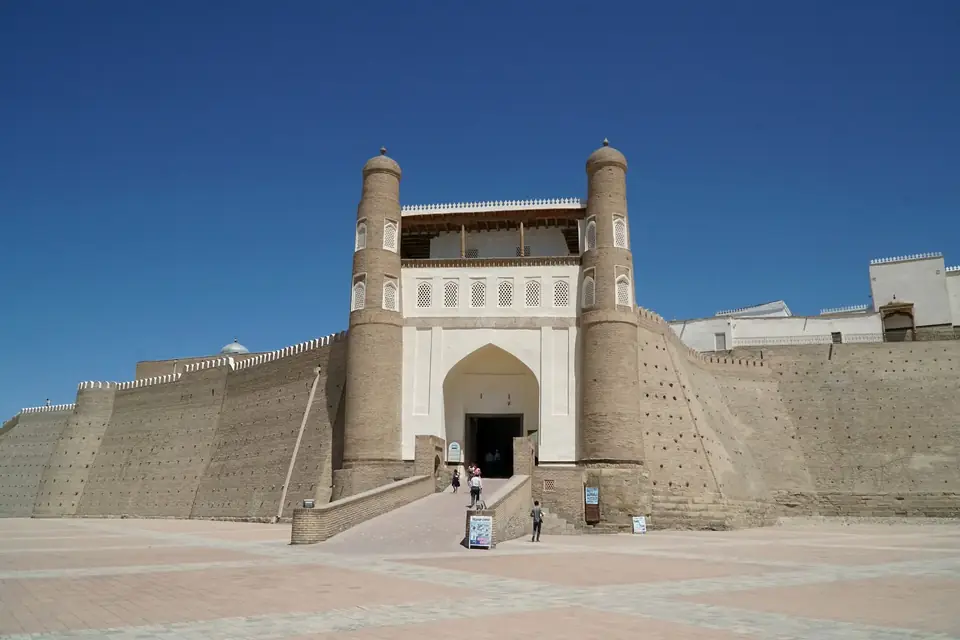
It is not a castle on a hill: it is the hill. More than twenty metres of stacked cities hold up the residence of Bukhara's rulers, which the 1920 bombardment left reduced to its great façade over the Registan.
- 75 min of audio
- Adobe citadel
The Ark of Bukhara, the city's citadel, has been its seat of power since its origins: the Bukhar Khudahs ruled from it, the Shaybanids rebuilt it in the 16th century and the emirs lived in it until 1920. Its walled enclosure has a perimeter of 789.6 metres, covers 3.96 hectares and raises walls of 16 to 20 metres above the Registan, although the figures change depending on the source. It is part of the Historic Centre of Bukhara, a World Heritage Site since 1993.
There is more history under your feet than above them. In the 1979–1980 test pit the cultural deposits exceeded 20 metres in thickness, a third of them underground, and between 16.5 and 18.5 metres down an adobe wall from the 4th–3rd centuries BC appeared. Above, the citadel housed Bukhara's first mosque, and what was left standing after 1920 now holds a museum with more than 140,000 items.
Highlights
- Gate of the two bastions — a lookout gallery over the Registan, attributed to 1742
- Dalon — the corridor of niches and the Navruz lamps for Siyavush
- Juma Mosque of the Ark — a wooden portico on the site of Bukhara's first mosque
- Kurinishjona — the throne courtyard where rulers were received and crowned
- Eastern half — the empty esplanade left by the 1920 bombardment
According to legend, the Ark fits inside the hide of a bull. Prince Siyavush, son of the Iranian king Kay Kavus, fled to Turan after rejecting his stepmother Sudabeh and there fell in love with Farangis, daughter of King Afrasiab, who set an impossible condition for the wedding: to build a palace that would fit inside a bull’s hide. Siyavush cut it into very fine strips, joined the ends and raised the fortress inside that outline. It is the same ruse that classical tradition attributes to Dido at the founding of Carthage, although here the ending is tragic: Afrasiab, jealous of his fame, ended up ordering his death, and his tomb lies beside the eastern gate of the Ark.
The history of the Ark of Bukhara that archaeology tells is just as vertical. Its age is disputed, and the versions run from the 3rd century BC to the 1st century BC, or to a rulers’ residence around the year 500. In the 7th century its fortifications were rebuilt; around 713, or 712 according to other sources, the Arabs built Bukhara’s first mosque here over a pre-Islamic temple; in the 16th century the Shaybanids remade the citadel, and the gate that now dominates the Registan is attributed to Nadir Shah, in 1742.
Inside these walls there are also stories nobody has been able to verify. One says that around 997 a very young Avicenna cured the Samanid emir Nuh ibn Mansur of a serious illness, was rewarded with access to the royal library kept in the Ark and, when it burned soon afterwards, his enemies accused him of setting it on fire to hide the sources of his learning. Another is tied to the small mosque of Ul’dukhtaron, “that of the Girls”: legend has it that forty young women were tortured there and thrown into a well.
The audio guide climbs the ramp and tours the citadel in five stops, from the square of punishment to the edge of the empty half, with documented narration checked against historical sources that saves for each courtyard the layer of history you cannot see at a glance.
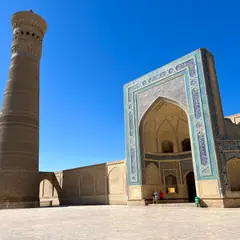
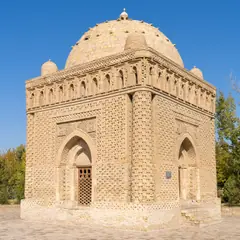
The Kalon Minaret, which the same 1920 assault robbed of almost half its lantern, appears some 500 metres to the southeast. To the west, in the park, the Samanid Mausoleum keeps the memory of a much older dynasty.
A lookout gate over the square of punishment
The Registan square
Summary of this stop
The tour starts at the Registan, the open esplanade at the foot of the western façade, once a space for markets, ceremony and punishment. Facing it rises the great front of sloping wall, the stretch that is still standing after 1920, and at its centre the gate of two raised bastions joined at the top by a balcony of six arcaded bays, from which the square was watched. A ramp some 20 metres long with stone railings climbs up to it. It is usually attributed to Nadir Shah, in 1742, although other sources date the pavilion that crowns it to the time of Abdulaziz Khan, in the 17th century, or take the great western gate back to the 16th.
On one of the walls of the Ark hung a great leather whip, the kamcha, a symbol of power in the Emirate of Bukhara. The square was also a court: on 24 June 1842 the British officers Charles Stoddart and Arthur Conolly were beheaded here on the orders of Emir Nasrullah Khan, accused of spying for the British Empire.
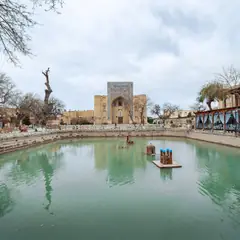
From the Registan you can also see the Bolo Hauz mosque, on the other side, and very close by the Zindan. How a lookout gate became the backdrop to the emir’s power is what the narration tells at the foot of the ramp.
The corridor of niches and Prince Siyavush
Dalon, the corridor of niches
Summary of this stop
Beyond the gate, the climb continues along the dalon, a long vaulted brick corridor that rises towards the interior and lets you feel the height of the hill in your legs. Rows of niches open along the sides, 12 on the left wall and 13 on the right, along with entrances to former storerooms and cells.
In the central niche on the right, lamps were lit at Navruz, the New Year, in honour of the spirit of Siyavush, the hero who according to legend drew the fortress out with a bull’s hide. The real scale of the enclosure makes the trick even more striking: 789.6 metres of perimeter and almost four hectares, according to the most cited measurement, although others speak of some 3 hectares or of 4.2.
Why a Muslim city kept lighting lamps for a pre-Islamic prince is one of the questions the corridor leaves hanging, and the narration answers it in its half-light.
A mosque over an older temple
Juma Mosque of the Ark
Summary of this stop
Beside the west wall stands the Juma Mosque of the Ark, the court mosque, with a portico of wooden columns, latticed windows and a ceiling decorated with geometric interlace. The place has a very long memory: the Arabs built Bukhara’s first mosque inside the Ark around 713, over a pre-Islamic temple, and at the end of the 8th century it was moved outside the citadel, between the Ark and the shahristan.
Under the portico, the ground hides even more. The 6 × 6 metre stratigraphic test pit of 1979–1980 cut through more than 20 metres of cultural deposits, a third of them underground, and between 16.5 and 18.5 metres down it came upon an adobe wall from the 4th–3rd centuries BC.
Islam did not wipe out everything that came before. Siyavush was venerated in Bukhara as a resurrected deity, and his cult stayed alive long after the arrival of the new faith. What the city’s men did every Navruz beside the hero’s tomb, at the eastern gate, is the detail the narration keeps for the portico.
A throne that moved to escape the cold
Kurinishjona reception courtyard
Summary of this stop
The courtyard of the Kurinishjona, the reception hall, is the stage of the court at its height: a paved courtyard with the throne platform, surrounded by galleries on wooden columns, where rulers were received and crowned. It was built under Subhan Quli Khan, who reigned between 1681 and 1702, as were the Friday mosque and the mehmonjona, the guest hall.
The throne was not always here. In December 1756 it was moved to a new tall building in the Ark, ordered by Muhammad Rahim, because of the cold. Much earlier, in the 7th century, tradition places in the citadel a palace of the Bukhar Khudahs whose plan reproduced the shape of the Big Dipper for magical purposes, surrounded by a chancery, treasury, prison and temple.
Of the palace of the stars no visible trace remains; of the court of the emirs, there is. How life was lived at the top of this hill is what the narration reconstructs in front of the throne platform.
The empty half left by 1220 and 1920
The razed eastern half
Summary of this stop
At the edge of the eastern esplanade the absence becomes visible: a large expanse of earth and foundation remains where the harem, the storerooms and the guard’s quarters once crowded together. On 2 September 1920 the last troops of the emirate entrenched themselves in the Ark; Mikhail Frunze ordered it bombarded with heavy artillery and aircraft, and the fortress, in ruins, surrendered the same day. The harem was the most damaged area and today is a mass of compacted clay that cannot be rebuilt. Some attribute part of the destruction to a demolition ordered by the emir himself, Muhammad Alim Khan, so that the Bolsheviks would not defile the harem, a version not all sources share.
The same edge holds a far older wound. In February 1220 Bukhara opened its gates to Genghis Khan after barely three days of siege, but a small group loyal to the Khwarazm shah shut themselves in the citadel and kept resisting. According to tradition, the Mongols opened a breach after ten days with siege engineers brought from China and incendiary and gunpowder weapons, and the citadel fell on the twelfth.
What was saved beside the west wall did not take up even a tenth of the area. Today it houses the state museum-reserve, with more than 140,000 items and, since May 2025, a room on the ancient and medieval history of the oasis created with the support of UNESCO and researchers from the Louvre. What became of those who resisted inside in 1220 is the last tale of the tour.