Covered bazaar of the 16th century
Jewellers' Dome Audio Guide (Toqi Zargaron)
A crossroads with a roof: the largest of Bukhara's covered bazaars, raised in the 16th century over the old junction of four bazaars. Under its bare brick, silver is still worked and sold.
- 25 min of audio
- Silk Road bazaar
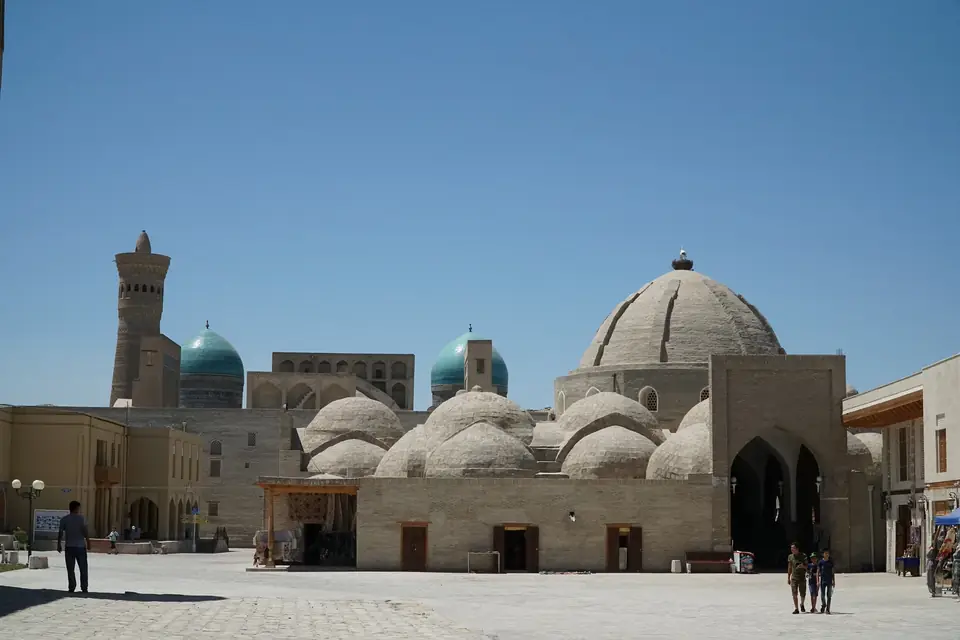
The Jewellers' Dome, the Toqi Zargaron, was raised in the second half of the 16th century over Bukhara's old Chorsu, the crossing of the main routes of the medieval shahristan where four bazaars met. It occupies a plan of 45.4 × 43.5 metres and reaches 16.7 metres in height, and its central dome, stretched upwards and reinforced with ribs, is unlike that of any other covered bazaar in the city.
It is the northernmost of the four commercial domes that survive in Bukhara, out of the six there were; two others fell in 1920, during the Red Army assault. Until the mid-20th century it worked as an ordinary bazaar, above all for jewellery, and after its restoration in the years of independence it houses workshops of jewellers and blacksmiths and stalls of spices, woodwork and antiques.
Highlights
- Ribbed central dome — the only one of its kind among Bukhara's covered bazaars
- Drum of 16 windows — the hall's only source of natural light
- 36 jewellers' workshops — made and sold in the same place
- Four vaulted passages — the trace of the old Chorsu of the four bazaars
- Brick without tiles — against the portals of the Ulugbek and Abdulaziz Khan madrasas
The Jewellers’ Dome is a building that has never stopped being a street. Two roads cross it from side to side, as they did when four bazaars met here, and under its vaults things have been made, sold, cried and eaten for centuries. When exactly that crossing was closed with a dome is another matter: the 16th-century chronicler Hafiz Tanish gives 1569–1570, other sources speak of 1582 or 1586–1587, and some hold that the building is basically 15th-century, remade entirely in the 16th.
The architecture of the Jewellers’ Dome is pure function: fired brick without decorative elements or majolica, an interior organised for trade that stays cool even on summer days. Around the great dome, a cluster of smaller domes, some with lanterns, covers the old workshops, and the shops extended from here to the neighbouring Ulugbek madrasa.
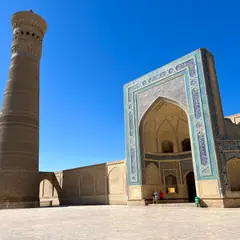
What to see at the Jewellers’ Dome also has its surroundings: a few metres to the west opens the Poi Kalon complex, with the minaret, the Kalon mosque and the Mir-i-Arab madrasa; to the east, the Ulugbek and Abdulaziz Khan madrasas, and some 300 metres to the south the Toqi Telpak Furushon, of 1570–1571, at a five-street junction.
The audio guide crosses the bazaar from west to east in four stops, with documented narration checked against historical sources, among the silversmiths’ galleries and out to the street of the madrasas.
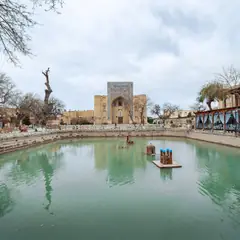
The square of Lyabi-Hauz, half a kilometre to the southeast, lived off the same trade, and just 150 metres to the west stands the Kalon Minaret, the tower that gives the Poi Kalon complex its name.
A dome over the old Chorsu
Toqi Zargaron
Summary of this stop
In front of the west arch, the building is understood at a glance as a crossroads. The great brick dome rises above the rooftops surrounded by a cluster of smaller domes, and the street enters beneath it. The four vaulted passages through which the two crossing roads arrive under the dome are the physical trace of the old Chorsu, the crossing of the main routes of the medieval shahristan where four bazaars met, the chahar suk.
The crossing was older than the roof. At the start of the 16th century it already worked as a chorsu, a covered commercial crossroads of Bukhara, according to the work of Zayn al-Din Vasifi, decades before Abdullah Khan II’s dome, which was raised in the second half of that century.
Bukhara came to have six commercial domes; four survive, and this is the northernmost. Two were lost in 1920, during the Red Army assault. Why this crossing deserved the largest and most complex dome of all is the question with which the narration opens the tour.
Thirty-six silver workshops
Galleries of workshops and shops
Summary of this stop
Under the side galleries there were 36 workshops and shops of jewellers, and around the building stalls, warehouses and caravanserais were built. Here things were made and sold in the same place: earrings, rings, weapon ornaments, engraved seals, beads and necklaces. According to a tradition the sources record with varying certainty, the tanga of Bukhara, the khanate’s coin, which from the 16th century to the early 20th was silver, was also minted here, at least in part.
In the 19th century about 400 jewellers lived in Bukhara, Uzbeks, Tajiks, Indians and Persians; the Indians ran small workshops for polishing and cutting gemstones, and the guild had its own place in this dome. It was an organised trade, with hierarchies, patron saints and a text of its own, the risola, a booklet with the legend of how the patron founded the craft and the prayers the craftsman had to say.
The technique, by contrast, was not learned from books, but in the usta-shogird relationship, an apprentice bound for years to a single master. That chain is still alive in today’s workshops, and the story of an apprentice of 1998 and his first piece is what the narration tells in the gallery.
Sixteen windows and a lost inscription
The ribbed central dome
Summary of this stop
After the compression of the galleries, the hall shoots upwards. The polygonal drum of the central dome, 14 metres across at the base, opens into 16 windows, the only source of natural light, and the dome is stretched and reinforced with ribs, a feature that sets it apart from the Toqi Sarrafon, the Toqi Telpak Furushon and the Tim Abdullah Khan.
This space was much more than a shop. Under the dome the decrees of Bukhara’s ruler were proclaimed, at the food stalls samsa, bread and hot dishes were sold, and Arab, Persian, Indian, Russian, Chinese and Turkish merchants passed through with Chinese silk, Kashmir shawls, gold-embroidered fabrics from Egypt, Arab prayer rugs and spices from Tibet.
At the base of the great dome there remains a fragment of a relief inscription that once ran around the whole perimeter of the building. What was lost with it, and why the plan is no longer the perfect square it once was, is what the narration reveals under the drum’s light.
The jewellers who worked outside
Ulugbek and Abdulaziz Khan madrasas
Summary of this stop
The east exit opens onto the street of the madrasas: on one side that of Ulugbek, which the bazaar’s shops reached, and opposite that of Abdulaziz Khan. The contrast is immediate: the bazaar is made of fired brick without decorative elements, organised by function, while the madrasas show tiled portals.
Until the mid-20th century the dome worked as an ordinary bazaar, above all for jewellery, and after the restoration of the independence years, since 1991, it houses craftsmen’s workshops and stalls of spices, woodwork, jewellery and antiques. In May 2022 it was also one of the venues of the first International Gold Embroidery and Jewellery Festival, held every two years and alternating with the Silk and Spices festival.
The final paradox lies on this very street: there was a time when the jewellers’ dome had no jewellers inside. What was sold under its vaults then, and where the guild worked, is the episode that closes the tour.