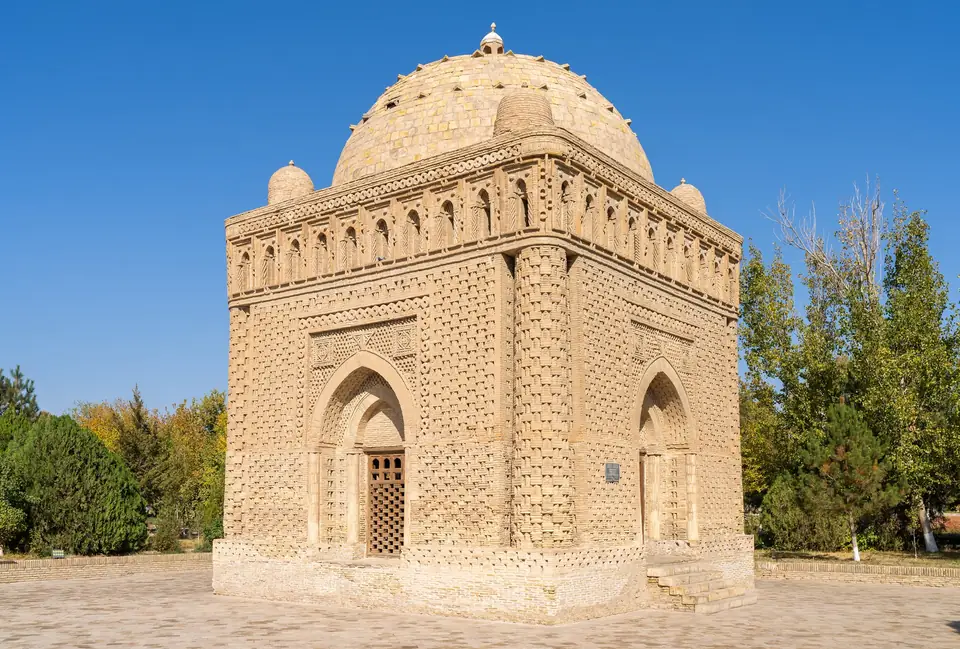
Samanid pantheon of the 10th century
Samanid Mausoleum Audio Guide (Somoniylar maqbarasi)
A brick cube barely ten metres on a side, without a single tile, woven like a basket. It is the oldest surviving domed mausoleum in the Islamic world, and it outlived Genghis Khan because mud had buried it.
- 30 min of audio
- 10th-century brick
The Samanid Mausoleum is the dynastic pantheon of the Samanids, built between 892 and 943 and linked above all to Ismail Samani, emir from 892 to 907. It measures 10.8 × 10.8 metres in plan, reaches 15 metres with the lantern and has walls 1.8 metres thick, all in fired brick that serves as structure and decoration at once. UNESCO singles it out within the Historic Centre of Bukhara, a World Heritage Site since 1993, as a masterpiece of 10th-century Muslim architecture.
The contrast is all around it. The building was part of a great Samanid necropolis with other mausoleums now vanished, and after the Second World War the cemetery that surrounded it was paved over to install an amusement park that still operates. A thousand years of funerary architecture thus coexist with the rides of a park that has borne the names of Kirov and of the Samanids.
Highlights
- Four twin façades — none is the main one
- Basket-weave brick — discs, rosettes and dog-tooth bands without a single tile
- Gallery of 40 small arches — and the 40 pearls of the forty saints
- Dome on squinches — one of the first in Islamic architecture
- The lost necropolis — under the paving of an amusement park
A royal pantheon barely ten metres on a side owes its life to having been buried. Before Genghis Khan’s troops besieged and sacked the city in 1220, floods and landslides had covered the Samanid Mausoleum in mud and sand, and the mud did what walls could not have done: it hid it from a destruction that razed almost every building of its time.
The history of the Samanid Mausoleum also has an unsolved riddle: who is buried here and for whom it was built. Some attribute it to the reign of Ismail Samani; a waqf document points to a tomb for his father, Ahmad ibn Asad, and an inscription found over the entrance bears the name of his grandson, Nasr II. It has also been argued that it was built after Ismail’s death. That is why the most cited date is a range, 892–943, and why the debate remains open.
The architecture of the Samanid Mausoleum explains why it became a model: four identical faces, engaged columns in the corners, a high gallery of small arches and a dome resting on four squinches. Its scheme reappears in the tomb of Sultan Sanjar in Merv, in that of Oljeitu in Soltaniyeh and in that of Timur in Samarkand. The symbolic readings, however, are at odds: some compare it to Zoroastrian fire temples, some link it to a sun cult and some interpret its plan as a mandala, with none having settled the question.
The audio guide circles the cube and enters it in four stops, with documented narration checked against historical sources, from the woven façades to the edge of the park’s pool.
The Magoki Attari Mosque, in the centre, shares with this cube the fate of having survived buried, and even an almost identical legend. About 800 metres to the east rises the Ark of Bukhara, the citadel of Bukhara’s rulers.
A royal pantheon the size of a house
Samanid Mausoleum
Summary of this stop
In front of any of its façades, the first surprise is the size: a royal pantheon 10.8 metres on a side with walls 1.8 metres thick, closer to a house than a palace. The four faces are twins, oriented to the cardinal points and leaning slightly inwards, each with its pointed-arch portal; none is the main one. Four thick three-quarter columns, engaged in the corners and without base or capital, give it the air of a small fortress.
Everything is fired brick, serving as structure and decoration at once, laid like the weave of a basket, with discs, four-petalled rosettes and dog-tooth bands. Beneath the cornice runs a gallery of small arches with ten openings per side, separated by slender columns enhanced with carved stucco, which lightens the weight and lets the light in.
Numbers have a second meaning here. The signs of nested squares flanking the entrance arches carry 40 rings like pearls, as many as the gallery has openings, and a popular belief links them to the chiltan, the forty protective saints. What invisible guard local tradition sees in those beads is what the narration reveals in front of the façade.
Saved from the Mongol by mud
Brick dome and lantern
Summary of this stop
Walking around the perimeter, the building shows how close it came to vanishing. Before Genghis Khan’s siege in 1220, the mud and sand of floods and landslides had buried it, and that is how it was saved. Local memory has preferred other versions: that the neighbours themselves covered it with sand so a cruel invader would not sack the shrine, or that the conqueror did not notice it among the mausoleums of a great cemetery. Another legend says the mud of the construction was kneaded with camel’s milk.
The oblivion repeated centuries later. At the start of the 20th century the brick vaults of a small cemetery covered it almost to a third of its height; that cemetery was removed during the restoration of 1937–1939 and the neighbouring houses were demolished in 1937. That work, directed by Boris Zasypkin with the Bukharan master Shirin Muradov, removed recent plaster, reused original bricks found in the excavations and stripped the late additions, except for the dome’s outer lining and the small brick lantern placed in 1925 over the oculus.
Above, the great hemispherical dome appears flanked by four small domes at the corners of the roof. When the building was truly rediscovered is a matter of debate among the sources, and the narration tells it while you walk around the cube.
Letters to a dead emir
Squinches and gravestones inside
Summary of this stop
In the centre of the inner chamber the building’s great technical achievement can be understood. At the four corners, decorated squinch arches form an octagon with four other arches, and on that eight-sided transition zone rests the dome: one of the first solutions of a dome on squinches in Islamic architecture.
The chamber also holds clues about who sleeps here. In the southeast corner there is a large gravestone, repaired several times, attributed to Ismail Samani. Over the main entrance there appeared, in the restoration of 1937–1939 or in 1940, a juniper board nailed to the lintel with a fragment of Arabic inscription, “… Nasr b. Ahmad b. Ismail”, the name of Nasr II, emir between 914 and 943. Three male tombs were found inside and only his is identified. And a copy, made around 1568, of a 10th-century waqf document, found in the 1930s, records that Ismail donated land from the Naukanda cemetery for a funerary building dedicated to his father, Ahmad ibn Asad.
In the midst of that silence sits the legend of the emir who kept ruling after death: petitions came in through an opening on the south side and the reply appeared the next day on the north side. Why one day the oracle fell silent is what is told under the dome.
A necropolis under the park
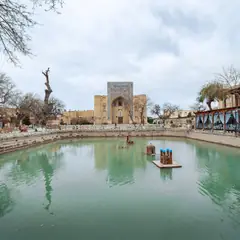
The park pool
Summary of this stop
To the southeast of the mausoleum, beside the recovered pool, the paving hides a city of the dead. The building was part of a great Samanid necropolis with other mausoleums now vanished; after the fall of the dynasty in 999 it dwindled, and the area was called successively Naukanda, Chahar-gumbazan, “four domes”, and Bahadur-biy, with residential districts built on top between the 16th and 18th centuries.
In the Soviet era, after the Second World War, the cemetery that surrounded the mausoleum was paved over and an amusement park was installed around it, which still operates, in the central park that bore the names of Kirov and of the Samanids. With it a festival also disappeared: after the New Year, in the cemetery beside the mazar of Ismail Samani, the sayli mazor was held for three days, a commemoration of the dead attended mostly by women.
Meanwhile, the humble cube travelled far from Bukhara as a pattern: its scheme inspired rulers’ tombs in Merv, Soltaniyeh and Samarkand, and even the Mazar-e-Quaid in Karachi, the tomb of Muhammad Ali Jinnah. How such a small building came to so much is the close of the tour.