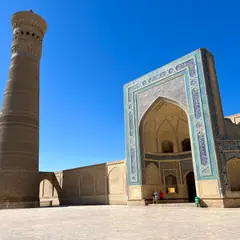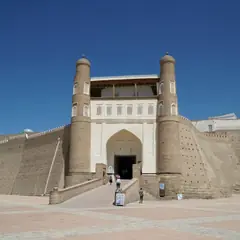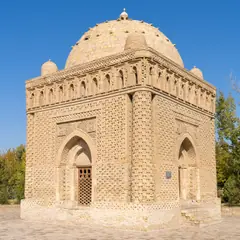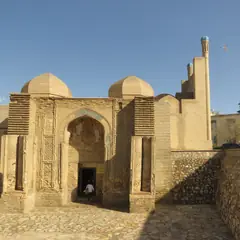
Pool and square of 1620
Lyabi-Hauz Audio Guide (Labi Hovuz)
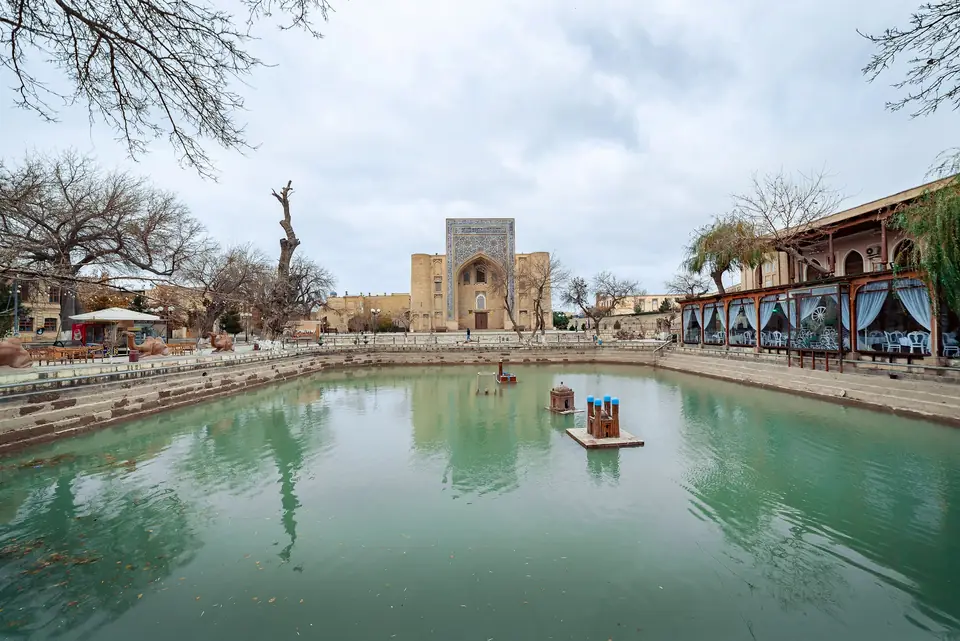
A pool of stepped stone in the shade of mulberry trees, between a dervish lodge and two madrasas. It is Bukhara's last great pool: the city drained almost all the others, its bed even became a sports pitch and only a fire brought the water back.
- 45 min of audio
- 17th-century pool
The Lyabi-Hauz was dug in 1619–1620 on the initiative and at the expense of Nadir Divan-Begi, vizier of Imam Quli Khan, who at the same time built the khanaka that bears his name. Its Persian name, Lab-i Hauz, means “beside the pool”: an octagonal basin of 42 × 36 metres and up to 5 metres deep, with walls of stone steps, that could hold more than 4,000 m³ of water arriving through the canal network and had no drain.
Around it is arranged one of the most complete ensembles in the city: to the north the Kukeldash madrasa, the oldest building on the square; to the west the khanaka of Nadir Divan-Begi, and to the east his madrasa, with a portal of fabulous birds and a sun with a human face unusual in an Islamic monument. Between them, Khoja Nasreddin rides in bronze on his donkey.
Highlights
- Stepped pool — 42 × 36 metres of stone and the legend of the widow who would not sell
- Nadir Divan-Begi Khanaka — the dhikr hall under the dome
- Perimeter fountain — the water that came back after the Gastronom fire
- Kukeldash Madrasa — school, caravanserai, fortress and place of executions
- Simurgh portal and Nasreddin — fabulous birds, a sun with a face and a bronze donkey
There was a time when Bukhara drank from its pools. The city had many hauzes like this one, its main source of water and also a source of disease, and in the 1920s and 1930s most were filled in. The Lyabi-Hauz was kept as the centre of its architectural ensemble, although the sources do not agree on whether it escaped the draining or whether it too dried up and was only refilled decades later. Either version makes it a survivor.
The history of the Lyabi-Hauz begins in 1619–1620, when Nadir Divan-Begi, vizier of Imam Quli Khan and a member of the Uzbek Arlat clan, paid for the pool and the neighbouring khanaka, and continues in 1622–1623 with the madrasa he built opposite. The water arrived by the Shahrud canal and water-carriers loaded it from the bank to sprinkle the streets and for drinking, beside a bazaar, a teahouse and barbershops in the shade of the mulberry trees. The sources differ on the vizier’s relationship to the ruler, uncle or brother, and on some dates of the complex.
What to see at the Lyabi-Hauz is spread around the water: the khanaka to the west, in line with the pool and with the madrasa to the east; the great Kukeldash madrasa to the north, with its courtyard taken over by workshops and craft shops; the jets of the fountain that keep the water moving, and the statue of Nasreddin, a constant photo spot. Beside the Kukeldash, an open space recalls the small Qazi-e Kalan Nasreddin madrasa, now demolished.
The audio guide circles the pool in five stops, with documented narration checked against historical sources, to tell how Bukhara drank, prayed, traded and enjoyed itself on the water’s edge.
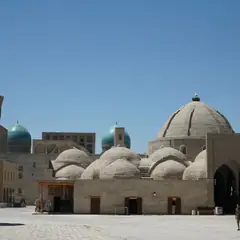
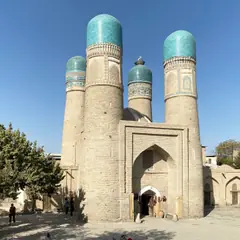
In the residential district northeast of the pool hides Chor Minor, the gateway of the four blue towers. Half a kilometre to the northwest, the Jewellers’ Dome recalls the street of bazaars that gave life to this square.
Steps that go down to the water
Labi Hovuz
Summary of this stop
From the southwest bank, the water appears set in its stone basin, with edges in flights of steps that go down to it. The measurements vary by source: 42 × 36 metres and an octagonal plan in one version, 46 × 36 and a rectangular plan in another, with more than 4,000 m³ of capacity and up to 5 metres of depth. It had no drain: the water came in from the Shahrud canal and went out in the water-carriers’ jugs.
The name, Lab-i Hauz, means “beside the pool” in Persian, but popular memory keeps a second nickname for it, Hauz-i Bazur, “the pool made by force”. Behind it is a documented tradition: a good part of the site belonged to an elderly Jewish widow who did not want to sell, the ruler’s muftis ruled that there was no legal way to buy her property without her consent and the vizier had a ditch dug beside her house, though it cost him more, until the water began to undermine the foundations.
The widow ended up giving in, but not at just any price. What she asked for in return, and what was born of that deal in another part of the city, is the story with which the narration opens the tour.
The dervish lodge across the water
Nadir Divan-Begi Khanaka
Summary of this stop
To the west, in line with the pool and with the madrasa opposite, stands the khanaka of Nadir Divan-Begi, a Sufi dervish lodge of 27.5 × 25 metres. Its front shows a tall, narrow portal and two towers fluted diagonally at the corners; inside, the central dhikr hall, 11.2 metres on a side, sits under the dome, and the roof adds up to 28 small domes.
Pool, khanaka and madrasa form an axis conceived by a single patron, the vizier who in 1619–1620 paid at once for the water and this house of prayer. What can be seen today, however, is not exactly what he built: between 1914 and 1916 the last emir of Bukhara, Sayyid Mir Muhammad Alim Khan, undertook the khanaka’s last great restoration, which altered the original look of its walls, and in 1978 it was renovated again.
The contrast between the bustle of the terraces and the silence of the dhikr hall is what the narration explores in front of the façade.
A pool that almost became a pitch
The pool's perimeter fountain
Summary of this stop
On the north bank, the jets coming out of the pipe laid around the pool look like simple decoration. They are, in fact, the scar of a near disappearance. Until the Soviet era Bukhara had many pools like this one, and most were filled in during the 1920s and 1930s.
This one was kept, but not always full. After the Second World War the Lyabi-Hauz was empty and its bed became a sports pitch where volleyball matches were played and kurash, traditional Uzbek wrestling, bouts were fought. The sources disagree here: one version holds that it escaped the draining of the 1920s because of the ensemble’s artistic value; another, that it dried up like the rest.
The water came back out of an emergency. What burned in the 1950s and why that fire forced the city to fill the pool again is the episode the narration tells beside the fountain.
The madrasa of a thousand lives
Kukeldash Madrasa
Summary of this stop
To the north rises the Kukeldash madrasa, the oldest building on the square: it was built in 1568–1569 by Kulbaba Kukeldash, a dignitary of Abdullah Khan II, as a rectangle of 86 × 69 metres with a mosque, a lecture hall and 160 cells. Its green and blue mosaic portal opens onto a courtyard now taken up by workshops and craft shops.
Few schools have had so many lives. Throughout its history the Kukeldash also served as a caravanserai, a defensive fortress and even a place of executions, and the outer row of the ground floor was let to the city’s shopkeepers. It is no surprise: in the Middle Ages the Lyabi-Hauz was a very busy commercial square, near the main street of trade and its market domes, one of them 200 metres away, and one of the few open spaces of a crowded city.
That caravan pulse returns every late spring with the international Silk and Spices festival, which in 2018 reached its seventeenth edition with a parade of horses and camels and concerts on a stage beside the pool. How school and market mingle here is what is told before the portal.
Simurghs, a sun with a face and Nasreddin
Khoja Nasreddin monument
Summary of this stop
The madrasa of Nadir Divan-Begi, to the east, began as something else. It was built in 1622–1623 as a caravanserai, but at the inauguration Imam Quli Khan proclaimed that it would be a madrasa, and the vizier had to add loggias, a portal, corner towers and an extra floor of cells. That is why it lacks a mosque and a lecture hall.
Its portal is a rarity: two simurghs, fabulous birds, carry white deer towards a sun with a human face, a figuration unusual in Islamic monuments that closely follows the Sher-Dor madrasa in Samarkand, begun in 1619.
Between the khanaka and the madrasa, Khoja Nasreddin rides his donkey in a statue installed in 1979 to a design by the sculptor Yakov Shapiro. Uzbeks hold him to have been born in Bukhara, and his anecdotes entered UNESCO’s intangible heritage list in 2022. In the city it is believed that sitting a child on the donkey ensures a life full of joy, so the bronze animal is rarely free. The gold coin the joker shows with a smile comes from a story with a moneylender and this very pool, and it is the humorous finale of the tour.