Sunken mosque of the 12th century
Magoki Attari Mosque Audio Guide (Mag'oki Attori masjidi)
A mosque you find by looking down: its floor lies about four and a half metres below the street. Beneath it was a bazaar of idols, above it the city grew, and its 12th-century portal stayed buried until the 1930s.
- 30 min of audio
- Mosque and carpet museum
The Magoki Attari Mosque stands on the site of a pre-Islamic bazaar of idols, potions and spices, where archaeology also identified a fire-worshippers' temple later adapted as a mosque. The building that has come down to us dates from the second half of the 12th century, under the Karakhanids, with a reconstruction in 1546 that replaced the round columns with square piers carrying double domes and faced the mihrab in marble.
The name says it all: maghaki means “in the pit” in Persian, and around 950 Narshakhi already called it that because half the building was hidden by the ground. In the 16th century it was known as Magoki Attari, “pit of the apothecaries”. Since 1991 its prayer hall has housed the carpet museum, with Uzbek, Turkmen, Persian, Kazakh and Armenian pieces from the 18th to the 20th centuries.
Highlights
- The drop to the street — 4.5 metres between today's city and that of the 12th century
- Karakhanid south portal — brick dodecagons over alabaster birds
- The scrambled blue inscription — a text no one can read any more
- 1546 east portal — the entrance hanging over the strata
- Carpet museum — 18th- to 20th-century carpets and saddlebags under twelve domes
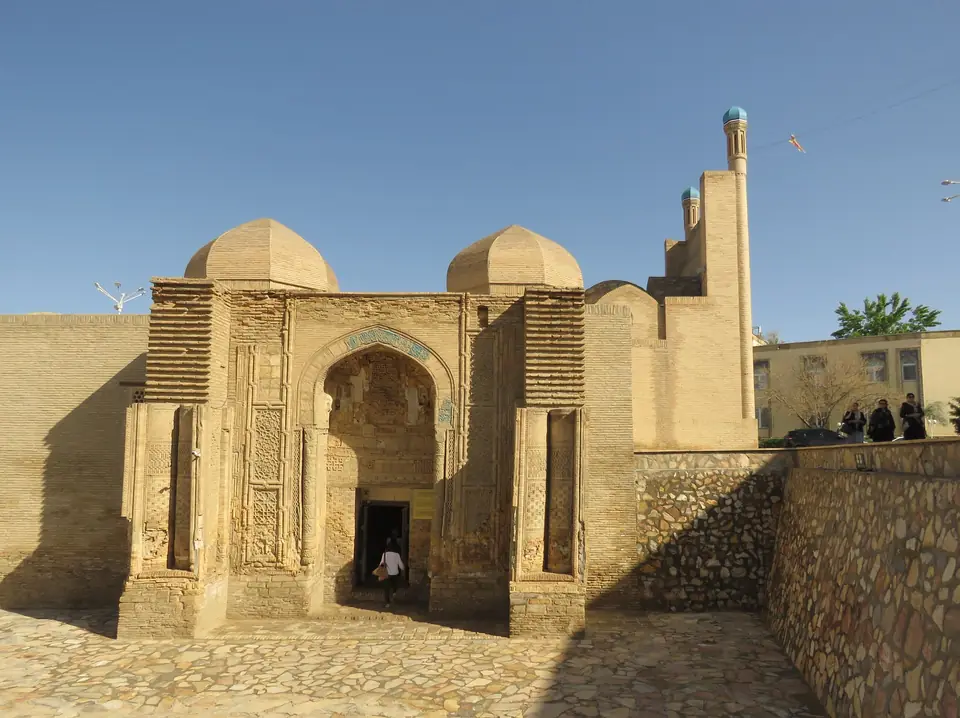
In Bukhara, the city did not tear this building down: it gradually swallowed it. The Magoki Attari Mosque ended up, century after century, below streets that kept rising around it, until at the start of the 20th century only its half-ruined domes and part of a portal showed. Today the square around it corresponds to the level of the 12th-century city, and going down to its door is going down through the strata of Bukhara.
The history of the Magoki Attari Mosque reads in layers. The lower mosque, with brick walls and a flat roof on carved wooden columns, burned in the great fire of 937; the one rebuilt afterwards was smaller; in the second half of the 12th century the Karakhanids raised the floor and gave the south façade a new design, and in 1546 another reconstruction swapped columns for piers. Its foundation is disputed: the official tourism website links it to the year 714 and Qutayba ibn Muslim, while other sources place the first mosque in the Samanid period, in the 9th and 10th centuries.
What to see at the Magoki Attari Mosque is ordered from top to bottom: the pit from which the drop is measured, the south portal of brick and alabaster, the east portal with its stairway, the two octagonal-drum domes that rise above the flat roof and, below, the hall of six piers and twelve bays of domes with the mihrab niche in the west wall.
The audio guide goes down from the street to the original level in four stops, with documented narration checked against historical sources, from the edge of the pit to the prayer hall.
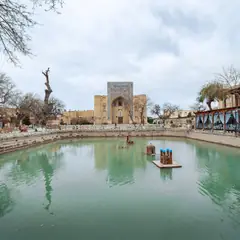
The same legend of neighbours throwing sand over a building to hide it from the invader is told of the Samanid Mausoleum, at the other end of the old town. Less than 200 metres away is the pool of Lyabi-Hauz, and a little further, to the northeast, the gateway of Chor Minor.
A bazaar of idols at the bottom of the pit
Magoki Attari Mosque
Summary of this stop
From the edge of the pit, the body understands the drop before the head does: the mosque’s floor is about 4.50 metres below the present surface. Hence the Persian name maghaki, “in the pit”, and around 950 Narshakhi already called it maghak because half the building was hidden by the ground.
That hollow was a pre-Islamic bazaar of idols, potions and spices, of attor, perfumes. At the Makh bazaar a one-day fair devoted to buying and selling idols was held twice a year, and according to Narshakhi’s History of Bukhara, finished in 943–944, the custom continued after the Islamic conquest and moved more than 50,000 dirhams a day. Archaeology also identified on the same spot a fire-worshippers’ temple that was later adapted as a mosque.
At the start of the 20th century the mosque was buried almost to the roof. The south portal was dug out in the works of 1934–1935, and V. A. Shishkin’s excavation could not go below 12 metres because of groundwater. A popular legend blames the burial on the neighbours, who supposedly covered the mosque with sand to hide it from the Mongols; why that story does not quite fit the place’s old name is what the narration raises at the edge of the pit.
Alabaster birds and a scrambled inscription
Karakhanid south portal
Summary of this stop
The great find of the site is the south portal, the main façade raised in the second half of the 12th century under the Karakhanids, when the floor level was raised and the front redesigned. It is shifted to the east and lacks its main arch, which collapsed in the 15th century; what remains is a pointed-arch niche on quarter-columns, with a half-dome and muqarnas in the corners.
On both sides, brick panels with interlaced dodecagons stand out against a background of carved alabaster with birds stylised almost to abstraction, and an inscription of blue-glazed terracotta runs around the inner arch. The epigraphic tiles on the walls of the niche, by contrast, were mixed up in one of the mosque’s great repairs, and their text can no longer be read.
In the outer niches melted candles and remains of small fires often appear. What reading Uzbek popular culture makes of them, on the very site of an old fire temple, is what is told in front of the portal.
The door a sheikh saved
16th-century east portal
Summary of this stop
To the east, a small 16th-century portal, remade in the early 20th, rests on the historical strata. Since the outside ground had already risen, at that time the entrance was opened in the upper part of the east wall, and from it a rough stairway descends to the hall, taking up almost half its length. Inside remain traces of the dedicatory inscription, in yellow letters on a blue ground, dating the reconstruction to 1546; other sources say 1547.
That reconstruction almost did not happen. During Abdulaziz Khan’s great remodelling of the district, between 1540 and 1550, the mosque, already sunk into the ground, was going to be demolished. It was saved by the Naqshbandi sheikh Makhdumi Azam, Ahmad Kasani, who used to pray and meditate in it. The round columns were then replaced by square piers supporting double domes, and the mihrab niche was faced in marble.
The building also changed its name over the centuries: Mah, “moon”, between the 9th and 13th centuries; Magok or Magoki Attari, “pit of the apothecaries”, in the 16th, and Magoki Kuhna, “old Magok”, in the 17th, to tell it apart from the Magoki Kurpa mosque, some 150 metres to the northwest. How a Sufi saint overturned a khan’s plans is what the narration tells at this door.
A prayer hall turned into a carpet display
Pier hall and mihrab
Summary of this stop
Below, six rectangular piers divide the hall into twelve bays covered with domes, and in the centre of the west wall opens the mihrab niche. Since 1991 the hall has housed the carpet museum exhibition: carpets, palases, saddlebags or jurchin and yurt ornaments, Uzbek, Turkmen, Persian, Kazakh and Armenian, from the 18th to the 20th centuries.
Under those domes several memories overlap. The lower mosque burned in the great fire of 937, and the one rebuilt afterwards had round columns and carved, painted ganch. According to tradition, before Bukhara had its first synagogue Jews prayed in the same hall as Muslims, at the same time in different corners or after the Muslim prayers ended, depending on the version, and this is credited for the custom of Bukharan Jews of closing the morning prayer with “Shalom aleichem”.
In one corner, a couple of steps reveal a stretch of the excavation of the 1930s, which was interpreted as the remains of a Zoroastrian temple ruined by the Arabs and of a Buddhist temple, a reading not all sources share. What can be seen there is the last stratum of the tour.