Four-tower gateway of 1807
Chor Minor Audio Guide
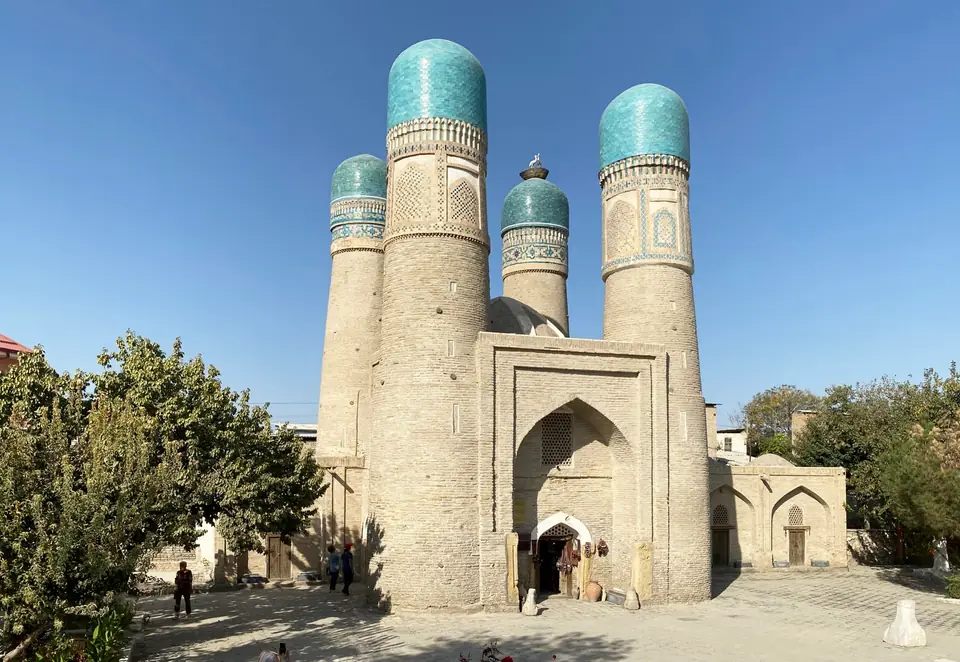
Four blue-domed turrets, no two alike, on a two-storey gateway hidden in an alley of low houses. It is almost all that remains of a madrasa of 1807, and nobody knows for certain what its builder meant by it.
- 20 min of audio
- Madrasa of 1807
Chor Minor is the gatehouse of the madrasa that Khalifa Niyazkul, a wealthy Bukharan of Turkmen origin and imam-khatib of the Kalyan mosque, the largest in the capital, ordered built in 1807, during the reign of Emir Haidar. Below there is a vaulted vestibule with a stone plinth; above, a library under a shallow dome with a ring of muqarnas. It is part of the Historic Centre of Bukhara inscribed by UNESCO.
Its name speaks of minarets, but the four towers are not: three served as storerooms and the fourth holds the staircase to the upper floor. Each has its own shape and decoration, and among their motifs you can make out forms resembling a cross, a Christian fish and a Buddhist prayer wheel. From there come the readings: four religions, four dynasties or, according to legend, four daughters.
Highlights
- Four blue-domed towers — each with its own shape and decoration
- Cross, fish and wheel motifs — the riddle of the four religions
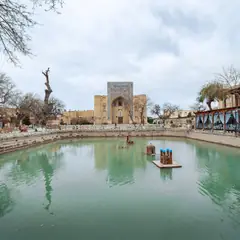
- Stone hauz — the pool that survives from the madrasa of 1807
- Southeast tower — brought down by an underground stream in 1995 and rebuilt in 1997
- Dhikr hall — a dome made for Sufi chanting
Chor Minor has a name that sounds almost the same as the Charminar of Hyderabad, the Indian monument of four minarets, and the idea circulates that its patron came to know Indian architecture on his travels and brought the image back to an alley in Bukhara. It is only one reading of a building that has no analogues in Bukharan architecture. Others see in its four towers four religions, or four dynasties of Bukhara: Samanids, Karakhanids, Shaybanids and Mangits. The real intention of Khalifa Niyazkul is not documented.
The history of Chor Minor is one of disappearance. The complete madrasa was far more than this gateway, and it functioned until the arrival of Soviet power; then its cells became homes, part of the complex was dismantled to reuse the bricks and its mosque ended up demolished. The usual date is 1807, although some give 1805–1806 as the first mention, and the Bukhara heritage inspectorate maintains that, according to archive documents, a Niyazkul madrasa already existed at the end of the 17th century, something hard to square with the reign of Haidar.
What to see at Chor Minor fits on one esplanade: the four towers, the stone pool to the right of the gateway, a few surviving cells and the vestibule where a craft shop now operates. It lies off the monumental axis, in a district of private houses and small stalls, and the audio guide covers it in four stops, with documented narration checked against historical sources.
About 600 metres to the southwest lies the pool of Lyabi-Hauz, with its own dervish lodge, and a little further on the Magoki Attari Mosque, sunk below street level.
Four blue domes that never repeat
Chor Minor
Summary of this stop
From the esplanade, the four towers can be compared one by one: each turret has its own shape and decoration, and all end in a small blue-tiled dome. In the panels of brick and tile you look for forms resembling a cross, a Christian fish and a Buddhist prayer wheel.
The patron was Khalifa Niyazkul, a wealthy Bukharan of Turkmen origin who was imam-khatib of the Kalyan mosque, the largest in the capital. He had the building raised in 1807, under the Mangit dynasty, during the reign of Emir Haidar, between 1800 and 1826.
Against the solemn readings, legend offers a more intimate explanation: the rich merchant who paid for the work had four daughters and dedicated one tower to each. How the four girls fit with the four designs is what the narration tells in front of the gateway.
A stone pool for horses and students
The stone hauz
Summary of this stop
To the right of the gateway lies a hauz, a rectangular pool lined with stone blocks, probably from the same period as the 1807 complex. It is one of the few pieces that let you imagine what stood behind.
Where today there are only neighbourhood houses, an irregular courtyard stretched out, surrounded by a single storey of 59 cells, the hujras, large and small, with a timber-framed mosque in the southwest corner: a layout foreign to the canonical scheme of Bukharan madrasas. In the southern part of the enclosure there were stables where the famed Karabair horses of the Turkmen and of Karshi, brought for sale, were kept, next to a large garden of which a part remains.
Students, horses and water in a single enclosure: how it all fitted together is what the narration reconstructs beside the pool.
The tower that swallowed the water in 1995
The rebuilt southeast tower
Summary of this stop
The southeast tower has more recent fabric than the others, and the reason lies underground. In 1995 an underground stream undermined it and brought it down, and the collapse destabilised the whole structure. On 1 September of that year the World Heritage Fund approved emergency assistance of 50,000 dollars, and the tower was rebuilt in 1997 with UNESCO support; the others had already been restored in 1968 and in the 1980s and 1990s. On the quality of that reconstruction the sources disagree.
The wound went back further. After the arrival of Soviet power the cells were used as homes, and in the 1950s, according to some sources, part of the complex and its mosque were dismantled to reuse the bricks. In 1961–1962 the neighbours living in the cells were rehoused in two new buildings, and the mosque, used as a salt store, fell into ruin and was demolished; some cells were rebuilt afterwards as a showpiece.
At the top of one of the towers there is now an artificial nest. Whom it recalls, and why its absence was felt as a loss of luck, is the detail with which the narration closes this stop.
A dome made for Sufi chanting
The darvozakhona vestibule
Summary of this stop
The gateway is the darvozakhona, the two-storey entrance house: below, a vaulted vestibule with a stone plinth; above, a library under a shallow dome with a ring of simple muqarnas, reached by the staircase housed in one of the towers. The other three were storerooms, and all are topped with blue-tiled domes.
The room under the dome has good acoustics and functioned as a dhikr-khana, the place for Sufi dhikr ceremonies, with recitation, chanting and music: the madrasa was one of the Sufi centres of Bukhara. Some sources even dispute what the building was, whether a simple gatehouse or the core of a mosque with ritual and lodging functions.
Today the vestibule houses a shop of folk crafts, antiques and souvenirs, and the monument is part of the Historic Centre of Bukhara inscribed by UNESCO. How that dome still resonates is what the narration leaves for the end.