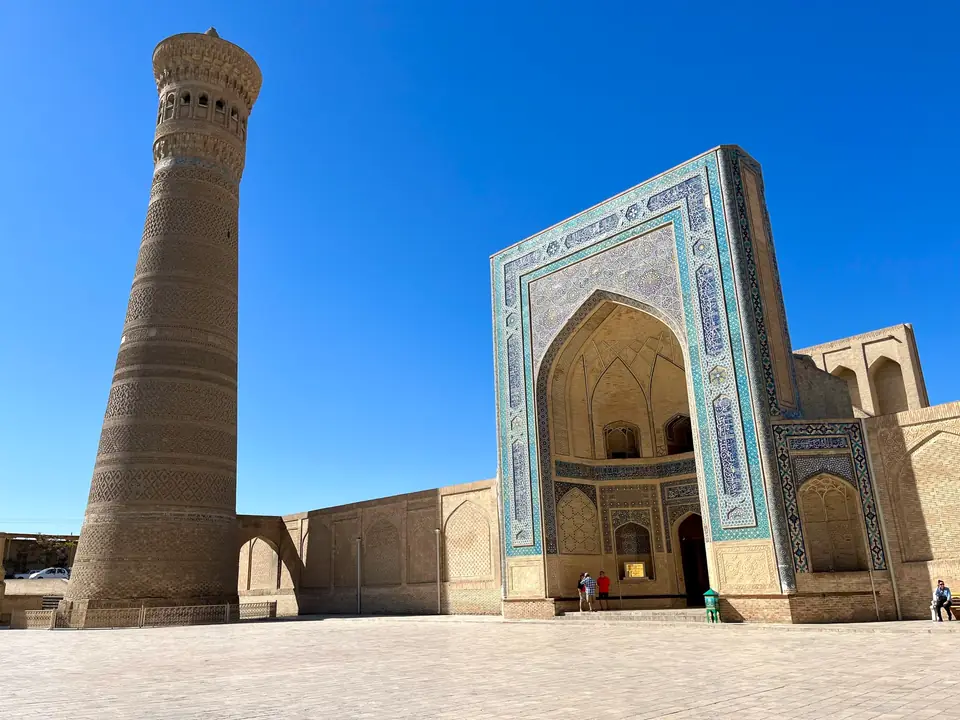
Karakhanid tower of 1127
Kalon Minaret Audio Guide (Minorai Kalon)
For almost nine centuries this fired-brick tower has ruled over the heart of Bukhara. Genghis Khan razed the mosque beside it, a shell in 1920 tore away nearly half its lantern and the whole square is still called “at the feet of the Great One”.
- 40 min of audio
- Karakhanid brick
The Kalon Minaret was built in 1127 by the Karakhanid ruler Mohammad Arslan Khan, to a design by the master Bako, to call the faithful to prayer five times a day. It was the second attempt: a first tower topped with a wooden lantern collapsed soon after completion, and the new one was made entirely of fired brick. The shaft reaches 46.5 metres and measures 9.7 metres across at the base; in Central Asia only the Kutlug-Timur minaret, in Konye-Urgench, starts from a wider base.
Not a single motif repeats on its brick skin: parallel carved bands climb, narrowing, to a lantern of 16 arches girdled by a turquoise strip, the only colour on the whole tower. From there the call to prayer was made, the horizon was watched and townspeople were summoned to hear decrees read. It also carries a nickname, Tower of Death, that the sources do not manage to confirm.
Highlights
- 46.5-metre shaft — carved brick bands with no repeated motif
- Ten-sided pedestal — a foundation that a 13-metre excavation did not reach
- 16-arch lantern — the turquoise band and the cornice mutilated in 1920
- Tower of Death — a disputed nickname and the legend of a condemned woman who survived
- Poi Kalon square — the Kalon mosque of 1515 and the Mir-i-Arab madrasa face to face
There is a legend that turns the Kalon Minaret into an apology. According to it, Arslan Khan killed an imam in a dispute, and that same night the victim appeared to him in a dream with a request: that his head should rest in a place where no one could step on it. The khan would then have raised the tower over his grave. The documented story is less novelistic, but just as stubborn: in 1127 the Karakhanid ruler commissioned the master Bako to build a minaret for Bukhara’s Friday mosque, after a first tower, crowned by a wooden lantern, collapsed soon after it was finished.
The history of the Kalon Minaret is that of a survivor. In 1220 Genghis Khan’s troops destroyed the original mosque beside it, and the tower was the only part of the complex left standing. Why it was spared is told in several ways: some versions say the conqueror ordered it respected, others that he took the mosque for a khan’s palace and that, even so, it burned entirely except for the minaret. Seven centuries later, in the Red Army assault of 1920, a shell took away almost half the lantern.
The architecture of the Kalon Minaret is pure brick engineering: fired bricks of 27 × 27 × 5 centimetres bound with gypsum mortar that, over the centuries, have fused into an almost monolithic mass. The figures vary by source, from 45.6 to “nearly 50” metres in height and 104 or 105 steps in the inner staircase, and even the master’s name appears as Bako, Baqo or Baqol. What to see around it also has its logic: Poi Kalon square was laid out at its feet, with the Kalon mosque on one side and the Mir-i-Arab madrasa opposite.
The audio guide tours the tower and its square in four stops, with documented narration checked against historical sources: from the ten-sided base to the lantern, and from there to the two buildings that grew up in its shadow.
The same 1920 offensive that mutilated the lantern left the Ark of Bukhara in ruins, some 500 metres to the northwest. And barely 150 metres to the east, the Jewellers’ Dome covers the old crossroads of the bazaars.
At the feet of the Great One, the rebuilt tower
Po-i-Kalyan
Summary of this stop
Poi Kalon square owes its name to the tower: “at the feet of the Great One”. From the paving, the first impact is one of scale. The shaft rises 46.5 metres and is 9.7 metres across at the base, with a perimeter of 30.43 metres; at about 32 metres up it narrows to 6. No minaret in Central Asia, except that of Kutlug-Timur in Konye-Urgench, starts from a wider base.
That solidity has an explanation: it is the second tower. Mohammad Arslan Khan had it built in 1127 to a design by the master Bako to call the faithful to prayer five times a day, after the first, topped with a wooden lantern, came down soon after it was finished. The new one was raised entirely in fired brick.
About its origin there is also the legend of the murdered imam and the grave no one was supposed to step on. What that burial has to do with the base from which the shaft rises is what the narration leaves for this first point.
A bottomless foundation and Bako’s wager
The ten-sided pedestal
Summary of this stop
At the foot of the tower rises a ten-sided pedestal of more than 185 centimetres, which you can touch from the square’s floor. It is made, like everything else, of fired bricks of 27 × 27 × 5 centimetres bound with gypsum mortar. Below it the mystery begins: a 13-metre excavation did not reach the base of the foundation, whose depth is still unknown. In 1960 the master Ochil Bobomurodov repaired and reinforced that underground part.
Tradition attributes that firmness to a trick. It says Bako kneaded the foundation mortar with alabaster and camel’s milk and, as soon as he finished, vanished from Bukhara. He came back two years later, when the foundation had already hardened, and only then went on building the tower.
What is documented is his tomb: the architect was buried 45 metres from the minaret, in the place he himself indicated in his will. What, according to tradition, that will added is the wager that gives this stop its title.
The lantern: call, watchtower and Tower of Death
The 16-arch lantern
Summary of this stop
From beneath the arched bridge that joins the tower to the roof of the Kalon mosque, the summit reads well. The exterior is clad in parallel bands of carved brick with no motif repeated, and the tower culminates in a rotunda lantern of 16 open arches, with a turquoise band of inscriptions beneath the muqarnas. From there the adhan, the call to prayer, went out, but the tower also served as a guard watchtower and as a beacon visible far beyond the city.
The cornice holds a scar. In the Red Army assault on Bukhara in 1920, under Mikhail Frunze, a shell took away almost half the lantern; the reconstruction was quick, but the two upper levels of the cornice were not rebuilt and only three rows of muqarnas remain today.
And then there is the nickname. It is called the Tower of Death because of the condemned who, according to tradition, were thrown from the upper gallery. Fitzroy Maclean, who slipped into Bukhara in 1938, placed those executions before 1870 and again between 1917 and 1920, while other sources hold that there are no documents of public executions from the minaret and that it is a popular tale. Amid so much shadow, the legend keeps one fall with a happy ending, that of the wife of a cruel shah; how she came out alive is the story told beneath the bridge.
What rose in the shadow of the tower
Kalon mosque and Mir-i-Arab madrasa
Summary of this stop
The square is understood as a consequence of the minaret. The original Friday mosque fell in 1220 to Genghis Khan’s troops; the one that occupies one side of the square today was finished in 1515 by Ubaydullah Khan on the model of Arslan Khan’s. It measures 130 by 81 metres, its blue dome reaches 30 metres above the mihrab and its courtyard is ringed by 288 domes.
Opposite, the Mir-i-Arab madrasa, of 1535 and attributed to the Yemeni sheikh Abdullah Yamani, shows a two-storey façade with glazed mosaic and two blue domes. Its origin has a dark side: it was financed by the sale of 3,000 Persian captives taken by Ubaydullah Khan in his campaigns against Iran. And it has an oddity too: it kept working as a madrasa during the Soviet era, as one of only three religious centres the Party allowed to stay open.
Between the two buildings, the tower goes on serving as the axis, as it has for almost nine centuries. How the square came to be arranged around it is the finale of the tour.