Fatimid architecture
Al-Azhar Mosque Audio Guide
Founded in 970 to preach the faith of the Fatimid caliphs and later turned into the great beacon of Sunni learning: a white marble courtyard ringed by a thousand years of gates, minarets and madrasas that no one has stopped adding to.
- 40 min of audio
- Founded in 970
The Al-Azhar Mosque was the first of Cairo’s new Fatimid city. General Jawhar al-Siqilli began it in 970 on the orders of Caliph al-Mu’izz, and in 972 it held its first Friday prayer. From that Shia temple grew one of the great centres of Sunni Islamic learning, and every power that passed through the city left its signature on it: keel arches of the 12th century, minarets of Mamluk sultans, an Ottoman gate and a prayer hall that doubled the space for worship.
The building has a history of enforced silences. Under Saladin it went almost a century without a Friday sermon, Napoleon’s troops rode into it on horseback up to the mihrab and the French occupation kept it closed for more than a year. And yet it was also a weapon: it was enough for the ulema to bolt its doors for Ottoman governors and Mamluk beys to back down.
Highlights
- Barbers’ Gate — an Ottoman portal of 1753 where students’ heads were shaved
- Fatimid white marble courtyard — keel arches and carved stucco from the 1138 reform
- Three Mamluk minarets — among them Qansuh al-Ghuri’s double-headed one, from 1509
- Fatimid mihrab — Quranic inscriptions rediscovered in 1933
- Recycled columns — marbles from Pharaonic, Roman and Coptic buildings
On 4 April 970, the Fatimid general Jawhar al-Siqilli began to build the congregational mosque of a newly laid-out city, Cairo, on the orders of Caliph al-Mu’izz. The first Friday prayer was held on 22 June 972, in the middle of Ramadan, and the Azhar still commemorates its foundation each 7 Ramadan. Its founders were Shia and built it to preach their doctrine; over the centuries it became the great beacon of Sunni learning. Even the name, al-Azhar, “the resplendent”, has its debate: the most widespread explanation links it to Fatima al-Zahra, from whom the Fatimids claimed descent, but no medieval Arabic source confirms it, and another hypothesis derives it from the neighbouring caliphal palaces.
The history of the Al-Azhar Mosque can be read on its walls like a book of signatures. To the original courtyard were added the reform of Caliph al-Hafiz in 1138, the minarets of the Mamluk sultans, the madrasas of their emirs and the great Ottoman extension of Abd al-Rahman Katkhuda in the 18th century. It is often presented as the oldest university in the world, although other sources place it as the second institution in continuous operation, after al-Qarawiyyin in Fez; nor is it the oldest mosque in present-day Cairo, because that of Amr ibn al-As, founded in Fustat in 642, is earlier. What to see at the Al-Azhar Mosque, and what each stone of its architecture tells, is what the audio guide unpacks in five stops and forty minutes, from the entrance gate to the pulpit.
A few steps away begins the Khan el-Khalili souk; the Citadel of Saladin and the Hanging Church, in Coptic Cairo, complete the religious and political portrait of the city.
The Barbers’ Gate and its lost minaret
Al-Azhar Mosque
Summary of this stop
The main entrance is Bab al-Muzayyinin, the Barbers’ Gate, an Ottoman portal that Abd al-Rahman Katkhuda raised in 1753: two doors beneath recessed arches, tympana with trefoils and a frieze of cypresses. The name is not metaphorical. Before it sat the barbers who shaved the heads of the students who lived in the mosque. In front there also stood a detached Ottoman minaret, the work of the same Katkhuda, which was demolished in the time of Tewfik Pasha to open al-Azhar Street; today the gate opens directly onto the space that street left, and the absence of the minaret is part of the landscape.
These doors have known how to close. In 1730-1731, when some Ottoman aghas pursuing three fugitives harassed the people of the Azhar, the ulema barred the mosque in protest and the governor, fearing an uprising, forbade the aghas to approach. In June 1795 the gesture was repeated, with markets and shops shut across the city, until the beys Ibrahim and Murad signed a document that the writer Abbas Mahmud al-Aqqad went so far as to compare to a Magna Carta. There was also an imposed closure: after the assassination of General Kléber in June 1800 by an Azhar student, the French occupation shut the mosque until August 1801. Who went to the Azhar’s sheikh in 1795, and what they wrested from the beys, is told in front of the gate.
Two madrasas where Ibn Khaldun taught
Mihrab of the Taybarsiyya madrasa
Summary of this stop
Just past the Barbers’ Gate, the entrance passage is flanked by two Mamluk madrasas. On the left, the Taybarsiyya holds a polychrome mihrab with porphyry columns and glass mosaics with pomegranates. Opposite, the Aqbughawiyya shows a façade of deep niches topped with muqarnas, a pointed dome and a slender minaret. The emir Aqbugha Abd al-Wahid built it in 1340 abutting the mosque wall, and its mosaic mihrab and minaret still stand.
The site has its irony: the Aqbugha madrasa occupies the place of the house of Izz al-Din Aydamur al-Hilli, the emir who had restored the Azhar in 1266. At this point the mosque ceases to be just a place of prayer to become a city of study. To it came Ibn Khaldun in 1383, who taught hadith and Maliki law at the Azhar and explained there his theories on civilisation and the origin of states. How those classrooms fit with the mosque around them is what the narration unpacks in this passage.
A Fatimid courtyard beneath sultans’ minarets
Fatimid white marble courtyard
Summary of this stop
At the centre, the great courtyard paved in white marble opens between arcades of keel arches, stucco medallions and niches, beneath a band of Kufic script and stepped crenellations. It owes that look to the great reform undertaken in 1138 by Caliph al-Hafiz, who also raised the dome over the central entrance of the prayer hall, on the axis of the mihrab. On the other side of the courtyard, opposite the Barbers’ Gate, the Qaytbay gate leads towards the hall.
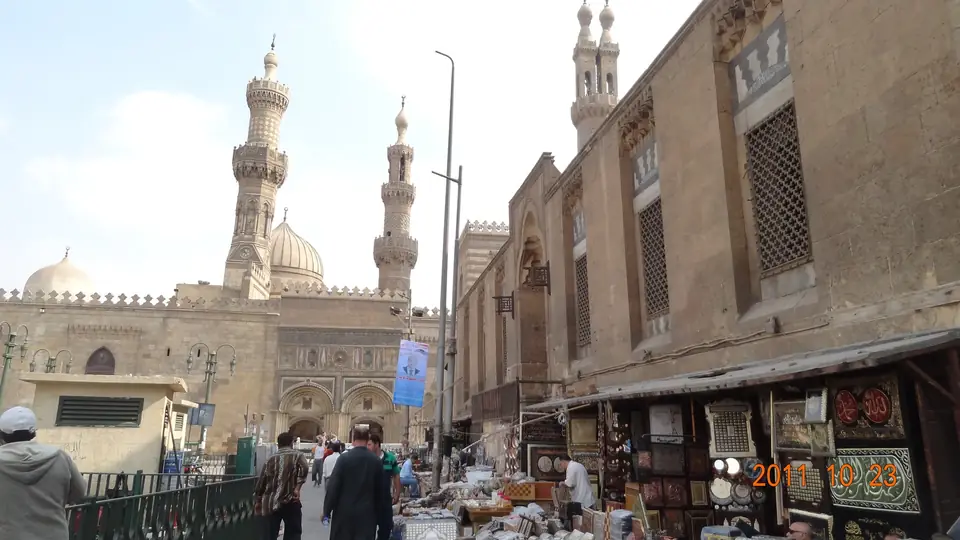
From here can be seen the three Mamluk minarets that dominate the complex: Qansuh al-Ghuri’s double-headed one, from 1509, with a section of blue tile and two twin turrets crowned with bulbs; Qaytbay’s, above his gate, which some works date to 1483 and others to 1495; and that of the Aqbugha madrasa, behind the dome. Not every attempt succeeded: the sultans Barquq, in 1397, and al-Mu’ayyad, in 1424, wanted to replace the old minaret with a stone one, and both times the work came out faulty and had to be torn down.
In Ramadan, this same marble changes function. After the afternoon prayer the tables are set up while foreign students form circles to recite the Quran, and at sunset the courtyard becomes a great communal iftar for young people from more than 120 countries: in Ramadan 2026 some 7,000 meals a day were served. The courtyard holds more signatures than meet the eye, and the audio guide points them out one by one.
The mihrab Saladin stripped and Napoleon desecrated
Fatimid mihrab
Summary of this stop
The Fatimid prayer hall is a forest of marble columns of varied origin: they came from Pharaonic, Roman and Coptic buildings, and since their heights did not match they were levelled with bases of different thickness. At the far end is the original Fatimid mihrab, discovered in 1933, with its semi-dome of carved stucco and a marble column on each side. On the conch are read two Quranic inscriptions, the opening of the sura al-Mu’minun and verses 162-163 of al-An’am, the only decoration attributed with certainty to the Fatimids.
The oldest niche in the building keeps the marks of two humiliations. After overthrowing the Fatimids in 1171, Saladin removed from the mihrab a silver band with the names of the caliphs, and his qadi Sadr al-Din ibn Dirbass banned congregational prayer, leaving the mosque almost a century without a Friday sermon. On 21 October 1798 the revolt against the French occupation set out from the Azhar; Napoleon ordered the city shelled from the Citadel with the mosque as the target, and his troops entered shod and armed, tied their horses to the mihrab and threw Qurans on the floor. What remained of that night, and what was erased under Saladin, is explained before the niche itself.
The pulpit that regained its voice
Minbar of the Katkhuda hall
Summary of this stop
South of the Fatimid hall extends the Ottoman extension of Abd al-Rahman Katkhuda, which doubled the prayer space and has its own mihrab and minbar. Katkhuda also built himself his own mausoleum in the mosque and was buried there in 1776; according to tradition, no one has been laid to rest in the Azhar since. The silence imposed by Saladin was broken under the Mamluk sultan Baibars: on 16 January 1266 the first khutba since the time of Caliph al-Hakim was delivered, from a new minbar finished five days earlier, while the emir Izz al-Din Aydamur al-Hilli repaired walls, roof and floors.
Since then, the Azhar’s pulpit has been the city’s loudspeaker. During the 1919 revolution against the British occupation, the qummus Sergius, a Coptic priest from Upper Egypt, climbed it in his black turban alongside ulema such as Sheikh Mahmud Abu al-Uyun, and went on rousing the crowd for some three months; he is remembered as the first priest to preach from the Azhar’s pulpit. In 1956, with Egypt’s radio stations bombed, Gamal Abdel Nasser spoke to the country from this same pulpit after Friday prayer. The building’s last full restoration, of about three years, concluded in 2018, and the phrase with which Sergius opened each speech is the one that closes the route.