Coptic Cairo
Hanging Church Audio Guide (El Muallaqa)
A Coptic basilica that hangs not from the air but from the towers of a Roman military gate: 29 steps, a glass floor over the fortress of Babylon and a nave with a roof shaped like Noah’s Ark.
- 30 min of audio
- Coptic basilica on Roman towers
The Hanging Church, al-Muallaqa in Arabic, “the suspended”, is the Coptic basilica of the Virgin perched between the two towers of the south gate of the Roman fortress of Babylon, in Coptic Cairo. Its oldest core probably existed already in the 4th-5th centuries, the main church is associated with Patriarch Isaac (690-692) and from 1047 it was the seat of the Coptic patriarchs. Inside await a domeless nave covered by a wooden roof shaped like a ship, a marble ambo and more than a hundred icons.
Its history is that of a temple that never stopped reopening: partly destroyed in 840, walled off and turned into a mosque in 1012, closed for 603 days from 1301 and reopened in 2014 after 16 years of works. Along the way it lost the carved cedar panels of one of its doors, sold for 100 pounds in the 19th century; one of them is kept today in the British Museum.
Highlights
- Glazed walkway — the Roman towers of the fortress of Babylon, visible beneath the floor
- Noah’s Ark roof — a domeless wooden nave
- Marble ambo — relief of the 8th-9th centuries and mosaic of the 18th-19th
- The “Coptic Mona Lisa” — a Virgin whose gaze seems to follow the visitor
- Chapel of Saint Takla Haymanot — the oldest part of the complex
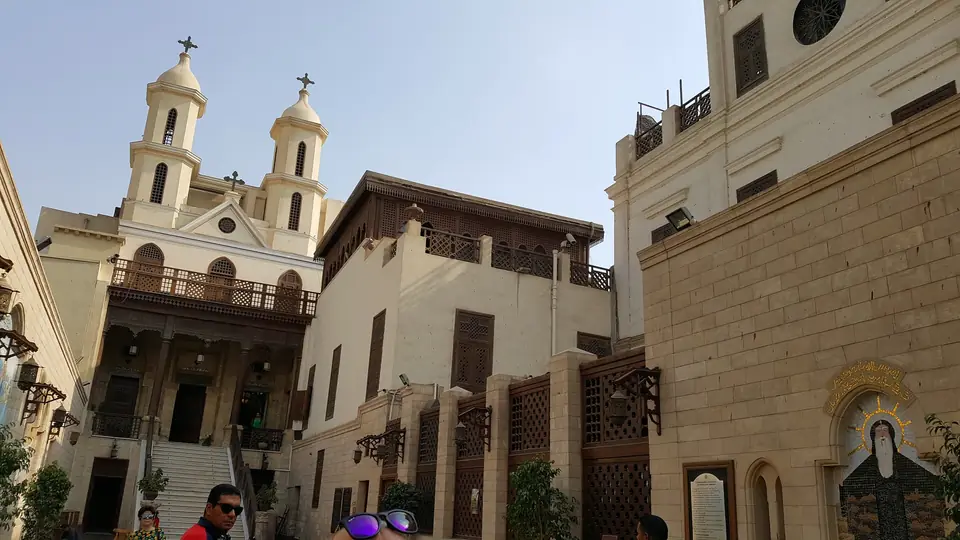
In the heart of Coptic Cairo, on Mar Girgis Street, a church rests on what is left of a Roman fortress. It is al-Muallaqa, “the suspended”, the Hanging Church: the basilica of the Virgin raised between the two U-shaped towers of the south gate of Babylon. Who built that fortress is still debated: the Egyptian press usually attributes it to Trajan, in the 2nd century, while recent archaeology gives the visible remains to Diocletian, around the year 300. The date of the church itself is not unanimous either. Historiography places its oldest part, the “little church”, in the 4th-5th centuries and the main church around 690-692, under Patriarch Isaac, although the Russian-Egyptian team that restored its interiors in 2004-2008 concluded that the present complex was built and decorated in the early 14th century.
What no one disputes is its weight. In 1047 Patriarch Christodoulos moved the Coptic patriarchal seat here from Alexandria, and for centuries in this nave the patriarchs were elected, the holy chrism consecrated and the date of Easter fixed each year. Before and after, it suffered destruction, walling-up, plunder, closures and sales, and always reopened. What to see at the Hanging Church, how to read its architecture and what history each piece hides is what the audio guide covers in four stops, from the staircase to the oldest chapel of the complex.
Another fortress, the Citadel of Saladin, dominates Islamic Cairo, where the Al-Azhar Mosque tells the city’s other great religious story.
A church on top of a Roman gate
Staircase of 29 steps
Summary of this stop
From the gate on the street, a courtyard with mosaics leads to the staircase and a 19th-century façade with two bell towers. There are 29 steps, the same ones that led early travellers to call it “the church of the stair”. The reason for the Arabic name is plain to see beside the access: the nave rests on a passage, above the Roman towers of the south gate, now mostly buried because the ground level has never stopped rising since Roman times.
Those bell towers have kept a long silence. After the collapse of a chapel roof in 1983 and the damage from the 1992 earthquake, the church was under works from 1998 for 16 years, at a cost of some 100 million Egyptian pounds and with the lowering of the water table beneath the building. It reopened on 11 October 2014 with Pope Tawadros II, and its bells rang again.
The Roman gate also has its own legend. A medieval Arab tradition speaks of a bronze idol, a rider on a camel, before which Romans and Copts came whenever someone wronged them, and which was buried on the eve of the Arab conquest. It was most likely a Pharaonic or Roman statue; why they hid it, and whom they feared it would speak of, is told by the narration at the foot of the staircase.
Beneath the floor, towers; above the nave, an ark
Glazed walkway over the Roman towers
Summary of this stop
Inside, a stretch of glass floor shows how the building rests on the towers of the Roman gate: the church rises some 13 metres above them. It is the fortress that lost its military function after the Arab conquest and ended up as the foundation of a Christian temple.
Above, the central nave and its two side aisles are covered by a wooden ship-shaped roof representing Noah’s Ark. There is no dome: the space, about 23.5 by 18.5 metres, is organised by marble columns on each side, several with Corinthian capitals, among which one of black basalt stands out.
The image of the ark fits the building’s history. In 840 the governor Ali ibn Yahya al-Armani partly destroyed it during a conflict with Patriarch Yusab, and the temple served as a mosque until its reconsecration in the 10th century. Under the Fatimid caliph al-Hakim it was ringed with a wall, turned into a mosque again in July 1012 and stripped of its vestments and liturgical objects. How it survived all this is part of what the audio guide explains from the walkway.
The patriarchs’ ambo and the miracle column
Marble ambo
Summary of this stop
North of the central nave rises the ambo, a pulpit of white and coloured marble with mosaics and crosses in relief, resting on slender columns. It is an assemblage of eras: the relief on the front is dated to the 8th-9th centuries and the mosaic panel to the 18th-19th. In the 2004-2008 restoration its columns were dismantled, reinforced with metal bars and put back. How many there are and what they symbolise is another open debate, and the sources do not agree.
This is the stage of the period when the church was the centre of the Coptic Church. Christodoulos wished to be consecrated here and not in neighbouring Abu Sarga, as custom required, and the priest of Abu Sarga responded by erasing his name from the diptychs of the Eucharist, until the patriarch celebrated there too to make peace. Between the 11th and 14th centuries the patriarchs were elected here, and in this nave cases of heresy were tried.
The columns also hold a tradition. The Muallaqa was called “the church of the Column”, because it is said the Virgin appeared beside one of them; in the version European pilgrims repeated for centuries, it was before a column that she showed herself to Patriarch Abraham during his vigil. To that patriarch is attributed the miracle of the moving of Mount Mokattam, after three days of fasting and prayer in this church, commemorated each 27 November. Which column those pilgrims were looking for is revealed before the ambo.
Icons that gaze and doors that disappeared
Chapel of Saint Takla Haymanot
Summary of this stop
The route ends at the chapel of Saint Takla Haymanot, built on one of the towers of the south gate and considered the oldest part of the complex, with remains of medieval wall painting. Around it, the church keeps 110 icons by the most cited count, most of them 18th-century. About 65 are the work of Yuhanna al-Armani, a painter of Armenian origin born in Jerusalem in 1726, who worked on the great restoration of 1775-1779 paid for by Abid Khuzam al-Bayad; among them, a series of 34 saints dated 1777.
The most famous icon is the so-called “Coptic Mona Lisa”: a Virgin with the Child and Saint John the Baptist whose gaze seems to follow the visitor from any angle.
At this stop what is missing also weighs. The carved cedar panels of a door from around 1300, with scenes such as the Annunciation or the Nativity, were sold for 100 pounds to a collector who decorated his Paris house with them, and in 1878 the British Museum acquired one, the Ascension. When the scholar Alfred Butler asked about them in 1884, the priest’s answer changed version mid-sentence; that dialogue, which exposed the plunder, closes the audio guide.