Museum of ancient Egypt
Grand Egyptian Museum Audio Guide
Three decades of works, an 83-tonne colossus that travelled upright across Cairo and, for the first time since 1922, Tutankhamun’s entire treasure in view of the Giza pyramids.
- 120 min of audio
- Opened in 2025
The Grand Egyptian Museum is the largest museum in the world devoted to a single civilisation. It stands about 2 km north-west of the Giza pyramids, in a triangular building by Heneghan Peng whose north and south walls align with the pyramids of Khufu and Menkaure. Announced in 1992 and opened to the public on 4 November 2025, it brings together in one complex the colossus of Ramesses II, the Grand Staircase, the Tutankhamun galleries and Khufu’s solar boat.
Almost everything it holds arrived after an impossible move. The colossus of Ramesses II left the central station square in one piece and upright, Khufu’s boat travelled 8.5 km at 1 km/h inside a steel cage and entered through the roof hanging from a crane, and twice a year the dawn sun falls squarely on the pharaoh’s face, as at Abu Simbel.
Highlights
- Colossus of Ramesses II — 11 metres of red granite and about 83 tonnes in the Grand Hall
- Grand Staircase — six floors among more than 60 statues and sarcophagi up to the window onto the pyramids
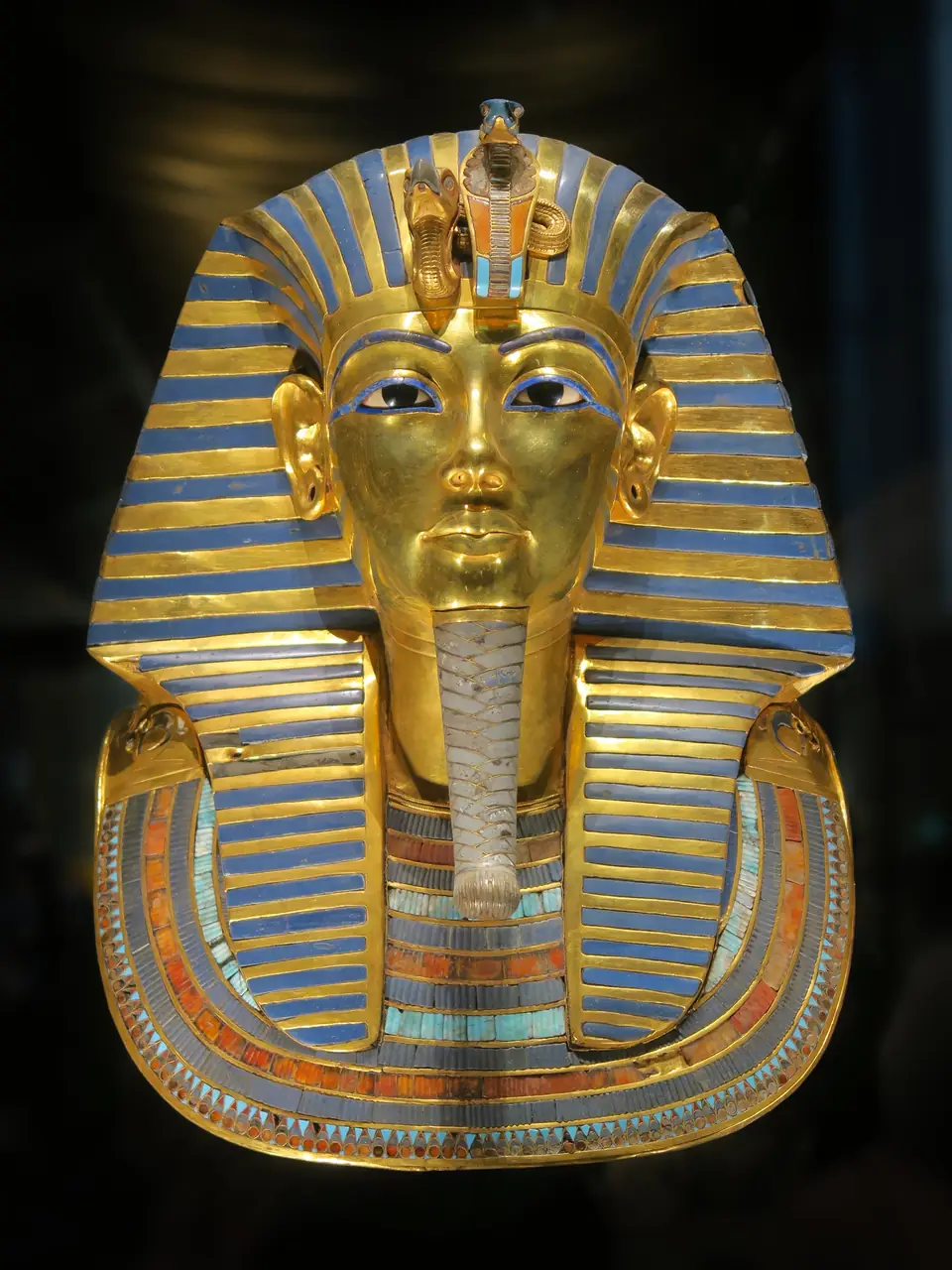
- Tutankhamun’s treasure — gathered for the first time since 1922, with the gold mask and a 110 kg solid-gold coffin
- Khufu’s solar boat — more than 40 metres of cedar and about 4,600 years old in its own building
- Hanging obelisk of Ramesses II — raised on pillars so the pharaoh’s cartouche can be read from below
For more than a century, the richest pharaonic collection on the planet lived cramped in the old museum in Tahrir Square. The project meant to move it out was launched in 1992 with an estimated budget of 550 million dollars and the promise of opening in mid-2012. It did not happen: in January 2012 the Minister of Antiquities Mohamed Ibrahim announced a 150 million cost overrun owing to the recession that followed the 2011 revolution, and later came further postponements because of covid, in 2020, and because of the war between Iran and Israel, in July 2025. Funding rested mainly on two soft loans from the Japanese agency JICA, of 280 million dollars in 2006 and 460 million in 2016, and that footprint can still be read on the room labels, written in Arabic, English and Japanese.
After an inaugural gala on 1 November 2025, with heads of state such as Felipe VI, the Grand Egyptian Museum opened to the public on 4 November, on the 103rd anniversary of the discovery of Tutankhamun’s tomb, and received 18,000 visitors on the first day. What to see at the Grand Egyptian Museum, how its architecture converses with the pyramids and what the story is of each piece that made it here is what the audio guide unpacks in five stops and two hours of walking, from the entrance plaza to Khufu’s boat.
The visit fits with that of the Pyramids of Giza, with which the museum is aligned, and with that of the old Egyptian Museum in Tahrir Square, regarded as the cradle of Egyptology.
A hanging obelisk aligned with Khufu
Grand Egyptian Museum
Summary of this stop
The visit begins in the open air, in the entrance plaza, beneath a granite obelisk of Ramesses II that arrived in 2018 from San el-Hagar, ancient Tanis. It does not rest on the ground: it was raised on pillars so that visitors can read from below the engravings on the shaft and the pharaoh’s cartouche, a detail nobody expected to find. The idea was General Atef Moftah’s, the project supervisor, when he discovered that cartouche hidden on the piece’s arrival. At its feet, a map of Egypt engraved in the paving.
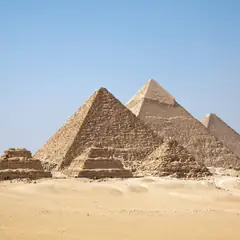
At the back rises the architecture of the Grand Egyptian Museum: a chamfered triangle whose façade of translucent alabaster and stone draws triangles evoking the pyramids, with hieroglyphic cartouches of kings and queens at the entrance. The geometry is not decorative: the building’s north and south walls are aligned with the Great Pyramid of Khufu and with Menkaure’s, some 2 km away.
The 2025 opening also had an unexpected echo outside its walls. Thousands of Egyptians portrayed themselves dressed as pharaohs with artificial intelligence, many beside the colossus of Ramesses, and the presenter Amr Adib summed it up with “Egyptians are flying with the museum”. What that pride of an entire country says about this building is told in the narration, there in the plaza.
Ramesses II, from the station to the hall
Colossus of Ramesses II
Summary of this stop
At the centre of the Grand Hall waits the colossus of Ramesses II: 11 metres of red granite and about 83 tonnes. It is a veteran traveller. It appeared in 1820 broken in six pieces at Mit Rahina, beside ancient Memphis, and in 1955 Gamal Abdel Nasser had it erected before Cairo’s central station, in Bab al-Hadid Square, which has been called Ramses Square ever since. There it spent half a century amid traffic fumes and metro vibrations.
On 25 August 2006 it was taken out of the square in one piece, upright, wrapped in foam rubber and on two lorries, in a ten-hour journey to a provisional site in Giza; weeks earlier, a replica had travelled the same route as a rehearsal. The move, criticised at the time for its cost, was broadcast live for more than 24 hours, and according to testimonies from that night there was a bit of everything in the square: vendors watching in silence, laughter of relief and women in black weeping as at a funeral. On 25 January 2018, on a 128-wheel vehicle, the colossus covered the last 400 metres and became the first object installed in the museum.
The building was designed for it too. On 21 February 2024 visitors saw for the first time the rising sun light its face fully, a calculated replica of the Abu Simbel phenomenon that repeats every 21 October. What the minister asked before the convoy set off, and what they answered in the square when someone wanted to know what it would be called now, is left for the audio guide before the colossus.
From “that Tahrir warehouse” to the pyramids
Pyramids window
Summary of this stop
The Grand Staircase climbs six floors, about 50 metres, among more than 60 statues and sarcophagi arranged in four sections: the royal image, the divine houses, gods and kings, and the funerary world. It is an ascent among pharaohs and divinities that ends at a great window open to the Giza pyramids.
The story of the museum fits in that ascent. According to the most cited account, it all began with a jibe: at a dinner at the Arab World Institute in Paris, an Italian architect friend asked the Minister of Culture Farouk Hosni what they planned to do with “that warehouse in Tahrir”, and Hosni replied that they would build the largest museum in the world beside the pyramids. There are other versions of the episode, including one by Hosni himself, and they do not agree on the details. What is documented is the 2002 competition: 1,557 entries from 82 countries, won in 2003 by Heneghan Peng, an Irish studio that was just two people at the time, Róisín Heneghan and Shih-Fu Peng.
Between that dinner and the inauguration more than three decades of delays and cost overruns went by. How that wait fits with the view that awaits at the top of the stairs is revealed by listening to the narration before the window.
The entire treasure and the trumpets of war
Tutankhamun’s gold mask
Summary of this stop
Two of the twelve main galleries are devoted to Tutankhamun. They display his complete treasure, more than 5,000 pieces (5,398 by the most cited count), gathered for the first time since Howard Carter found the tomb in 1922. At the centre, the gold mask, beside the three nested coffins, one of them solid gold and weighing 110 kg; nearby, the throne covered in gold and silver with scenes of the king and his wife Ankhesenamun. The pharaoh’s mummy, however, remains in the Valley of the Kings.
Amid so much gold, two modest pieces carry the most unsettling fame: the trumpets from the burial equipment, one of silver and one of bronze or copper. In 1939 the BBC had them sounded live before millions of listeners, and legend says that every time someone blows them, the world goes to war. The list of coincidences that feeds that belief, and what happened to one of them in 2011, are told in the audio guide in front of the display case.
The Khufu boat that came in through the roof
Khufu’s solar boat
Summary of this stop
The route ends in a building of its own within the complex, built for Khufu’s solar boat: a cedar ship more than 40 metres long and some 4,600 years old, found in 1954 by Kamal el-Mallakh at the foot of the Great Pyramid. The figures for its length and weight vary by source. The second boat found beside the pyramid is being restored in the museum itself.
Its arrival sums up the spirit of the place. Between 5 and 7 August 2021 the boat travelled whole inside a steel cage, on a remote-controlled convoy that advanced at 1 km/h for 8.5 km, and an 800-tonne crane lifted it 30 metres to slip it in through the roof of its new hall. Why this snail-paced move says so much about the whole museum is the idea with which the narration closes.