Mamluk souk
Khan el-Khalili Audio Guide
Beneath the shops of Cairo’s great souk lay the pantheon of the Fatimid caliphs; a Mamluk emir emptied it to build a khan that no longer exists and that still gives its name to the whole district.
- 60 min of audio
- 14th-century bazaar
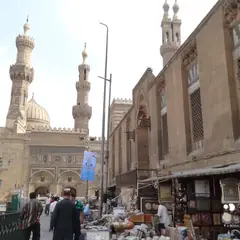
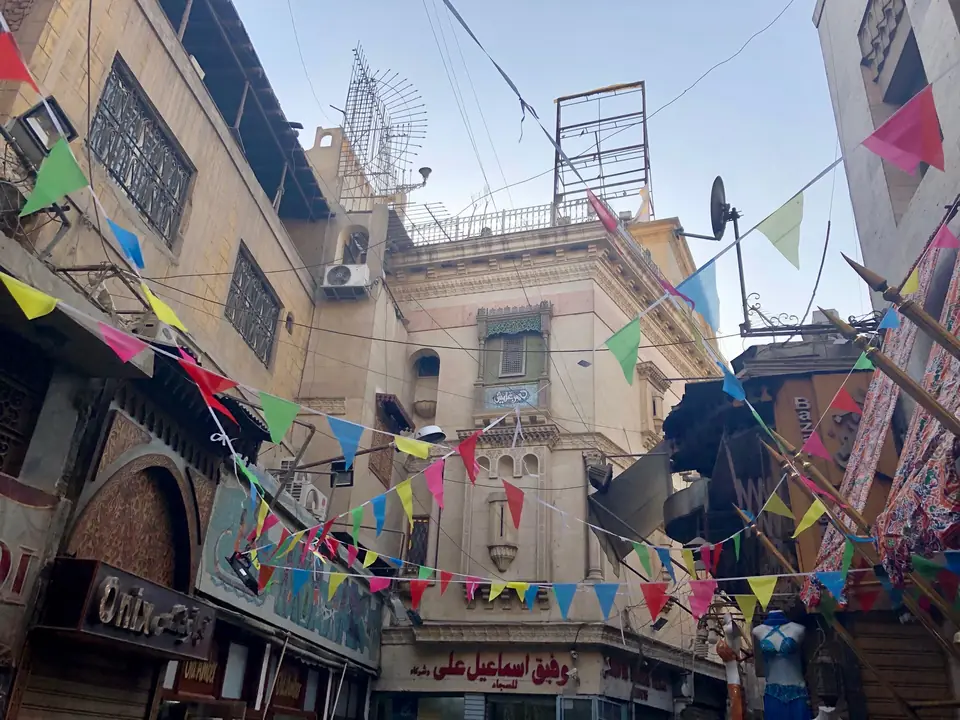
Khan el-Khalili is Cairo’s great medieval souk, a labyrinth of alleys between al-Muizz Street and the al-Hussein Mosque. Its ground was the southern end of the Fatimid caliphs’ Eastern Palace and the site of their dynastic pantheon; at the end of the 14th century Jaharkas al-Khalili, master of the stable to Sultan Barquq, raised a great khan there that gave the place its name. By the end of the 15th century the district was the centre of the city’s foreign trade, and two monumental stone gates from Sultan al-Ghuri’s reform survive.
Nothing visible remains of the caliphs’ pantheon or of the original khan: only the layout of alleys and shops that occupies their place. What still stands, a few steps away, is El Fishawy café, open 24 hours, with its huge mirrors, copper lamps and a room named after Naguib Mahfouz, the Nobel laureate who set two of his novels in these alleys.
Highlights
- Bab al-Ghuri and Bab al-Badistan — Sultan al-Ghuri’s two stone gates, from the early 16th century
- El Fishawy café — open 24 hours and run by the same family for seven generations
- Tomb of the Saffron — the pantheon of the Fatimid caliphs that lay beneath the souk
- Wikala al-Qutn — the remains of the 1511 khan that replaced al-Khalili’s original
- Al-Hussein Square — thousands of coloured lanterns on Ramadan nights
Every souvenir shop in Khan el-Khalili stands on several layers of history. When the Fatimids founded Cairo in 969, this ground lay inside the caliphs’ great Eastern Palace, at its southern end, beside their dynastic pantheon, the Turbat az-Za’faran or “Tomb of the Saffron”. During the first reign of Sultan Barquq (1382–1389), his master of the stable, Jaharkas al-Khalili, tore down that pantheon to build a great khan in the heart of the city. The building took his name, and in time that name came to designate the whole district.
The story of Khan el-Khalili is that of a caliphs’ palace, a desecrated pantheon and a market of the world: at the end of the 15th century the district was Cairo’s great centre of foreign trade, from precious stones to slaves, and after the Ottoman conquest of 1517 it became the quarter of the Turkish merchants. What to see at Khan el-Khalili goes far beyond the stalls: Sultan al-Ghuri’s stone gates, the trace of the vanished khan, the mirrors of El Fishawy café and al-Hussein Square. The audio guide covers it in five stops and an hour of walking, each episode documented and fact-checked against historical sources.
A few steps from the souk stands the Al-Azhar Mosque, the first of the Fatimid city, and further south the Citadel of Saladin completes the portrait of medieval Cairo.
The edge of the palace and the Kiswa procession
Gate of the al-Salihiyya madrasa
Summary of this stop
The route starts on al-Muizz Street, before the portal and remains of the Ayyubid al-Salihiyya madrasa, from 1242, on the western edge of the souk. This rim of the bazaar was the southern end of the Fatimid caliphs’ great Eastern Palace, and centuries later the heart of a district that, at the end of the 15th century, concentrated the city’s foreign trade, including the sale of slaves and precious stones.
Along this main street, for generations, passed the Kiswa, the black cloth of the Kaaba, woven in the Citadel and carried to the al-Hussein Mosque to be sewn and lined before leaving with the Mecca caravan. On 15 February 1834 the Orientalist Edward William Lane sat down at dawn in the shop of the pasha’s booksellers, almost opposite the bazaar entrance, to watch it pass. What he noted bears no resemblance to a solemn procession, and the scene he witnessed, with dervishes and two jesters in the middle of it, is told in the narration on the spot.
Two stone gates of 1511
Bab al-Badistan
Summary of this stop
On the Sikkat al-Badistan rise the two monumental gates ordered by Sultan al-Ghuri, the last great Mamluk sultan. The western one, formerly called Bab al-Silsila, is now Bab al-Badistan; the eastern one, formerly Bab al-Nuhhas, is known as Bab al-Ghuri. Both were part of the Suq al-Nabulsi, the only thing that survives of his reform of the souk. The most cited date is 1511, although some specialists place them between 1501 and 1506.
The sources agree that al-Ghuri intervened in al-Khalili’s original khan; most say he demolished and rebuilt it, though another reading speaks only of repairing it. The new building was called for centuries Khan al-Fisqiya, the “Khan of the Fountain”, and later Wikala al-Qutn, the “Cotton Wikala”. A few years later came the Ottoman conquest of 1517, and Cairo’s Turkish community settled in the district, with Turkish merchants occupying the Wikala al-Qutn. The paradox of a bazaar named after a building that no one can see any more is left to be heard beneath the stone.
The tomb of the caliphs that is no longer there
Bab al-Ghuri
Summary of this stop
Facing Bab al-Ghuri, with its ornate vaulted ceiling, survive the façade and portal of the Wikala al-Qutn, and just opposite the portal of the Wikala al-Silahdar, from 1837, with shops opening in its stone walls. This is the spot where the souk’s great absence is best felt: the Tomb of the Saffron. There the caliph al-Mu’izz li-Din Allah buried the coffins of three ancestors he had brought from Kairouan, and there he and his successors were later buried.
To build his khan, Jaharkas al-Khalili had those tombs exhumed. According to the most cited sources, the caliphs’ bones ended up in the rubbish dumps east of the city, though another version speaks of a transfer elsewhere. Al-Khalili’s own end has an echo hard to miss: he died in 1389 in Damascus, on campaign against rebels to the Mamluk state, far from his khan. What happened to his body is revealed by the audio guide at the gate.
The café of mirrors
El Fishawy Café
Summary of this stop
In a long alley with tables on both sides stands El Fishawy café, with enormous mirrors, copper lamps, mashrabiya panels and walls of yellowish ochre. Its opening is usually dated to 1797, a year before Napoleon’s invasion, although other sources make it older. Of the founder only the surname is remembered, Fishawy; the same family has run it for seven generations and it never closes. In the small kitchen, the tea is boiled in kettles sunk into a tray of hot sand.
One of its rooms is named after Naguib Mahfouz, who set his novel “Midaq Alley” (1947), filmed in Mexico in 1995, in an alley of the Khan, and who in December 1982 signed the café’s guest book as “your loyal son”. The mirrors, which earned it the nickname “café of mirrors”, serve, according to the family, a less decorative purpose than they seem to; among the gifts the house keeps is also an African crocodile reputed to bring luck. What those mirrors were really for is told while seated among them.
The square that grew at the café’s expense
Al-Hussein Mosque
Summary of this stop
The souk ends at the great esplanade of the al-Hussein mosque-shrine, with its minarets. In the eastern sector, the one most visited by tourists, stand the residential blocks with shops on the ground floor that Princess Shawikar promoted in the late 1930s. And the square itself has its story: in 1986 the authorities enlarged its surroundings and swallowed most of the Fishawy, which until then had been four times bigger, even though Fahmy el-Fishawy offered financial compensation to prevent it.
The square also knew fear: on 7 April 2005 a suicide attack on al-Muski Street, beside the mosque, killed three foreign tourists, and on 22 February 2009 another bomb, in front of a café, killed a 17-year-old French girl. Even so, each Ramadan the district changes its hours and its skin: after the night prayer, the alleys fill with thousands of coloured lanterns and the cafés stay full until dawn. A much-repeated account places the origin of those lanterns on the night Cairenes went out to welcome a caliph at the gates of his new city, and who that caliph was closes the route.