Pharaonic necropolis
Pyramids of Giza Audio Guide
Three pyramids that ended up as the quarry of medieval Cairo, a royal chamber without a single inscription and the name of Khufu surviving in the red paint of his own workmen.
- 120 min of audio
- Egyptian Fourth Dynasty
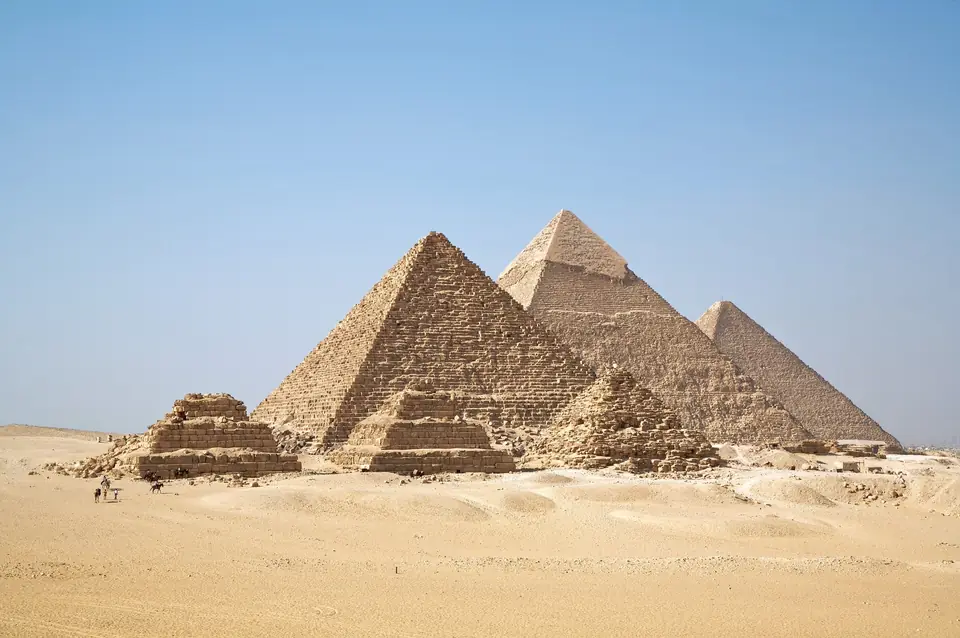
The Giza plateau is the royal necropolis of the Fourth Dynasty: three generations of pharaohs, Khufu, Khafre and Menkaure, built their pyramids here around 2600-2500 BC, beside the Great Sphinx carved from the bedrock. The Great Pyramid originally stood 146.6 metres tall and was the tallest structure built by humans for more than 3,700 years. Since 1979 the complex has been on the UNESCO World Heritage List, as part of “Memphis and its Necropolis”.
What is seen today is a stepped core: the Great Pyramid lost its white limestone skin, which ended up in the fortifications and mosques of Cairo, and Khafre’s keeps it only on its upper third. And the king of Egypt’s largest monument left no name in his burial chamber: it survives in the marks painted in red by the work gangs that built it.
Highlights
- Great Pyramid of Khufu — 146.6 m originally, the tallest human construction for more than 3,700 years
- North face casing — Tura limestone blocks with joints averaging 0.5 mm
- Robbers’ Tunnel and King’s Chamber — Aswan granite, an empty sarcophagus and not one inscription
- Pyramid of Khafre — a 53° slope and original casing on its upper third
- Great Sphinx — 73 m long, with the Dream Stele of Thutmose IV between its paws
On the Giza plateau, at the edge of the desert with Cairo reaching right to its foot, three generations of Fourth Dynasty pharaohs raised the world’s most famous pyramids around 2600-2500 BC. Khufu’s originally stood 146.6 metres tall and no human construction surpassed it in height for more than 3,700 years; beside it rise those of his son Khafre and of Menkaure, the small queens’ pyramids and the Great Sphinx, carved from the bedrock. Since 1979 the complex has been on the UNESCO World Heritage List, as part of “Memphis and its Necropolis”.
The story of Giza is not that of a mute mystery but of a human undertaking full of signatures, plunder and legends: workmen who painted their gang’s name on the blocks, sultans who tore out its stone to build medieval Cairo and Arab chroniclers who saw in the pyramids something very different from a tomb. According to the tradition recorded by al-Suyuti around 1500, they were not the work of Khufu but of Surid, a king who supposedly lived three hundred years before the Flood, foresaw it in a dream and wished to store inside them talismans, treasures and all the secret sciences. What to see at the Pyramids of Giza, how they were built and how they ended up as a quarry is what the audio guide unpacks in five stops and two hours of walking, from the north face of the Great Pyramid to the feet of the Sphinx.
The Grand Egyptian Museum, aligned with the pyramids, and the Egyptian Museum in Tahrir Square, regarded as the cradle of Egyptology, complete the visit to the Egypt of the pharaohs.
Khufu’s lost skin
Great Pyramid of Giza
Summary of this stop
The north face of the Great Pyramid holds the first surprise of the route: what is seen is not the pyramid Khufu finished, but its skeleton. The rough steps are the core; the original surface was a casing of polished white limestone, and by losing it the monument dropped from 146.6 to today’s 138.5 metres.
At the base, beneath the entrances, a few blocks of the lowest course of that casing survive, the best preserved of the whole perimeter. Howard Vyse uncovered them in 1837, and their joints average only 0.5 millimetres. They are the only in situ sample of what the smooth white surface of the entire pyramid looked like.
The rest went to the city. A strong earthquake around 1300 shook loose much of the casing, and the blocks were pulled out and carried to Cairo to build fortifications and mosques; in 1356 the Mamluk sultan an-Nasir al-Hasan was still having stones hauled from the pyramid. How much the image of Giza changes when that polish is compared with the steps of the core is something truly understood by listening to the narration on the spot.
A chamber without the king’s name
King’s Chamber
Summary of this stop
The visitors’ entrance is not the builders’ one. The original, with its gable of great chevron slabs, lies about 17 metres up the north face, beside a hieroglyphic panel carved in 1842 by the Prussian expedition of Karl Richard Lepsius in honour of Frederick William IV. Today visitors enter through the Robbers’ Tunnel, a breach forced through courses 6 and 7, some 7 metres above the base, which runs 27 metres almost horizontally before turning sharply left towards the ascending corridor. Tradition attributes it to the workmen of the Abbasid caliph al-Ma’mun, around 820-832; many scholars, starting with Antoine de Sacy, hold instead that it was dug shortly after the sealing and that the caliph’s expedition only cleared it. At that opening a legend is also told about what al-Ma’mun found inside, with an irony the audio guide saves for that moment.
Beyond the Grand Gallery, with its high corbelled ceiling, the King’s Chamber is a room of Aswan granite with an empty sarcophagus and not a single inscription or decoration. Khufu’s name appeared higher up, in 1837, when four relieving chambers covered in red paint were opened: the workmen had marked the blocks with the names of their gangs, such as “The gang: the White Crown of Khnum-Khufu is powerful”, and the king’s name is repeated more than a dozen times. Those marks served to date the pyramid to the Fourth Dynasty.
Of his face even less remains. The only nearly complete three-dimensional depiction of Khufu is an ivory statuette about 7.5 centimetres tall that Flinders Petrie found in 1903 at Abydos, hundreds of kilometres from Giza. Most Egyptologists consider it contemporary with the king, though Zahi Hawass believes it far later. How Petrie recovered the figure’s lost head is another of the stories of this stop.
Boatmen, bakers and a slandered princess
Queens’ pyramids
Summary of this stop
At the south-east corner of the Great Pyramid the site fills with ordinary names. In 2013 a French mission led by Pierre Tallet found at Wadi al-Jarf, beside the Red Sea, the papyrus diary of the inspector Merer, the oldest known inscribed papyrus: it records how his gang shipped white limestone blocks from the Tura quarries to the pyramid, then called Akhet Khufu, “Horizon of Khufu”, in the 27th year of the reign. At the south foot lie the pits cut into the rock where Kamal el-Mallakh found Khufu’s dismantled cedar-of-Lebanon boat in 1954; reconstructed it measures 43.4 metres long and since August 2021 it has been on display in the Grand Egyptian Museum.
In 1990 the tombs of its builders and the remains of the town of craftsmen and overseers came to light beside the pyramids. The remains indicate that some 10,000 workers received 21 cattle and 23 sheep a day from farms in the north and south of Egypt, and the workers’ village excavated by Mark Lehner had bakeries, breweries, a copper workshop and a hospital. Labour figures are still debated, from Herodotus’s 100,000 men to far lower modern estimates, but those tombs refute the image of an army of slaves, although the skeletons show the wear of hard labour.
Facing the small queens’ pyramids, surrounded by mastabas of the royal family and the court, stands Giza’s most scandalous story, the one the local guides told Herodotus in the 5th century BC about a daughter of Khufu and the tomb she supposedly paid for stone by stone. It is tradition, not history, and even today some rush to defend the princess’s honour; the details are told in the audio guide, before the very stones the tale speaks of.
The sultan who could not tear them down
Panorama of the three pyramids
Summary of this stop
From the viewpoint to the south-west of the plateau, the three pyramids line up with their subsidiary pyramids, and the view deceives: Khafre’s looks the largest. It measures 136.4 metres, less than his father’s, but it sits on bedrock 10 metres higher and has a steeper slope, of 53°. It also keeps its original casing on the upper third, a smooth cap that reveals how all three once looked.
The smallest, Menkaure’s, bears on its north face the mark of an attempted demolition. In 1196 the sultan Al-Aziz Uthman, son of Saladin, set out to demolish the pyramids, starting with this one; his workmen laboured for eight months pulling out barely one or two stones a day and finally gave up, leaving the great vertical gash still visible above the entrance. At the base remain courses of unsmoothed red Aswan granite.
From its interior came, in 1837, Menkaure’s basalt sarcophagus, decorated with a palace façade, extracted by Howard Vyse and John Perring. It never reached London: the Beatrice, the ship carrying it, sank with all its cargo in a storm in 1838, and only drawings of that sarcophagus remain. What Khafre’s cap reveals about the fate of the other two pyramids is best appreciated with the narration at this same viewpoint.
The nose Napoleon did not break
Great Sphinx of Giza
Summary of this stop
The Great Sphinx, carved from the plateau’s bedrock, is 73 metres long and 20 high. Around 1400 BC sand covered it up to the shoulders, and the young Thutmose IV uncovered its front paws and placed between them the Dream Stele, a granite slab that still stands there. Alongside, Khafre’s valley temple shows megalithic blocks faced with red granite, monolithic pillars and the marks in the floor where 23 statues of the king were set. Whom the face represents is debated: the majority opinion attributes it to Khafre, though no contemporary inscription proves it, and some Egyptologists argue for Khufu or Djedefre.
The face keeps traces of red pigment, but not the nose, about a metre wide. It was prised off with bars or chisels driven into the bridge and beneath the nostril, and it has never been found. The popular version blames Napoleon’s cannons, but a drawing by the Dane Frederic Louis Norden from 1737 already shows it without a nose, six decades before the 1798 campaign. Who did it remains in dispute, and the hypotheses reviewed in the narration point to very different hands and centuries.
In Arabic it is called Abu al-Hol, understood as “the father of terror”, although Zahi Hawass maintains that this meaning arose from a misunderstanding of a much older name. Behind it, the city reaches the edge of the plateau: in the mid-1990s a motorway began to be cut beside the pyramids, and only UNESCO’s threat to remove them from the World Heritage List led President Hosni Mubarak to halt the work.