Cradle of Egyptology
Egyptian Museum Audio Guide
A pink palace of 1902 in Tahrir Square that was born fleeing a Nile flood, keeps its founder buried in the garden and now fills with the gold and silver of Tanis the gap Tutankhamun left.
- 120 min of audio
- 1902 building
The Egyptian Museum in Tahrir Square was the first building erected expressly as a museum in the Middle East and North Africa. It was designed by the French architect Marcel Dourgnon, winner of a competition that drew 73 projects, and was among the first in the region built with reinforced concrete. It opened on 15 November 1902 and has since been the historic home of Egyptology: in 2025 it entered UNESCO’s World Heritage Tentative List.
Its history is not that of a quiet display case. The museum sold original antiquities in one of its rooms until 1979, was stormed in January 2011 while hundreds of citizens formed a human chain before the door, and in recent years has seen the royal mummies and Tutankhamun’s treasure leave. Even so it still displays some 100,000 pieces, with as many more in its storerooms.
Highlights
- Pink façade of 1902 — statues by Ferdinand Faivre symbolising Upper and Lower Egypt
- Mariette monument — the founder’s sarcophagus among busts of Egyptologists
- Atrium beneath the dome — colossus of Amenhotep III and Queen Tiye, the museum’s largest piece
- Tanis room — gold and lapis lazuli mask and silver coffin of Psusennes I
- Narmer Palette — around 3100 BC, with some of the oldest hieroglyphic inscriptions
On the northern edge of Tahrir Square, among the traffic and office buildings, stands a light red palace crowned by a dome. It is the Egyptian Museum, Cairo’s old museum, not to be confused with the Grand Egyptian Museum in Giza. It was inaugurated on 15 November 1902 and was the first building constructed as a museum in the Middle East and North Africa, but its collection is older than its walls: it began in 1858 in a warehouse in Bulaq, beside the Nile, and had to flee the water before finding a permanent home.
The story of the Egyptian Museum is made of moves, lootings and absences. Here Tutankhamun’s treasure was registered in 1934, here the royal mummies rested and here original antiquities were sold for decades. Today, without Tutankhamun or the mummies, the museum displays some 100,000 pieces according to recent figures, although the total size of the collection varies greatly from one source to another. Among them are the statue of Khafre with the Horus falcon embracing the back of his head, the Narmer Palette and the funerary equipment of Yuya and Tuya, great-grandparents of Tutankhamun, with a Book of the Dead papyrus some 19 metres long.
Its galleries also hold pieces with a legend of their own, such as the statue of the healer-priest Djed-Hor, which Egyptians popularly call “the enchanted statue”: it is covered in magic formulas against snakes and scorpions, including an entire spell to save a cat stung by a scorpion. What to see at the Egyptian Museum and how to read the history of a building that is almost as much a protagonist as its collection is what the audio guide unpacks in two hours of walking, from the garden to the first floor.
Tutankhamun’s treasure, which was its great star, is now gathered in full at the Grand Egyptian Museum, beside the Pyramids of Giza.
A pink palace born of a flood
Egyptian Museum
Summary of this stop
Standing before the façade, the first thing perceived is a neoclassical building designed to impress. But its origin has more of urgency than whim. In 1858 Auguste Mariette installed the collection in a former warehouse on the Nile bank, in Bulaq, and the flood of 1878 inundated its rooms. After that Mariette demanded a permanent museum, bigger and beyond the river’s reach.
The Tahrir building came out of a competition that drew 73 projects; the Frenchman Marcel Dourgnon’s won, and the first stone was laid on 1 April 1897 in the presence of Khedive Abbas Hilmi II, whose monogram is still above the door. The sources do not entirely agree on the chronology of the competition and the design, but they do on what came next: a colossal move from the Giza palace, where the collection was then kept.
In 1902 it took five thousand wooden carts and two trains making some nineteen round trips between Giza and Qasr el-Nil. The first shipment alone carried about 48 stone sarcophagi weighing more than a thousand tonnes, and the transfer ended on 13 July 1902. How such a load was moved through an early-century city is one of the details the narration reserves for this point.
Mariette’s tomb and the awkward bust
Mariette monument
Summary of this stop
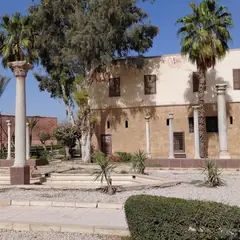
In the garden, to one side of the entrance, a sarcophagus in plain view and a statue preside over a semicircle of busts. It is the tomb of Auguste Mariette, moved here in 1902 at his own wish to rest among the pieces he had gathered. Around it are the great names of Egyptology, from Champollion and Lepsius to the Egyptians Selim Hassan, Sami Gabra, Labib Habachi and Ahmed Kamal.
That last bust holds an irony. Mariette, director of the antiquities service between 1858 and 1881, forbade Egyptians to copy hieroglyphs in the museum and held back careers like that of Ahmed Kamal, who now keeps him company in the garden as one more of the scholars around him. Egyptology, which was born studying Egypt, for a long time shut out the Egyptians themselves.
The garden, moreover, was once much larger: originally it reached the Nile bank, until in 1954 that land was expropriated to build the Cairo City Hall. What that small monument says about who told the story of Egypt is left for the audio guide, before the sarcophagus.
A human chain before the looted door
Main door with Faivre’s statues
Summary of this stop
The main door is flanked by two large female figures by the sculptor Ferdinand Faivre that symbolically represent Upper and Lower Egypt, with the head of Isis on the keystone of the arch. On the façade are engraved the surnames of European Egyptologists such as Champollion, Lepsius, Birch or Mariette.
On this threshold the night of 28 January 2011 was lived, in the midst of the Tahrir revolution. The museum was stormed: two mummies were destroyed, a third damaged by fire and 54 objects stolen, although in the first days the official figures were far lower and the tally changed over time. A gilded statuette of Tutankhamun carried by the goddess Menkaret is still missing. That same night, young men armed with truncheons taken from the police formed a human chain before the entrance to protect the collection; UNESCO’s director-general, Irina Bokova, later cited it as proof of the museum’s worth.
Superstitions also leave through this door. Popular belief holds that the “curse of the pharaohs” awakens whenever the treasures leave the museum, and in 2021, days before the mummies were moved, some on social media attributed several misfortunes in Egypt to their wrath. The most famous anecdote, that of a kick to a crate and a broken leg, is told in the narration beside the door.
The crowded atrium Maspero defended
Central atrium and colossus of Amenhotep III
Summary of this stop
Beneath the dome opens a great double-height hall lit from a glazed roof. It is presided over by the museum’s largest piece: the colossus of Amenhotep III and Queen Tiye with three of their daughters. Above it, the dome is itself a technical document: its 1898 plans bear the signature of the Hennebique system as engineering, with Dourgnon as architect and the Italian firm Garozzo & Zaffrani as contractor, in one of the first buildings in the Middle East to use reinforced concrete.
From its opening the museum was so full that it looked like a warehouse. Gaston Maspero defended it with a surprising argument: that abundance was the reflection of a pharaonic tomb or temple, where every handbreadth of space was used. Seen that way, the apparent disorder of statues, sarcophagi and stelae takes on another meaning.
And there is a fact that baffles almost every visitor: from 1902 the museum itself sold original antiquities in a sales room, room 56 on the ground floor, which did not close until November 1979. How that trade worked, with its fixed day of the week, is what the audio guide tells in the atrium.
Silver of Tanis in Tutankhamun’s gap
Tanis treasures room
Summary of this stop
On the first floor, the former Tutankhamun galleries no longer display his treasure, moved to the Grand Egyptian Museum in Giza; the royal mummies have also gone. On 3 April 2021, 22 royal mummies, 18 kings and 4 queens, left here for the National Museum of Egyptian Civilization in Fustat in the Pharaohs’ Golden Parade, inside containers with a nitrogen atmosphere.
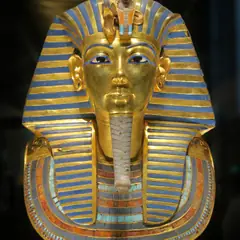
Their place is taken by the treasures of Tanis, found during the Second World War and kept for years in storerooms. One room is devoted to Psusennes I, the “silver pharaoh”, whose tomb Pierre Montet discovered in 1939: his gold and lapis lazuli mask and silver coffin share the space with the mask of Amenemope. These rooms were also the scene of an embarrassing, documented episode involving Tutankhamun’s gold mask when it was still here, which the narration relates at this point.
After the departure of its most famous pieces, daily attendance fell from 7,000 or 8,000 visitors to between 1,000 and 2,000. The museum nevertheless keeps some 100,000 pieces on display and already looks ahead to its 125th anniversary, set for November 2027.