Royal residence
Amalienborg Palace Audio Guide (Amalienborg Slot)
Four twin palaces built to celebrate a dynasty, lent to four noblemen and turned into the king's home by a fire. In the centre, a bronze monarch that cost more than all of them.
- 45 min of audio
- Danish Rococo
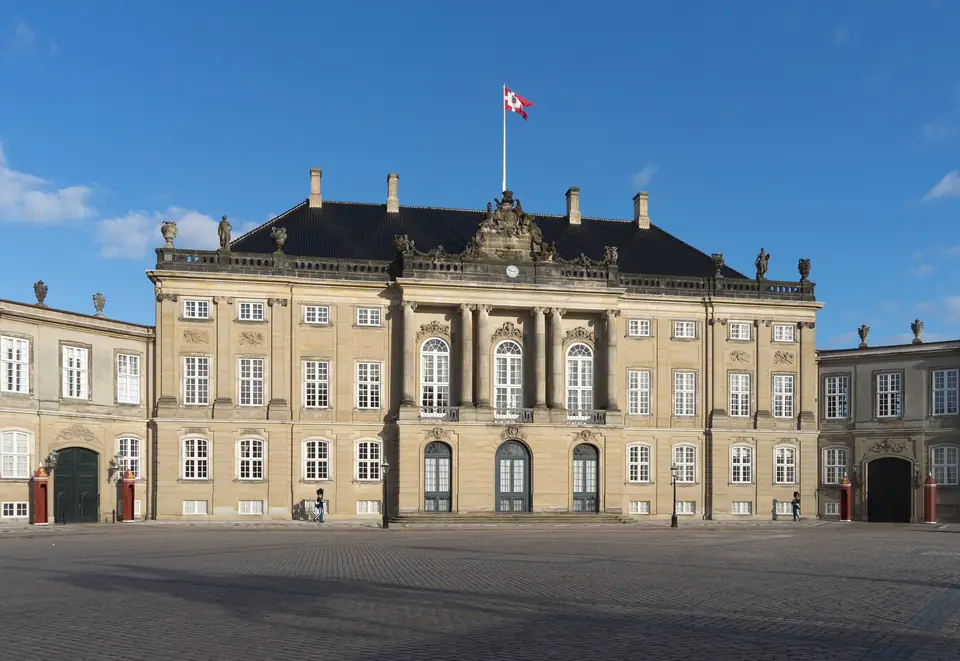
Amalienborg is the heart of Frederiksstaden, the district that Frederick V ordered laid out in 1749 for the 300th anniversary of the House of Oldenburg. The king reserved the four plots of the octagonal square and shared them among four of the most powerful men in the kingdom, who between 1750 and 1760 built four palaces with the same Rococo sandstone façade designed by Nicolai Eigtved. Since 1794 it has been the residence of the Danish royal family in Copenhagen.
The name comes from a tragedy: in 1689 Sophie Amalienborg's palace burned here during an opera, with some 180 victims trapped behind locked doors and barred windows. A century later, another fire, that of Christiansborg, left the royal family without a roof, and within days they bought two of those noble palaces and never left.
Highlights
- Equestrian statue of Frederick V — almost 12 metres with the pedestal and about 22 tonnes of bronze
- Octagonal square between Marmorkirken and the harbour — an axis that puts the sea behind and the church ahead
- Harsdorff's colonnade — eight Ionic columns and a passage over Amaliegade since 1794
- Levetzau coats of arms — still on the façade thanks to a sale clause of 1794
- Changing of the Royal Guard — the square at 12:00, with bearskin hats
The Danish king’s home was not designed as the king’s home. Amalienborg was born in 1749 as the set of a dynastic celebration: Frederick V marked 300 years of the House of Oldenburg with a new district, Frederiksstaden, and at its centre he reserved four plots that he gave to four noblemen to build identical palaces. The idea of an octagonal square with an equestrian monument is owed to the German architect Marcus Tuscher, although the square is usually attributed to Nicolai Eigtved’s plan, who drew the façades. It took two fires, that of 1689 which gave the place its name and that of Christiansborg in 1794, for the crown to settle here and never leave.
The history of Amalienborg does not stop at architecture. This square, empty almost all year except for the sentries, has filled whenever the country had something to say to its king: women who had just won the vote, a crowd calling for a republic, a guard that fought a gun battle on the morning of the German invasion. The audio guide route crosses the square from side to side, from the harbour axis to the Royal Guard’s sentry boxes, with a narration documented and checked against historical sources.
The other end of that history is at Christiansborg Palace, whose fire of 1794 brought the court here. From the square, the harbour leads south to the sailing ships of Nyhavn and north, along the Langelinie promenade, to the Little Mermaid.
A square written like a sentence
Frederiksgade axis towards Marmorkirken
Summary of this stop
At the mouth of Frederiksgade, on the harbour side, the square is understood at a glance. The statue of Frederick V rides from the water towards the dome of Frederik’s Church, Marmorkirken, at the exact crossing of the district’s two axes: the sea, the basis of Denmark-Norway’s power, is behind, and God ahead. Eigtved’s plan even foresaw stepped cornices, lower on the burghers’ houses than on the palaces and on these than on the church, a hierarchy turned to stone.
Around it, the four twin façades repeat the same block of 11 bays on two and a half storeys over a high basement, clad in sandstone, with the three central bays brought forward, giant doors and balconies. The streets that open onto the square complete the other four sides of the octagon. To the east, beyond the Amaliehaven garden, the Opera closes the axis on the far bank, although whether that continuity was deliberate or chance is a debate that remains open in Copenhagen.
What looks like decorative symmetry is really a political message about who ruled the kingdom. The narration on site reveals how to read it.
The bronze king who cost more than his palaces
Equestrian statue of Frederick V
Summary of this stop
Behind the central railing waits the equestrian statue of Frederick V, dressed in Roman style, crowned with laurel and holding the baton of command. It was commissioned in 1752 by the Asiatic Company, chaired by Count Adam Gottlob Moltke, marshal of the court, who was called king «in fact» against Frederick V, king «in name». Moltke himself received the square’s first plot and built the most luxurious of the four palaces.
The work of the French sculptor Jacques-François-Joseph Saly took 14 years to complete and cost more than the four palaces around it. According to documented tradition, Saly observed horses daily for years from his workshop in Charlottenborg; the casting of 2 March 1768 gathered 300 guests, and the roughly 22 tonnes of bronze crossed the city on a sledge pulled by 200 sailors over two days. It was unveiled on 1 August 1771, five years after the king’s death, and in 2006 it entered the Danish Cultural Canon.
A monument for a king who never saw it finished, paid for by the company of his most powerful man: the irony is completed by the scene of the hauling through the streets, which the audio guide reserves for this point.
Two fires and a temporary bridge
Christian VII's Palace
Summary of this stop
Christian VII’s Palace, the former Moltke Palace, was the first to be finished and was inaugurated on 30 March 1754, the eve of the king’s birthday. Its Riddersal is one of the most remarkable Rococo rooms in Denmark, and today the building serves as a palace for state functions and guests. But the name of the complex points to another story: on 19 April 1689, at an opera for Christian V’s birthday, rockets and stage fire set alight the theatre of Sophie Amalienborg. The door to the palace was locked, the windows were barred and some 180 people died.
More than a century later, on the night of 26 to 27 February 1794, Christiansborg burned. Within days the crown bought the Moltke and Schack palaces, and the royal family moved to Amalienborg. To join the palace of the mentally ill King Christian VII with that of his son, the regent Frederick, the architect C. F. Harsdorff stretched across Amaliegade a colonnade of eight Ionic columns with a passage on the first floor.
That bridge was meant to be temporary, of plastered wood, and to fit it in Moltke’s library was sacrificed. It is still standing, and what it says about that improvised court is discovered beneath its columns.
The square that shouted «Republic!»
Frederik VIII's Palace
Summary of this stop
In front of Frederik VIII’s Palace, residence of Frederik X and Queen Mary, the empty paving keeps some of the most intense scenes of the Danish 20th century. In 1912 Christian X had been proclaimed king from the balcony of Christian VII’s Palace, and in 1915, after signing the Constitution that gave the vote to women and domestic servants, between 12,000 and 20,000 women marched here and the king received them.
Five years later came the Easter Crisis. According to documented tradition, on 3 April 1920, days after Christian X dismissed the Zahle government, thousands of people filled the square shouting «Republic!» and «Down with Christian!», a shot rang out that nobody could explain and, the next morning, the king gave way. It is the closest Denmark has come to a political upheaval by non-parliamentary means.
On the morning of 9 April 1940, the day of the German invasion, the Royal Guard held a one-hour gunfight here against a German battalion until Christian X ordered a ceasefire; three guardsmen were wounded. The narration reconstructs those hours in the very place where they happened.
Coats of arms that stay, flags that signal
Christian VIII's Palace
Summary of this stop
On the façade of Christian VIII’s Palace, home of the Amalienborg Museum, the arms of Count Levetzau and his wife Sophie Rantzau remain beside the royal coat of arms. It is no oversight: when selling the palace in 1794 to Prince Frederick, half-brother of Christian VII, the Levetzau family demanded that their shield never be removed, and the clause has been respected to this day.
Above, on the roofs, swallow-tailed flags fly which, according to a documented custom, announce who is at home: that of the monarch, the heir, the regent and the Royal House. After the proclamation of Frederik X in January 2024, the change of reign could be read on the flagpoles, with two flags lowered and two others raised.
Below, the Royal Guard, founded by Frederick III in 1658, changes the guard every day. With the king in residence, the parade sets out from the Gothersgade barracks at 11:27, passes the Round Tower and Kongens Nytorv and enters the square shortly before 12:00. How to read those signals, and what changes on the king’s birthday, is told at the foot of the palaces.