Pleasure garden of 1843
Tivoli Audio Guide
A rampart moat turned into a lake of lanterns, a Chinese theatre with a peacock curtain and a roller coaster that is still braked by hand: Tivoli is the garden where Copenhagen invented its own leisure and which never wanted to be finished.
- 120 min of audio
- Chinese theatre and 1914 roller coaster
Tivoli opened on 15 August 1843 on the fortification ground that stretched just outside the Vesterport gate, on the initiative of Georg Carstensen and with a name borrowed from Paris and London: Tivoli og Vauxhall. Of those wooden pavilions none remains, but the layout of the garden is roughly the same, and its history can be read in buildings of very different eras: the Chinese-style Pantomime Theatre of 1874, the illuminated pagoda of 1900, the wooden roller coaster of 1914 and a modernist concert hall of 1956.
Behind the postcard there are less friendly chapters. On the night of 24 to 25 June 1944, during the German occupation, a commando of Danish Nazis from the Peter group entered the garden at night and planted incendiary bombs against the concert hall, the Glassalen and the Arena theatre. And in 1905, in the middle of a colonial exhibition, the same grounds of «joy shared with the people» displayed two children from the Danish West Indies behind a fence.
Highlights
- Pantomime Theatre — a Chinese pavilion of 1874 with a peacock curtain moved by five men
- Rutschebanen — a wooden roller coaster of 1914 with a brakeman aboard each train
- Tivoli Lake — a stretch of the old rampart moat, with the pagoda of 2,800 lamps
- Concert hall — reborn in 1956 after the Nazi fire of 1944, host of Eurovision in 1964
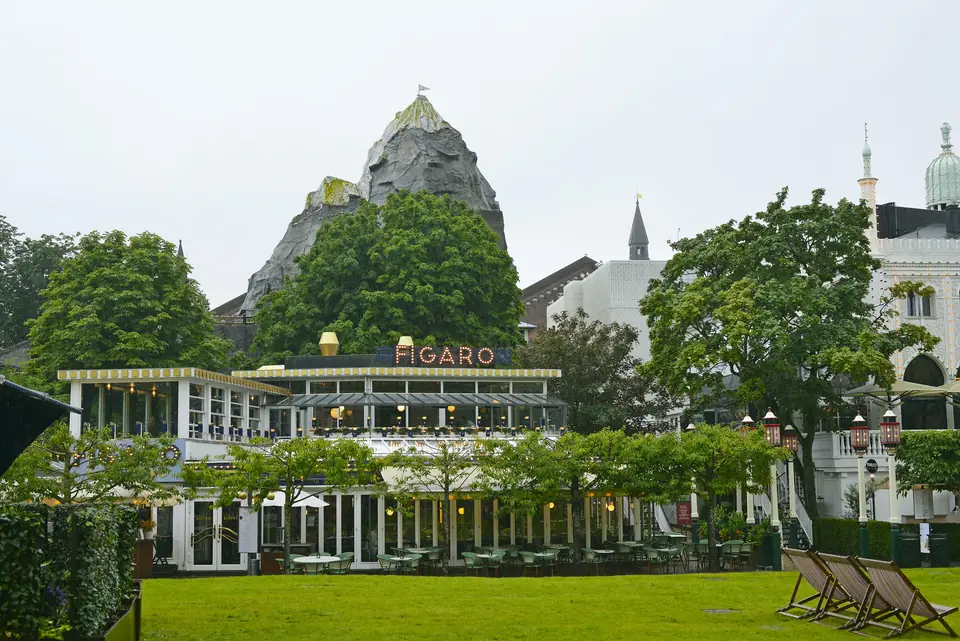
- Nimb Palace — a Moorish bazaar of 1909 with a bubble fountain linked to Niels Bohr
Opposite Copenhagen’s central station, behind a gateway of 1890, stretches a garden that is much more than an amusement park. Tivoli opened on 15 August 1843 on the glacis of the Vesterport fortifications, and its history is that of a city learning to enjoy itself: silent pantomimes performed without interruption since the first summer, the waltzes and galops of Hans Christian Lumbye, exotic sets built on the water and a wooden roller coaster that has been running since 1914. Hans Christian Andersen was at the opening, Walt Disney visited in 1951 and in 1964, and its founder maintained from the start that the garden would never be finished.
Although it is often presented as the oldest amusement park in the world, that title belongs to Bakken, north of the city; Tivoli is the second oldest still operating, and its interest lies elsewhere: in how each building keeps a chapter of Danish history, from the royal permit of 1843 to the night of June 1944 when music burned. The audio guide covers the garden in six stops, from the Vesterbrogade entrance to the fountain of Nimb Palace, with a narration documented and checked against historical sources that is best enjoyed walking among the lanterns.
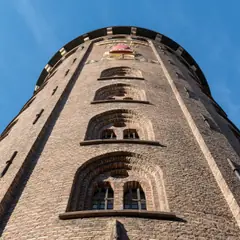
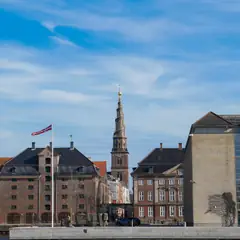
A walk from the garden are Christiansborg Palace, seat of the Danish Parliament, and the Round Tower, Christian IV’s observatory with its stepless ramp.
The Vesterbrogade gate and the king’s permit
1890 gateway on Vesterbrogade
Summary of this stop
The route starts at the main entrance on Vesterbrogade, a gateway of 1890 with two pavilions that is what remains of a larger frontage, with the Apollo theatre and the Wivel restaurant, and which replaced a modest wooden gate. What lies behind occupies the fortification ground that stretched just outside the Vesterport gate: Georg Carstensen built his garden here in 1843 and christened it Tivoli og Vauxhall, with names taken from the pleasure gardens of Paris and London.
Not one of the buildings of that first summer survives: everything seen is later, although the general layout of the garden has hardly changed. What does remain is the founding anecdote: according to tradition, Carstensen convinced Christian VIII to grant him a five-year licence with an argument as pragmatic as it was unsettling, «when the people amuse themselves, they do not think about politics». What that phrase says about Tivoli, and about the country that hosted it, is unpacked in the narration before the gateway itself.
A peacock curtain and Andersen’s tale
Pantomimeteatret
Summary of this stop
The Pantomime Theatre is the oldest standing building in Tivoli: a Chinese-style pavilion built in 1874 to a design by Vilhelm Dahlerup and Ove Petersen, protected since 1979, with the stage inside and the audience in the open air. Two dragons peer from the roof and green toads top the downpipes; the load-bearing elements are red and the beams yellow and blue. Above the proscenium, in Chinese characters, reads the motto «Med folket dele glæde», to share joy with the people.
Its great trick is the mechanical curtain in the shape of a peacock’s tail, an idea of the artistic director Bernhard Olsen, which folds towards the floor to open each performance. At first it was all wood and it took 13 men to move it; rebuilt in canvas, five are enough today, three of them turning cranks in the basement. Before it, silent commedia dell’arte pantomimes have been performed since 1843, with Harlequin, Columbine, Cassander and Pierrot, an unbroken tradition unique in the world.
Tivoli’s Chinese roofs also have a place in literature. Andersen attended the opening of 1843 and was captivated by its Chinese pavilions; according to his own diary, one October evening that year he returned to the garden and began his «Chinese tale», which in barely two days became «The Nightingale». Andersen never travelled to China: his China was that of Tivoli. What is told about the soprano Jenny Lind and that bird is left to be heard in front of the curtain.
Rutschebanen, the roller coaster braked by hand
Rutschebanen
Summary of this stop
At the foot of an artificial mountain crowned with two snowy peaks runs Rutschebanen, the wooden roller coaster that opened in 1914, heir to a first one of 1843 that offered seven seconds of thrills. It is one of the oldest still running and one of only seven in the world that carry on board each train a brakeman standing up, in charge of braking before each bend. Its exact length and the authorship of its construction vary depending on the source, and the narration reviews those versions without treating any as settled.
The mountain also has its war story. With electricity rationed during the Second World War, passengers climbed to the top on foot and the cars were hoisted by hand with a winch installed in the roof; in June 1944, the attack on the garden blew up a stretch of the track. And its silhouette has changed over the years: the fibreglass peaks were removed in the mid-1920s at the demand of Copenhagen City Council and did not return until the centenary of 2014, along with a 22-metre waterfall, in a refurbishment costing 40 million kroner. At its foot nestles Smøgen, the little shopping lane of 1952 imitating a Danish market town.
The lake, the pagoda and the sets of the world
Tivoli Lake with the pagoda
Summary of this stop
Tivoli Lake is no landscaper’s whim: it is a stretch of the city’s old moat, which took its present shape in 1887, when Copenhagen’s western ramparts were demolished. Between that year and the 1930s, its banks served as the stage for great open-air sets: Italy in 1887, Egypt in 1911 and a Javanese village in 1933. Today it reflects the pagoda designed in 1900 by Knud Arne Petersen as an illuminated tower, called the Chinese Tower until 2009, with 2,800 coloured glass lamps.
Those exotic mirrors had a dark side. In the summer of 1905, during a colonial exhibition with pavilions from Greenland, Iceland, the Faroe Islands and the Danish West Indies, two children arrived from Saint Croix, Victor Cornelins, aged seven, and his half-sister Alberta, aged four, and ended up displayed behind a fence in a show visited by more than 100,000 people. Victor answered the curious by spitting at them. How that boy in the cage became, in time, a teacher with a statue in Denmark is one of the most unexpected tales on the route.
The concert hall and the fire of 1944
Tivolis Koncertsal
Summary of this stop
For almost three decades, from 1843 to 1872, Tivoli’s music bore the signature of Hans Christian Lumbye, the «Strauss of the North», author of pieces such as the «Champagne Galop». His original scores were lost in a single night: that of 24 to 25 June 1944, when a commando of Danish Nazis from the Peter group entered the garden after closing and planted incendiary bombs against the concert hall, the Glassalen and the Arena theatre. The German-controlled press blamed the resistance. Tivoli closed for two weeks and reopened on 12 July.
The Moorish hall of 1902 did not survive. In its place stands the present modernist concert hall by Frits Schlegel and Hans Hansen, inaugurated in 1956 as the largest in Northern Europe, with about 2,000 seats, and the stage of the Eurovision Song Contest in 1964; the circular glazed foyer, the Rotunda, was added in 2005. Very close by, the octagonal Glassalen was rebuilt in 1946 by Poul Henningsen as a replica of its 1943 version. The narration reconstructs that night from the place where it happened.
Nimb, the bubbles and the garden that is never finished
Nimb Hotel
Summary of this stop
The route ends in front of Nimb Palace, an Oriental-style bazaar of 1909 now a hotel and restaurants, with a bubble fountain in front designed by the landscape architect Eigil Kjær (dated 1961 or 1971, depending on the source). Legend has it that the idea was born from a conversation with the physicist Niels Bohr, a Nobel laureate, who compared the bubbles of an aquarium’s oxygenator to an underwater fountain.
It is also the place to close the story of Georg Carstensen, born in Algiers in 1812, who directed Tivoli for only five years: in 1848 he enlisted in the First Schleswig War and the board dismissed him for breach of contract. He later designed a Crystal Palace for the New York exhibition of 1852 and died of pneumonia in January 1857, months before his rival park, the Alhambra of Frederiksberg, opened. His idea of 1844, that of a garden that would never be finished, ended up crossing the Atlantic in the hands of Walt Disney, and how it did so is the finale of the audio guide.