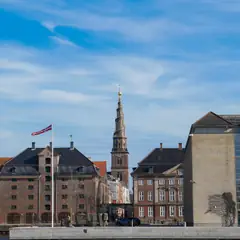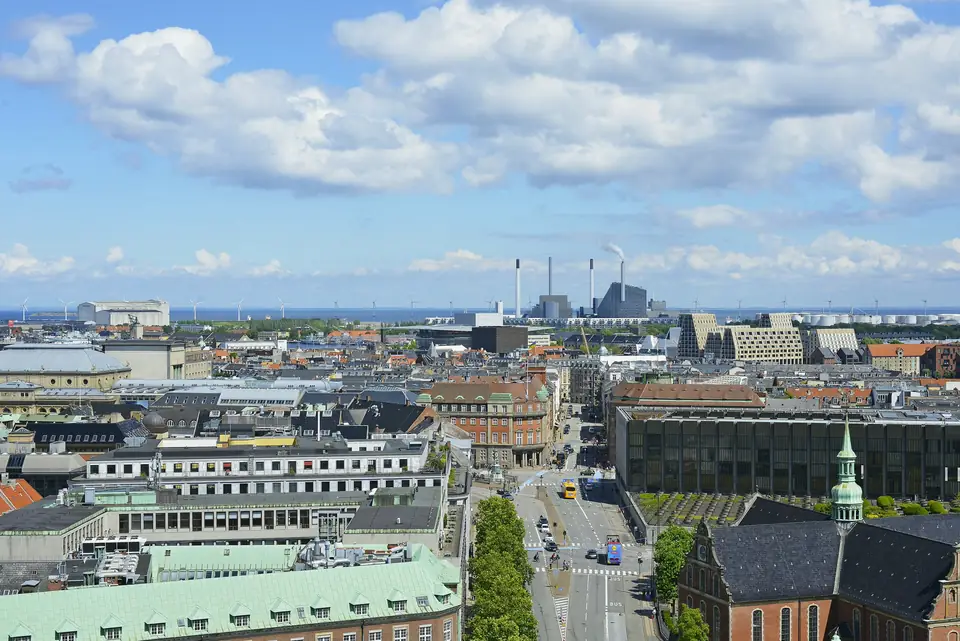
Seat of the Danish Parliament
Christiansborg Palace Audio Guide (Christiansborg Slot)
Three palaces built one after another on the islet where Copenhagen was born: fire took two, the third ended up in the hands of Parliament, and beneath its foundations the wall of 1167 still shows.
- 90 min of audio
- Parliament and medieval ruins
Christiansborg occupies Slotsholmen, the islet that Bishop Absalon fortified in 1167. On that ground came, in succession, Absalon's castle, razed by the Hanseatic League, Copenhagen Castle and three palaces: the Baroque one of Christian VI, the Neoclassical one of C. F. Hansen and the current one by Thorvald Jørgensen, built between 1907 and 1928 in reinforced concrete clad in granite. Today it brings together under one roof the Folketing, the Prime Minister's Office and the Supreme Court of Denmark.
The façade looks like a fortress because it is, a little, made of the whole country: the ground floor and basement carry stones sent from more than 700 Danish parishes, and the granite came even from Greenland. Above rises the tower that most sources measure at 106 metres, the tallest in Copenhagen, and below, in half-light, wait the ruins of the earlier castles.
Highlights
- Christiansborg Tower — 106 metres and a free viewing platform since 2014
- Absalon's castle ruins — a limestone wall of 1167 beneath the palace
- Great Hall — 17 tapestries by Bjørn Nørgaard on a thousand years of Danish history
- Smertens Port — four granite atlantes the country wanted to chisel away
- Ridebanen and the Royal Stables — the Baroque ensemble that survived two fires
The history of Christiansborg is that of a building that refuses to disappear. In 1167 Bishop Absalon built a castle on the islet of Slotsholmen; in 1369 the Hanseatic League sent 34 stonemasons to wipe it out. Christian VI later demolished the medieval Copenhagen Castle to lay, on 21 April 1733, the first stone of the first Christiansborg, which burned in 1794. The second, by C. F. Hansen, was inaugurated in 1828 and fell in the fire of 1884. Its ruins endured 23 years of political disputes until Thorvald Jørgensen built, between 1907 and 1928, the present palace.
That palace, conceived for the Crown, Parliament and the judiciary, ended up as the political heart of the country, to the point that Danes call it «Borgen», the castle, and use its name to mean politics itself. The history of Christiansborg, its granite architecture and what it hides beneath the ground are better understood on site: the audio guide, documented and checked against historical sources, covers in five stops the square, the chapel, the stables’ esplanade, the Parliament courtyard and the medieval ruins.
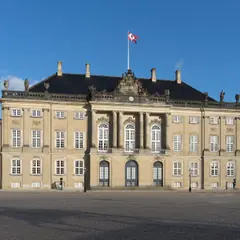
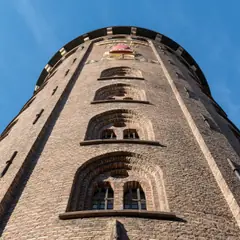
The fire of 1794 took the royal family to Amalienborg Palace, which is still their home. From the island, a walk away, are the Round Tower, in the old town, and the gardens of Tivoli, opposite the central station.
A palace made of stones from all over the country
Christiansborg Slotsplads
Summary of this stop
On Slotspladsen, beside the equestrian statue of Frederik VII, the main façade shows its most curious feature: a plinth of stones of different colours and rustic cut, sent from more than 700 Danish parishes. The cladding granite was gathered from all over the country, including Greenland and Dybbøl, which was then German territory. Above the ground-floor windows peer granite faces of figures from Danish history, such as Absalon, Tycho Brahe or Grundtvig.
Above rises the tower, topped since 1934 with a weathervane and two crowns. Most sources give it 106 metres, about 40 centimetres more than the City Hall’s, although the figure is not unanimous; its viewing platform has been free since June 2014.
But what concentrates the memory of this square is the balcony. Since the Constitution of 1849, every new Danish monarch is proclaimed from Christiansborg, the latest time on 14 January 2024, with the square so full that police had to close access. The ritual carries a medieval detail that the narration reveals, facing the façade.
The chapel that escaped one fire and fell to another
Christiansborg Slotskirke
Summary of this stop
On the corner of the square stands C. F. Hansen’s chapel, with its portico of four Ionic columns and its flat copper dome. Inaugurated in 1826, it was part of the second palace, the one built in times of bankruptcy with materials from Hirschholm Palace, demolished for the purpose. When the fire of 3 October 1884 razed everything else, the chapel was the only thing saved; that fire so impressed a young Sophus Falck that in 1906 he would found the rescue corps that bears his name.
Its luck lasted until 7 June 1992, when a Whitsun carnival rocket set it on fire. The dome had to be rebuilt without plans, from the charred remains, and the church reopened in January 1997.
Behind that sober façade one of the realm’s most solemn ceremonies is also held: the castrum doloris, the «castle of grief», in which the coffin of deceased monarchs is displayed. What role the Danish crown plays there is one of the discoveries of this stop.
The esplanade that survived two fires
Christiansborg Ridebane
Summary of this stop
The Ridebanen, the great horseshoe-shaped esplanade closed off by the Marble Bridge and two Rococo pavilions, is what remains of the first Christiansborg, that of Christian VI. The court moved into it on 26 November 1740, with the interior still unfinished, and lost it on 26 February 1794, when a chimney flue caught fire: spending on chimney sweeping had been cut and the great attic was rented out as a timber store. Since then the royal family has lived at Amalienborg.
The riding ground and bridge ensemble, built between 1738 and 1746, withstood that fire and the one of 1884 too. The royal stables, which housed as many as 270 horses in 1789, are still in use today with about 20, and in the centre of the esplanade the equestrian statue of Christian IX by Anne Marie Carl-Nielsen stands guard.
Above the stables stood the Court Theatre, today the Theatre Museum. There, in January 1772, a masked ball served as the backdrop to a conspiracy against Struensee, the royal physician who in fact governed the country. How that night ended, according to documented tradition, is one of the darkest episodes told on the route.
The guardians the country wanted to destroy
Rigsdagsgården
Summary of this stop
In Rigsdagsgården, the Parliament courtyard, the entrance to the Folketing is guarded by four granite atlantes by Anders Bundgaard titled «Det Daglige Slid». Their tormented expression so scandalised people when unveiled that money was even raised to chisel them off. They are still there, humorously renamed Ørepine, Hovedpine, Mavepine and Tandpine, and the door is known as Smertens Port, the gate of pain.
The courtyard sums up the building’s fate. The third palace was born to house the Crown, Parliament and the judiciary at once, but the kings had long since stopped living here: Frederik VI declined to move into the second Christiansborg and Frederik VII was the only monarch who lived in it, between 1852 and 1863. Today the main tenant is politics, and the reason behind the atlantes’ nicknames is explained in detail in the narration.
Beneath the three palaces, the city of 1167
Limestone wall of Absalon's castle
Summary of this stop
The route ends underground. When the foundations of the present palace were laid, the ruins of Absalon’s castle and of Copenhagen Castle came to light, and to protect them a reinforced-concrete structure was laid in 1908 that was the largest of its kind in Denmark. The ruins have been open to the public since 1924.
In the gallery can be made out the remains of the limestone wall brought from the Stevns cliffs, which enclosed an area about 53 metres across and reached some 5 metres high, next to the base of the Bakery Tower and the foundations of the castle that came after. It is the wall the Hanseatic League wanted to make disappear in 1369 after conquering the city, and what those 34 stonemasons achieved can be checked right here, at the end of the audio guide.