Observatory of 1642
Round Tower Audio Guide (Rundetaarn)
A brick tower without a single step: up its spiral ramp went carts of books, astronomical instruments and, according to the accounts, a tsar on horseback, to the oldest working observatory in Europe.
- 45 min of audio
- Astronomy and Baroque architecture
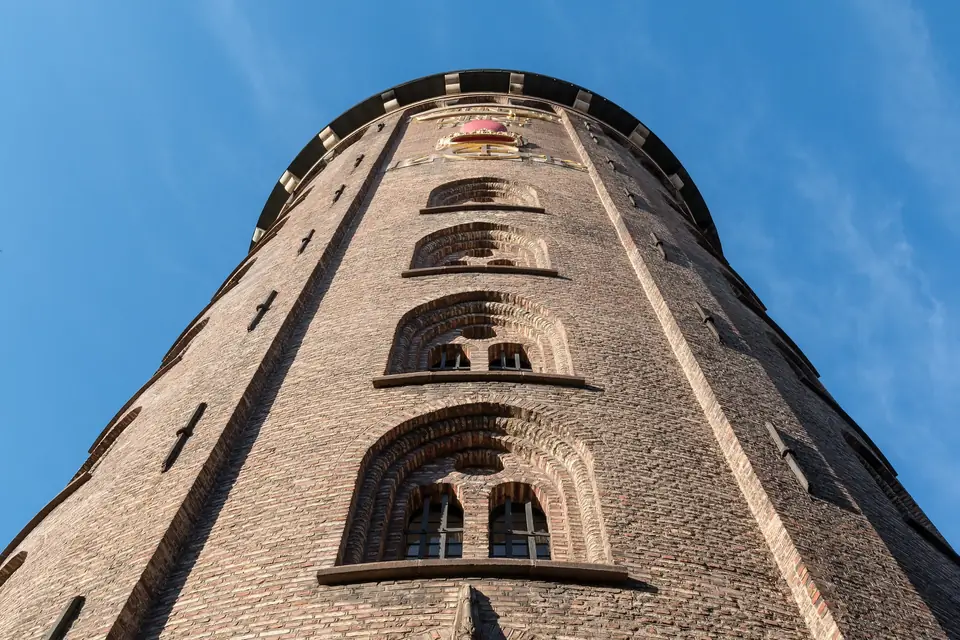
Christian IV had the first stone laid on 7 July 1637 and the tower was finished in 1642 as the first piece of the Trinitatis complex, a university building with three floors of learning: the students' church below, the library in the attic and the observatory at the top. Instead of stairs, a corridor of bricks laid on edge makes about seven and a half turns around a hollow core, designed so that horses and carts could reach the top with their load.
Its first official name was Regium Stellæburgum Hafniense, the royal Stjerneborg of Copenhagen, heir to Tycho Brahe's observatory on the island of Ven. Ole Rømer, the man who had shown that light has a finite speed, worked in the tower, and in a single night in 1728 the great fire of the city took the observatory, the library and most of its unpublished papers.
Highlights
- Stepless spiral ramp — about 210 m of bricks laid on edge around a hollow core
- Golden rebus on the façade — Latin, Hebrew, a sword and a heart sketched by Christian IV in 1642
- Bibliotekssalen — the University of Copenhagen's library for 200 years, above the church vaults
- Planetary machine — descendant of the one Ole Rømer installed at the top in 1697
- People's observatory of 1929 — copper dome renewed in 2026 and 360° views over the old town
In the heart of Copenhagen’s old town, on the street Købmagergade, rises a cylinder of yellow and red brick, the royal colours of the Oldenburgs in Christian IV’s time, unlike any other tower in the city. The Round Tower, Rundetaarn in Danish, was begun in 1637 and finished in 1642 (sources disagree on whether the tower was ready in 1641 and the observatory a year later) as the first piece of an ambitious university complex: church, library and observatory stacked in a single building. Almost four centuries later, its top still points to the sky with the oldest working observatory in Europe.
The history of Rundetaarn is that of a scientific tool designed for hooves and wheels: up its ramp went books, brass instruments and even a tsar on horseback, and visitors, runners and children playing in its niches still climb it every day. What to see in the Round Tower goes far beyond the view from the top: a royal rebus on the façade, a library that burned, a planetary machine descended from Ole Rømer’s and a freshly restored dome that holds a message for a century from now. The audio guide, documented and checked against historical sources, accompanies the climb turn by turn, from the street to the platform.
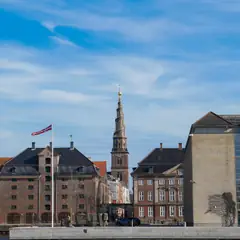
To keep climbing, the spire of the Church of Our Saviour, in Christianshavn, is ascended by an outdoor staircase to a golden Christ. Also within walking distance are Christiansborg Palace, with the city’s tallest tower, and the gardens of Tivoli.
A royal rebus and a tower that almost moved
Rundetaarn
Summary of this stop
The visit starts on the pavement, facing the Købmagergade façade. High up shines a golden hieroglyph: the Latin words DOCTRINAM ET, a sword, DIRIGE, the name of God in Hebrew, IN and a red heart above the crowned monogram C4 with the date 1642. It was sketched by Christian IV himself in his own hand, the draft survives in the Rigsarkivet, the Danish National Archives, and includes the four Hebrew consonants of the tetragrammaton. Read in full, it says roughly «Guide, Jehovah, right doctrine and justice into the heart of the crowned King Christian IV, 1642».
For ordinary people it was indecipherable, and Copenhagen humour resolved it in its own way: the parody that became popular turned it into «the doctor with a knife steers gadgets to Christian IV’s heart». The street around the tower also has its own story. In 1898 the architect Anton Rosen proposed moving the whole tower on rollers to the east side of the church to unclog the narrow passage to the Regensen student residence.
The tower did not move. In 1907 the city council chose another solution, Martin Borch’s project, and the following year an arcaded gallery was opened through the ground floor of Regensen: its arches are still there, just opposite. How the hieroglyph is read piece by piece is one of the details the narration reveals in front of the wall.
The brick ramp a tsar rode up
Glass door of Trinitatis Church
Summary of this stop
Just inside the entrance begins the Sneglegangen, the «snail walk»: a wide corridor paved with bricks laid on edge that replaces stairs. It was a practical decision, so that a horse with a cart could climb to the library and almost to the observatory with books and heavy instruments. The ramp measures about 210 metres, some sources speak of 7.5 turns and others of 7.3, and gains 3.74 metres per turn; against the outer wall it runs 257.5 metres at a 10% gradient, while beside the hollow core it is only 85.5 metres, but at 33%. Half a turn from the entrance, a glass door lets one see the Baroque interior of Trinitatis Church.
In 1716, during his visit to Frederick IV to agree a landing in Scania with 20,000 Russian soldiers, Tsar Peter the Great rode this ramp on horseback to the top, and Tsarina Catherine followed in a carriage, although this last detail is passed down with qualifications. The campaign never took place. A later myth holds that the tower had stairs and that it was turned into a ramp for the tsar, but the ramp is original to the works of 1637-1642.
So much slope has had other uses. There was a time when Copenhageners ran up and down the tower after dinner in summer; a medal in the collection points to a cycle race as early as 1888, and in 1993 Henrik Djernis did the climb by bike in 50.05 seconds. Which even more extravagant record was broken here on a single wheel is told halfway up the slope.
The library that fire almost erased
Bibliotekssalen
Summary of this stop
After some four and a half turns, the narrow corridor opens into a broad, bright hall: the Bibliotekssalen, above the vaults of the church. From 1657 and for two hundred years it housed the library of the University of Copenhagen, and in the early 19th century it displayed among its shelves the antiquities gathered by Rasmus Nyerup, the seed of the Nationalmuseet, which in 1832 had to move for lack of space. Since 1987 it has been an exhibition and concert hall, with a shop and café.
The great fire of Copenhagen in 1728 almost completely destroyed the library, and with it a good part of the sources of Denmark’s ancient history; of the church below only the altar silver was saved. Eighty years later came another blow: during the British bombardment of 1807 a cannonball pierced the roof and, as was already told in the mid-19th century, smashed an old copy of Hugo Grotius’s treatise on war and peace.
A bomb is still kept in the hall today. The irony of that shot, and what else was lost between these walls, is rounded off in the audio guide right in front of it.
Tycho Brahe’s legacy and Rømer’s machine
Ole Rømer's planetary machine
Summary of this stop
At the end of the ramp, on the wall, a planetary machine driven by a clock shows the current position of the planets. It descends from the one Ole Rømer installed at the top in 1697: after the fire of 1728 it was repaired to show only the Copernican system and since 1822 it has hung vertically. Rømer had discovered in Paris, in 1675-1676, that light has a finite speed, and in 1681 he returned as professor and director of the tower.
The observatory was born as successor to Tycho Brahe’s Stjerneborg, and its first astronomer was Longomontanus, a former assistant of Tycho. It began without a telescope, with a sextant, octant and brass quadrant in the Tychonic style; the first known observation is a lunar eclipse of 1653 and the first telescope appears in an inventory of 1686, a gift from Bishop Hans Bagger. Many works claim one already arrived in 1642, but Helge Kragh’s research holds that the claim comes from a distorted quotation.
Tycho never set foot in the tower: he died in exile in Prague long before it was finished. His great celestial globe, on which according to tradition he marked for years the position of 1,000 fixed stars, did reach here, by a tortuous route. How that sphere ended up is one of the bitterest episodes of the climb.
A people’s observatory reborn in 2026
Observatory platform and dome
Summary of this stop
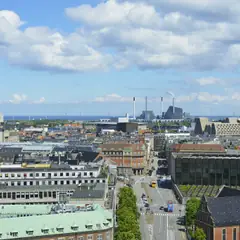
The platform at the top offers a 360° panorama over the green roofs of the old town: Marmorkirken, Christiansborg, Vor Frue Kirke, the City Hall, the spire of Vor Frelsers Kirke and, on clear days, the Øresund Bridge and the coast of Sweden. It is surrounded by Caspar Fincke’s wrought-iron railing of 1643, with Christian IV’s monogram. The height depends on where it is measured: 34.8 metres to the platform and more than 41 counting the observatory.
The city’s growing light and traffic vibrations made the university observatory obsolete, and in 1861 it moved to Østervold. In 1929 the present people’s observatory opened at the top, with a 150 mm refractor 3 metres long. In 2026 its copper dome was lowered to the street on 12 January, renewed and hoisted again on 21 May, and King Frederik X reopened the observatory on 12 August during a solar eclipse.
The tower also has a place in literature: in «The Tinderbox» (1835), Hans Christian Andersen gives the biggest of his three dogs eyes as large as the Round Tower. What was left stored at the foot of the telescope, and until which year it cannot be opened, is the last secret the narration keeps for the very top.