Symbol of Copenhagen
Little Mermaid Audio Guide (Den Lille Havfrue)
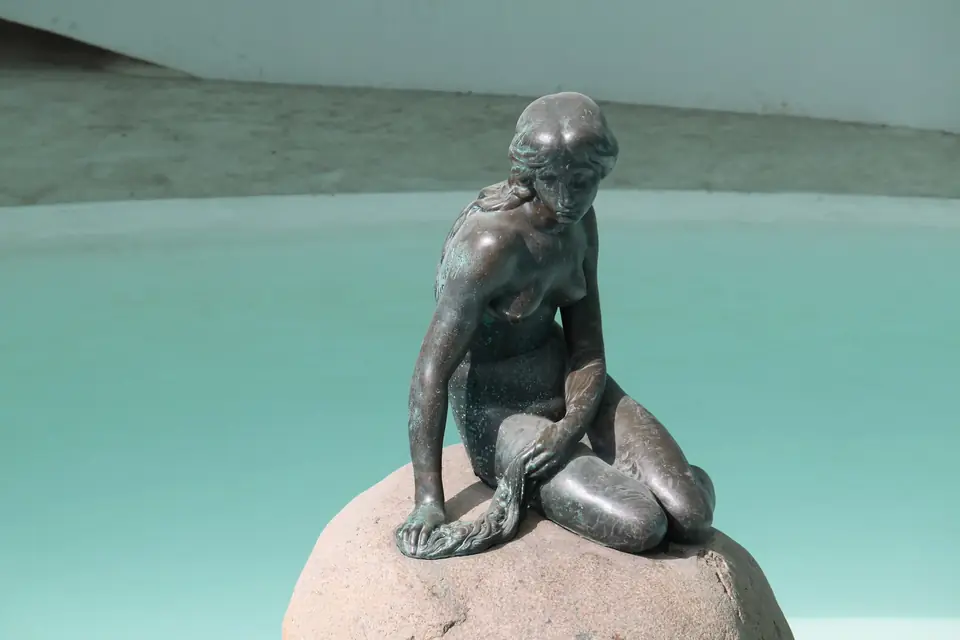
A bronze of barely 1.25 metres born from a ballet, seated on a rock at the entrance to Copenhagen's harbour. Small in size and enormous in history: beheaded twice, blown up with explosives, sent to Shanghai and taken to court.
- 20 min of audio
- Bronze sculpture
In 1913 the Carlsberg brewer Carl Jacobsen gave Copenhagen a bronze mermaid for the mouth of its harbour. He had commissioned it from the sculptor Edvard Eriksen after seeing the ballet Den lille Havfrue, premiered at the Royal Theatre in 1909 from the tale by Hans Christian Andersen. It arrived at Langelinie on 23 August 1913, without ceremony, on a cart and face down. More than a century later it is a national symbol of Denmark and the centre of a walk that receives visitors from all over the world.
Its size disappoints many: 1.25 metres and 175 kilos against the scale of an entire harbour. But that tiny figure has become the city's favourite target: its head has been sawn off, it has been toppled with explosives, dressed in a burqa and in football shirts, painted with political slogans, and its image has an owner until 2030.
Highlights
- Bronze of 1.25 metres and 175 kilos — Carl Jacobsen's gift to the harbour in 1913
- Two fish tails — the middle ground between a brewer and a sculptor
- Two beheadings — the head of 1964 never turned up
- Shanghai Expo 2010 — its only trip outside Denmark
- The graffiti rock — a noticeboard of Danish controversies
It all began in a theatre stalls. On 26 December 1909 the Royal Theatre of Copenhagen premiered the ballet Den lille Havfrue, with Ellen Price in the role of the mermaid of the tale Hans Christian Andersen had published in 1837. In the audience was Carl Jacobsen, the Carlsberg brewer, who left with an idea: a bronze mermaid for the harbour entrance. The commission went to the sculptor Edvard Eriksen, and the result, a figure of 1.25 metres, reached the shore of Langelinie on 23 August 1913, at three in the afternoon, with no speeches or ribbons to cut.
The history of the Little Mermaid (Den Lille Havfrue) is much more eventful than her calm pose suggests. What to see in her goes beyond the photo: two tails that are not in the tale, a neck that has been sawn through twice, a rock that has travelled to China and today serves as a political noticeboard. The audio guide covers the place in four stops along the promenade, with a narration documented and checked against historical sources, to read each detail of the figure in front of her.
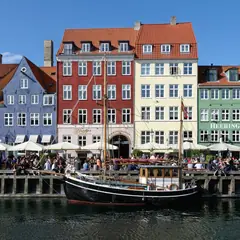
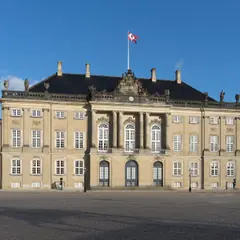
Her creator is linked to Nyhavn, the canal where Andersen wrote his first tales and lived in three houses, and the way back to the centre along the harbour passes the Amalienborg Palace, the royal family’s residence.
A small mermaid against the horizon
Langelinie promenade
Summary of this stop
From the Langelinie promenade, the first thing that strikes is the scale: an almost life-sized figure, 1.25 metres and 175 kilos of bronze, facing the mouth of an entire harbour and the cruise-ship quay. It is no oversight. In September 1912 a trial mermaid was set up on this very spot for a week; Jacobsen had already ruled out placing her on an islet as too expensive, and Eriksen demanded she stand high and free, outlined against water and sky, rather than boxed in beside the quay and an iron fence.
Smallness has generated its own story. Tired of hearing that the Little Mermaid was smaller than expected, a restaurateur planted in the mid-2000s, a few hundred metres away, a granite mermaid about four metres tall, so convincing that, as locals told it, many tourists took it for the real one. Neighbours’ complaints ended up sending it in 2018 to Dragør. Near Langelinie, on the other hand, another legitimate sister remains: Bjørn Nørgaard’s «genetically modified» mermaid, installed in 2006. The narration, heard there, explains why size is precisely the key to understanding the figure.
A mermaid halfway
Den Lille Havfrue
Summary of this stop
On the shore, facing the statue, the figure changes meaning. The dancer who inspired it never posed: Ellen Price, soloist of the Royal Danish Ballet, turned the sculptor down with a phrase that became famous, «a royal soloist does not pose for an artist». The body is that of Eline Eriksen, the sculptor’s wife, who posed for some 350 hours of work. Whether the face is Price’s or also Eline’s remains a disputed matter: accounts differ, and Eriksen himself came to say the statue did not look much like the dancer.
The most striking feature is at the bottom: the mermaid ends in two fish tails, when Andersen’s tale describes one. According to a documented tradition, Eriksen’s first sketch had no tail but legs and feet, and Jacobsen refused to accept it because, for him, a mermaid had to have a tail. After the disagreement, the brewer left the decision to the artist, who agreed to a middle ground. What came out of that tug of war is best appreciated with the audio guide in front of the stone.
The mermaid’s neck
The mermaid's neck and arms
Summary of this stop
In profile, the bronze tells another story, that of a repeated victim. In April 1964 the head was sawn off and stolen; it never turned up, and the founder Lauritz Rasmussen had to cast a new one from Eriksen’s original plaster model. The homicide squad investigated without result, and by 1997 at least 200 people had confessed to the police without being able to prove it. Authorship is still disputed: Situationist artists and a painter have been named, and nobody was convicted.
On 6 January 1998 the mermaid lost her head for a second time, in an episode involving a photographer who years later admitted taking part. On the night of 10 to 11 September 2003 she was toppled from her rock with explosives and turned up in the harbour water. Before all that, she had already been painted in the 1960s, and in 1984 an arm was sawn off, which its authors ended up returning. How much of the bronze of 1913 is left today is a question the narration poses in front of the figure’s very neck.
The rock everyone wants to use
The mermaid's rock
Summary of this stop
Past the mermaid, the gaze goes to the rock. On 25 March 2010 the statue left Denmark for the first time, separated with her rock from the stones beneath, to preside over the Danish pavilion at the Shanghai Expo, while a video installation by Ai Weiwei broadcast her live; she returned on 20 November that year. The stone has also served as a noticeboard: in 2017 the statue appeared painted red with a slogan against whaling in the Faroes, in 2020 the graffiti «RACIST FISH» appeared on the plinth and in 2023 the rock awoke in the colours of the Russian flag. There is even debate over whether the figure on display is the original or an exact copy.
The mermaid’s image has an owner: its rights belong to Eriksen’s heirs until 1 January 2030, and a lawsuit over a caricature in the newspaper Berlingske reached the Danish Supreme Court, which in 2023 acquitted the paper on the principle of parody. Popular belief holds that a kiss to the statue and a flower at her feet guarantee safe sailing, and the city even considered moving her a few metres out to sea. The mermaid is still in her place, beside the shore, and the end of the story is heard right there.