Historic harbour
Nyhavn Audio Guide
Copenhagen's most photographed postcard was once a quay of taverns, emigrants and tattooists, the canal where Andersen wrote his first tales and a car park that the city decided to hand back to the sailing ships.
- 40 min of audio
- 17th-century canal
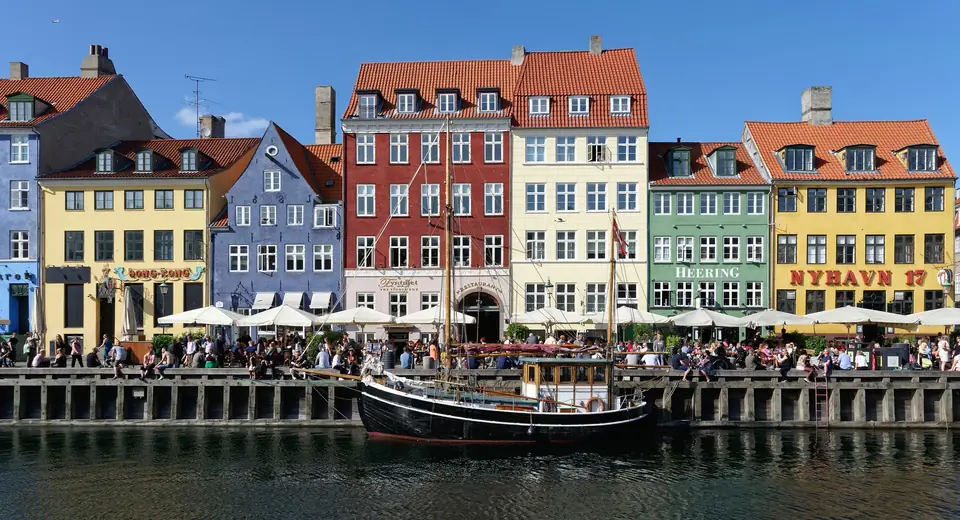
Nyhavn is a 450-metre canal dug between 1671 and 1673 by Danish soldiers and Swedish prisoners of war, following the plan of the Dutch engineer Henrik Ruse, so that ships could reach Kongens Nytorv from the sea. On one side stands Charlottenborg, home of the Royal Danish Academy of Fine Arts since 1754; opposite, a row of coloured houses holds the oldest on the canal, from 1681, and three addresses where Hans Christian Andersen lived.
Behind the terraces lies a less friendly history: from 1800 the north bank had a reputation for beer, sailors and prostitution, and since 1884 a tattooist has worked in a basement at number 17, the oldest tattoo studio still in business in the world. In the mid-20th century the canal was left almost without ships and the quay ended up as a car park, until in 1977 it was reborn as a harbour for veteran and museum ships.
Highlights
- Nyhavn 20 — the flat where Andersen wrote the tales he published in 1835
- Tattoo Ole — the oldest tattoo studio still in business in the world, since 1884
- Nyhavn 9 — the oldest house on the canal (1681), still at its original height
- Charlottenborg — a palace built with the bricks of a demolished castle
- Mindeankeret — the anchor of the frigate Fyn, for the sailors killed in the war
The yellow, red and orange houses of Nyhavn are the image Copenhagen exports to the world, but the history of Nyhavn begins with picks and spades: between 1671 and 1673, under Christian V, Danish soldiers and Swedish prisoners cut a 450-metre gash from the harbour to Kongens Nytorv. What followed was not a postcard but a working quay. From 1800 the north bank filled with hotels, emigration agencies, sailors’ taverns and steamers, and the district earned a reputation for beer and prostitution. After the Second World War overland transport emptied the canal; for some years the quay served as a car park, until in 1977 it was inaugurated as a harbour for veteran and museum ships, and in 1980 it became pedestrian.
What to see in Nyhavn goes far beyond the façades. A house from 1681 that refused to grow, the Baroque palace of Charlottenborg, three Andersen addresses, a tattooist’s basement open since 1884 and an anchor that gathers the city every Christmas Eve. There is a popular explanation for the colours, that they were painted that way so drunks could find their home at night, which has never been proven. And a few doors along, one house is still called «the Gold Maker’s» after a 17th-century alchemist and his lawsuit with a physician. The audio guide, documented and checked against historical sources, covers the whole inner stretch, from bank to bank, to read the canal as what it was: a quay of work, revelry and mourning that the city came close to losing.
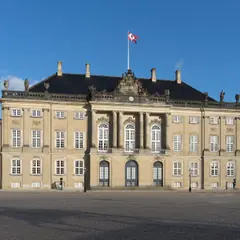
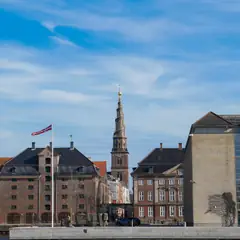
From the canal, a walk along the harbour leads in a few minutes to Amalienborg Palace and, following the water north, to the Little Mermaid, the bronze inspired by an Andersen tale. Across the harbour, in Christianshavn, rises the spire of the Church of Our Saviour.
Charlottenborg: bricks from another castle and a renamed canal
Charlottenborg
Summary of this stop
The route starts at the corner where the canal meets Kongens Nytorv, facing the brick façade of Charlottenborg. The mansion was built between 1672 and 1683 by Ulrik Frederik Gyldenløve, an illegitimate son of Frederick III, with bricks brought from his castle of Kalø in Jutland, which he had pulled down. Since 1754 it has been the seat of the Royal Danish Academy of Fine Arts, and today it shares the building with the Kunsthal Charlottenborg.
The canal running at its feet was born at the same time, as part of Henrik Ruse’s master plan to give the city direct access from the sea. Its first name, according to documented tradition, was Gyldenløves Kanal, probably after the palace’s neighbour. Copenhageners ended up calling it in their own way, «the new harbour», although it belongs to the oldest part of the port. How a popular nickname displaced the name of a king’s son is the first clue the narration reveals in front of that façade.
Nyhavn 20: the flat of Andersen’s first tales
Nyhavn 20
Summary of this stop
On the south bank, a plaque on the façade of Nyhavn 20, today part of the Hotel Bethel, records that Hans Christian Andersen lived there when he published his first tale. He rented two rooms on the second floor from 1 September 1834, and in them he wrote the stories that came out in May 1835: «The Tinderbox», «Little Claus and Big Claus», «The Princess and the Pea» and «Little Ida’s Flowers».
Living there was not idyllic. While he was working on «The Improvisatore», his landlady and the maid opened the windows and poured water on the floor of the next room so that the four children of the house could skate when it froze. Fed up, Andersen moved out on 1 December 1838 to the Hotel du Nord. But he did not say goodbye to the canal: over twenty years he lived in three houses on Nyhavn, the second at number 67, on the opposite bank, where sources do not agree on the exact dates of his stay.
The last was number 18, right next door, where he spent his final years from 1871 until his death in 1875. There, already celebrated, he received on 23 February 1873 a visit from King Christian IX and Prince Valdemar. From the young man fleeing a frozen floor to the writer visited by the king there are only a few metres of quay.
The bascule bridge: an empty canal that filled up again
Nyhavn bascule bridge
Summary of this stop
From the middle of the 1912 bascule bridge, the structure of Nyhavn can be read: on one side, the outer stretch open to the harbour; on the other, the inner stretch of wooden sailing ships. This bridge replaced a temporary wooden footbridge of 1874-1875, the first to cross the canal.
The story of the ships explains today’s landscape. As ocean-going vessels grew, Nyhavn was left to small Danish coastal trade, and after the Second World War overland transport took that away too. In the early 1950s the last steamers and potato boats disappeared, and the canal was left almost empty. After the association Nyhavnsforeningen was founded in the mid-1960s, Mayor Egon Weidekamp inaugurated in 1977 the harbour for veteran and museum ships; in 1980 the quay, which until then had been used as a car park, became pedestrian.
Since then the south side of the inner stretch has been reserved for National Museum ships and the north side for private wooden sailing ships that still put to sea. Among them is one with a not entirely respectable past, built in 1920 for a very specific purpose and seized by customs off Helsingør in 1923; its full story is left for the narration.
Nyhavn 17: tattoos, taverns and songs on the sunny bank
Nyhavn 17
Summary of this stop
The north bank, today a continuous row of terraces, was from 1800 the less respectable side of the canal: sailors’ taverns, emigration agencies and a reputation for beer and prostitution. On the corner with Lille Strandstræde, the orange building at Nyhavn 17 keeps the liveliest witness of that world: in its basement a tattooist has worked since 1884, the oldest tattoo studio still in business in the world. Its first customers were sailors and prostitutes, it has been called «Tattoo Ole» since 1947 and even King Frederick IX passed through.
A few doorways along, Nyhavn 9 draws attention for the opposite reason: it is lower than its neighbours. It is the oldest house on the canal, from 1681, probably built for the harbour captain Christen Christensen, and one of the few not raised in the 19th century, so it keeps its original height.
At number 17 itself lived, according to documented tradition, the lyricist Sigfred Pedersen, author of «Nu går våren gennem Nyhavn», the song with which Denmark sings the spring on the canal. He also immortalised the Shanghai tavern, which stood at number 27 and whose bar, under another name, is still open. What name it serves under today is left for the audio guide, at the quayside.
Mindeankeret: the anchor of the sailors who never returned
Mindeankeret
Summary of this stop
The route ends where the canal begins, beside Kongens Nytorv, in a cobbled hollow presided over by a large anchor with the monogram of Frederick VII. This is the Mindeankeret, the anchor of the frigate Fyn, inaugurated on 29 August 1951 in memory of the Danish sailors killed in the Second World War. Before it the spot was occupied by a 10-metre wooden cross, raised on 26 September 1945, and another of marble, from 1948.
Beneath the anchor lies a lead capsule with 1,600 names, and every Christmas Eve since 1945 a ceremony is held there. Sources do not fully agree either on the number of sailors the inscription commemorates or on the date the anchor was made, a mismatch the narration handles with care.
Very close by, the quay holds another episode, dark and disputed: it is said that tickets for the Titanic’s maiden voyage were sold at an office in Nyhavn, and three houses on the canal contest having been that ticket window. Which of them still keeps a clue engraved in the first-floor windows is the last detail revealed right there.