Baroque and viewpoint
Church of Our Saviour Audio Guide (Vor Frelsers Kirke)
A Baroque brick church that waited more than half a century for its spire and ended up crowned by a spiral of black copper and gold, with an outdoor staircase that climbs to a golden Christ 90 metres above Christianshavn.
- 60 min of audio
- Danish Baroque
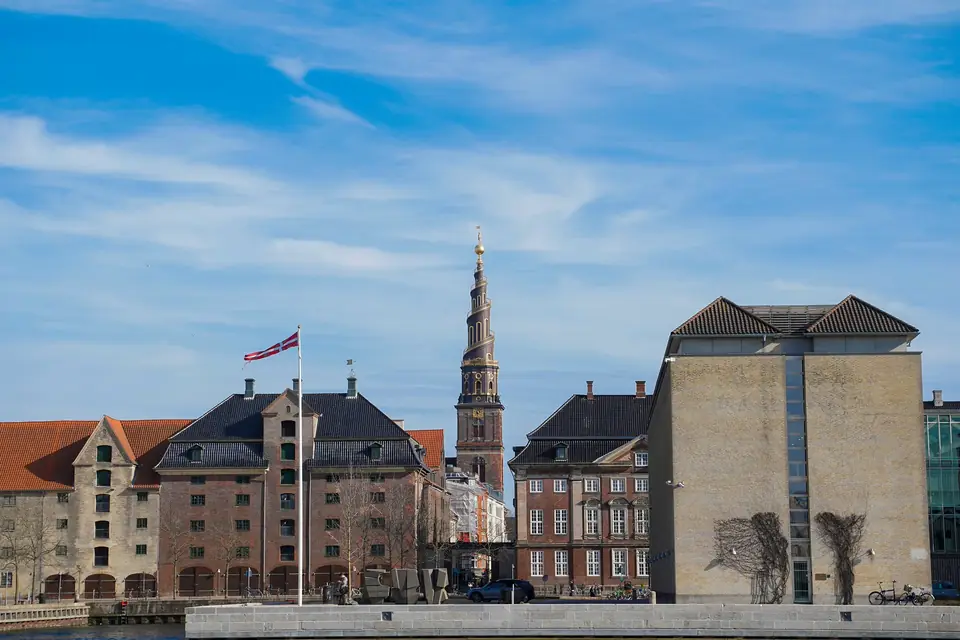
Christian V laid the first stone in 1682 on a marshy plot that had to be filled and drained, and Lambert van Haven's church was consecrated in 1696 with the king present. Inside, his hand shows everywhere: some 40 elephants, emblem of the Order of the Elephant, an organ carved in 1698 and a marble altarpiece by Nicodemus Tessin the Younger. Outside, the history of Vor Frelsers Kirke culminates in the helical spire that Lauritz de Thurah raised between 1749 and 1752, inspired by Borromini's lantern at Sant'Ivo alla Sapienza in Rome.
Beneath the floor lies another story: that of Elisabeth Helene von Vieregg, secret wife of Frederick IV in a bigamous marriage, who died in childbirth at the age of 25. According to documented tradition, she and her son spent almost a century walled up in the tower crypt before being buried again beneath the church floor in 2007. And at the top, on the hour every hour, the 48-bell carillon sends over the rooftops a melody that can be a hymn or a Michael Jackson song.
Highlights
- Helical spire — a spiral of wood and copper of 1752 with an outdoor staircase of 150 steps
- Summit at 90 metres — a 2.5 m golden globe that would hold 12 adults and a Christ with a banner
- Organ of 1698 — a Baroque façade resting on two wooden elephants
- Tessin's altarpiece — marble and gold, consecrated in 1732 after decades of work
- 48-bell carillon — the largest in northern Europe, with a melody on the hour
The most recognisable silhouette in Christianshavn is, in fact, the end of a long wait. The Church of Our Saviour, Vor Frelsers Kirke to the Danes, began to be built on 19 October 1682, when Christian V laid the first stone on marshy ground that had to be filled and drained. Lambert van Haven’s building was consecrated on 19 April 1696 (some popular sources bring the date forward to 1695, but the building accounts fix 1696), and its tower was left for more than fifty years with a simple tiled hood. The spire that now defines the district’s skyline did not arrive until 1752.
In between pile up royal whims, ballooning budgets, marbles that never arrived, a pulpit sunk at sea and a tomb that ended up walled in. What to see in Vor Frelsers Kirke goes far beyond the climb up the tower: the history of this church is written in its wooden elephants, in its blocked-up windows and beneath its own floor. The audio guide covers all of it from the street to the interior and ends on the outdoor staircase, with a narration documented and checked against historical sources that is best heard there, with the spiral overhead.
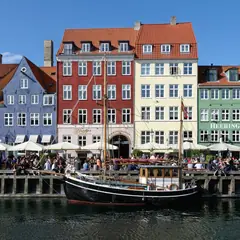
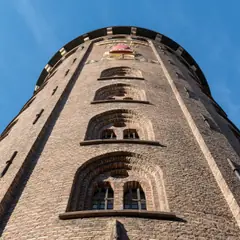
The city’s other great climb is the stepless ramp of the Round Tower, in the old town, and across the harbour opens the canal of Nyhavn, with its coloured houses and sailing ships.
The tower that was left without a spire
Vor Frelsers Kirke
Summary of this stop
Facing the tower’s sandstone portal, the architecture of Vor Frelsers Kirke tells of two distinct eras. Below, van Haven’s brick; above, the spiral he had drawn and never saw. In 1693 the tower was topped with only a small pyramidal tile hood, and the church lived like that until 1749.
The impulse came in 1747, when Frederick V donated 5,000 rigsdaler to build the spire according to the model once approved by Christian V. But Lauritz de Thurah imposed his own design, budgeted at 25,857 rigsdaler against the old one’s 15,500, and the Copenhagen magistrate even protested by letter to the Chancellery.
Thurah was inspired by Borromini’s lantern at Sant’Ivo alla Sapienza in Rome and swapped the sandstone of his first project for copper-clad wood. That lighter choice is the key to the whole silhouette: it allowed a much taller spiral without lopping the existing tower. What that lightness hides is discovered in the narration, in front of the portal.
The king of elephants and a secret wife
Organ on two elephants
Summary of this stop
Beneath the organ gallery, Christian V’s presence is hard to ignore. The Baroque façade, carved by Christian Nerger and dated 1698, bears the king’s golden monogram, his bust and two wooden elephants that seem to carry all the weight. They are not the only ones: the church hides some 40 elephants, emblem of the absolute monarchy and of the Order of the Elephant, which the monarch had just made the highest in the kingdom.
A few steps away, the white marble font, held up by four cherubs beneath a golden canopy with a count’s coronet, opens the darkest episode of the church. According to documented tradition, it was a gift from Elisabeth Helene von Vieregg, a mistress of Frederick IV, whom the king secretly married in 1703 although Queen Louise was still alive. She died in childbirth in 1704, aged 25, and was buried in the south crypt of the tower beside her son, who died the following year.
In 1889-90, when the tower staircase was rebuilt, the two coffins were walled up in a wall. Their end, much more recent than one might expect, is revealed by the audio guide at this very spot.
A chancel where nothing arrived on time
Tessin's altarpiece
Summary of this stop
The altarpiece by Nicodemus Tessin the Younger, in marble and gilded wood, shows Christ comforted by an angel in Gethsemane on a blue background, between the figures of Pietas and Justitia. Its figures were ready around 1700, but the marshy ground meant spending a couple of years just draining, and between 1713 and 1725 the works stood still. In 1728, 184 men from the Holmen naval base set up the scaffolding to hoist the marble blocks; the consecration came in 1732. The two side windows of the east end were blocked at Tessin’s wish, so that the altarpiece would not be backlit.
The pulpit has its own odyssey. In 1696 Christian V gave one of Norwegian marble that was shipwrecked on the crossing to Copenhagen, and the temporary wooden one stayed in use for almost 80 years, until in the summer of 1773 the present one, by C. F. Harsdorff and Johannes Wiedewelt, was installed.
From that pulpit N. F. S. Grundtvig preached between 1822 and 1826. He resigned a week before Whitsun, after losing a libel suit with Professor H. N. Clausen and after being forbidden to sing his hymns here for the millennium of Danish Christianity. The narration reconstructs that clash in front of the altar.
Four hundred steps up to the ugly Christ
Helical spire
Summary of this stop
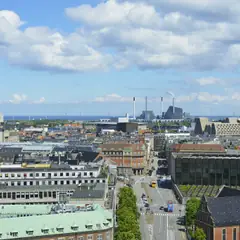
The climb up the tower is about 400 steps: the first ones inside the old tower and the last 150 outside, on a staircase that makes four turns anticlockwise around the spire and narrows as it rises. More than 200,000 people climb it every year. At the top, 90 metres from the ground to the tip of the banner, the golden globe measures 2.5 metres in diameter, and 12 adults would fit inside.
Above it stands a triumphant Christ, the work of the coppersmith Jacob Høvinghof, placed in 1750; its height varies by source, around 3 metres. It has a reputation as the ugliest sculpture in Copenhagen, because its proportions were deliberately exaggerated so that it can be read from far away. There is also an urban legend according to which Thurah threw himself from here on seeing that the spiral turned the wrong way, but he died of illness in 1759, and the spiral turns in the same direction as its Roman model. The staircase even has literary history: in Journey to the Centre of the Earth (1864), Jules Verne makes young Axel climb it five days in a row to cure his vertigo.
And the spire sounds. Every hour on the hour, from eight in the morning to midnight, the 48-bell carillon, the largest in northern Europe, plays a short melody that can range from a hymn to a pop song. How that tradition began, and why it still gives people something to talk about, is told at the top, with Copenhagen at one’s feet.