Mosque and centre of learning
Al Quaraouiyine Mosque Audio Guide
A mosque almost invisible from the street that has for over a thousand years marked the hour, the faith and the study of Fez, and keeps behind its door a sultan’s library with four keys.
- 30 min of audio
- 9th-century mosque
Al Quaraouiyine is the great mosque of Fes el-Bali and the centre of learning around which the medina grew. Work began in 859, under the Idrisid ruler Yahya I, and it takes its name from the emigrants from Kairouan, the qarawiyyin. For over a thousand years every dynasty enlarged it: the caliph of Córdoba Abd al-Rahman III paid in 956 for the square minaret that still stands, the Almoravids gave it ten aisles and a minbar from a Córdoban workshop, and the Saadians added two pavilions to the courtyard inspired by the Court of the Lions of the Alhambra.
Its origin holds a riddle. Tradition attributes the foundation to Fatima al-Fihri, who is said to have paid for it with her own money, but in the 20th century an inscription in cedar turned up under the plaster naming another founder, Dawud ibn Idris, in 877. And although Guinness recognises it as the oldest educational institution still in operation in the world, it was not a state university until 1963, and historians still debate when formal teaching began there.
Highlights
- Square minaret of 956 — its call to prayer gives the signal to the other mosques of Fez
- Rose Gate (Bab al-Ward) — Almoravid bronze leaves and a view of the courtyard and its fountains
- Saadian courtyard pavilions — of 1587 and 1609, modelled on the Court of the Lions
- Abu Inan Library (1349) — a manuscript room with a four-key door and a book donated by Ibn Khaldun
- Dar al-Muwaqqit — the timekeeper’s room and its water clock of 1361
In the heart of Fes el-Bali stands an enormous building that can hardly be seen. Al Quaraouiyine, also written Al-Qarawiyyin, is the mosque around which the religious and intellectual life of Fez was organised for centuries. Work began on 1 Ramadan of the year 245 of the hijra, 30 November 859, and its name recalls the emigrants from Kairouan who settled on this bank of the city. Since then every dynasty has left its signature: the enlargement of 956 financed by the caliph of Córdoba, the ten Almoravid aisles finished in 1143, the great Almohad bronze chandelier for 520 candles, the Marinid lamps made from church bells and the Saadian pavilions of the courtyard.
The history of Al Quaraouiyine is also that of its debates. Guinness recognises it as the oldest educational institution still in operation in the world, and the Arab press calls it without qualification the oldest university; but it did not become a state university until 1963, and the date when formal teaching began is placed very differently depending on the historian, from the Almoravid period to the Marinid. Nor is the question of its founder closed, nor the oft-repeated idea that the future Pope Sylvester II studied here: modern research has produced no evidence to support it.
The interior is reserved for Muslim worshippers, so the visit goes around the mosque on the outside. What to see at Al Quaraouiyine comes down to three thresholds: the minaret that rises between the shops, the Rose Gate that shows the courtyard when it is open and the library entrance in the coppersmiths’ square. The audio guide, documented and checked against historical sources, accompanies that route in thirty minutes.
A few minutes’ walk away are the Nejjarine Museum and the vats of the Chouara tannery, and up the street the Bou Inania Madrasa, which was at once a student residence and a Friday mosque.
A minaret that sets the hour for Fez
Square minaret of 956
Summary of this stop
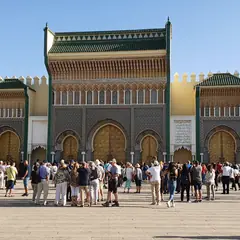
The first bewilderment is not finding the mosque. On the north-west side, the building is so hemmed in between houses and stalls that it can only be guessed at from its entrances. Around 1526 Leo Africanus spoke of a temple of incredible size, with thirty-one doors of enormous height; in 1861 the German traveller Gerhard Rohlfs saw it, by contrast, as half sunk in the ground. Rohlfs gave the key: the mosque was one of the richest in Fez and owned, by his account, a third of the shops in the city, so a good part of what hides it was its own.
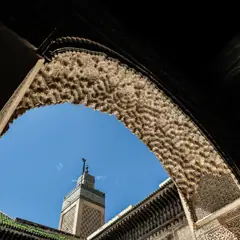
Above that labyrinth rises the minaret with a square shaft. It was built in 956 by the Zenata emir Ahmed ibn Abi Said, with the permission and funds of Abd al-Rahman III, in the enlargement that took the mosque to its present eastern and western limits; its poor-quality stone forced the Marinids to restore it in 1286. From here the muezzin of Al Quaraouiyine sets the hour for the whole city: the other mosques of Fez give their call only after hearing his, a custom that remains in force.
At the foot of the minaret the Marinids installed the Dar al-Muwaqqit, the timekeeper’s room that fixed the hours of prayer. Its last water clock, commissioned by the sultan Abu Salim and finished on 20 November 1361, keeps an astrolabe 71 centimetres in diameter, though without its mechanism. Nearby, another tower is often mistaken for a second minaret, and why that mistake is made is told in the narration, right there.
The Rose Gate and the founding riddle
Bab al-Ward gate
Summary of this stop
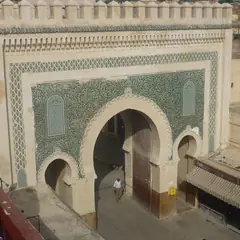
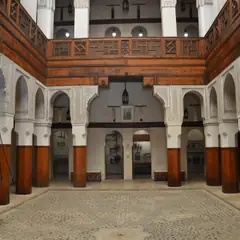
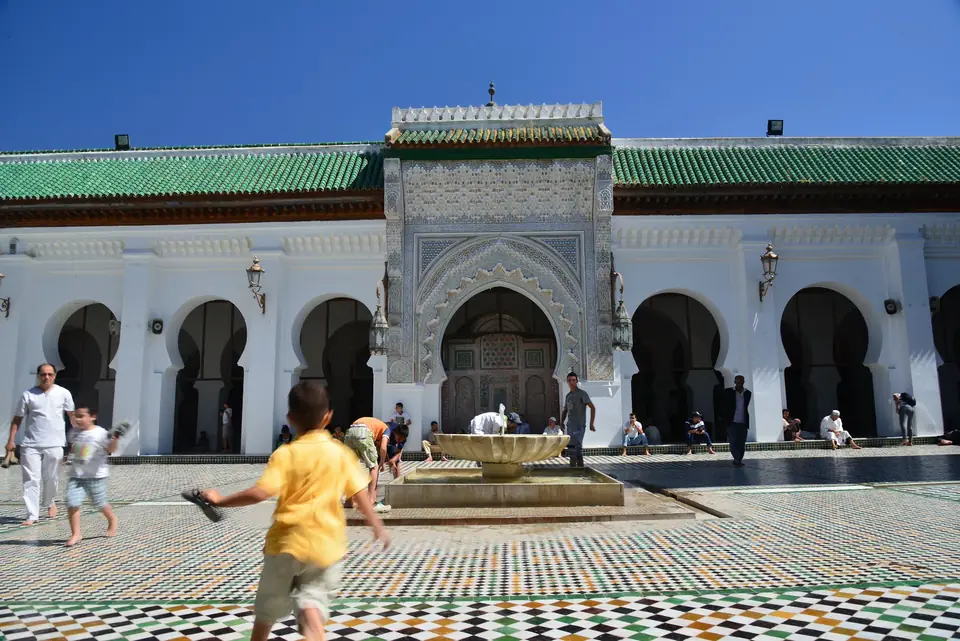
Bab al-Ward, the Rose Gate, is the main north entrance and the visitor’s great window: its wooden leaves keep their Almoravid bronze cladding, restored between 2005 and 2007, and when it is open it shows the courtyard, its fountains and, at the ends, the two Saadian pavilions with slender marble columns. The eastern one was raised by Ahmad al-Mansur in 1587-1588 and the western one by his grandson Abdallah al-Ghalib II in 1609, both modelled on the Court of the Lions of the Alhambra. At the far end, on the axis of the mihrab, appears the anaza, a screen of carved and painted wood that the Marinids set up in 1289: it serves as a summer mihrab for those who pray in the courtyard and occupies, according to tradition, the site of the mosque’s first minaret.
From this threshold the courtyard tells two stories that do not fit together. According to the traditional account, the work was paid for by Fatima al-Fihri, daughter of a family that had emigrated from Kairouan, and it is said she fasted while the work lasted and used only earth, plaster and stone taken from the site itself. But in a 20th-century restoration there appeared, hidden for centuries under the plaster and over the probable site of the original mihrab, a Kufic inscription on cedar panels that attributes the founding of this mosque to Dawud ibn Idris, son of Idris II, in 877. Gaston Deverdun deciphered it, and the debate has remained open ever since: some historians consider Fatima possibly legendary and others believe the inscription came here from another mosque.
That plaster has its own history. Around the Almohad conquest of Fez, in 1145-1146, the most ornate Almoravid decoration beside the mihrab was covered with hastily prepared lime, which did not quite take; that haste made it possible to remove it in the early 20th century and preserve a good part of the original decoration. What the courtyard reveals about that decision is heard in the audio guide, before the gate.
Four keys for a treasure of manuscripts
Bibliothèque Al Quaraouiyine
Summary of this stop
In the Seffarine square, amid the hammering of the coppersmiths, the most unexpected side of the mosque opens: the entrance to its library, separated since the reform of 1940 so that foreigners and non-Muslims could enter without crossing the prayer hall. It was founded by the Marinid sultan Abu Inan in 1349, according to the inscription on its door, and came to gather some 30,000 manuscripts, many destroyed, stolen or plundered over the centuries. In 1396 Ibn Khaldun donated to the students of Fez a volume of his Kitab al-Ibar, the one that begins with the Muqaddima; UNESCO inscribed it in 2011 in the Memory of the World programme.
The old manuscript room was closed by a door with four locks whose keys were kept by four different people, who had to be present at the same time to open it. Today, behind metal doors and shutters closed against the sun, some 3,800 titles are kept, among them a 9th-century Quran in Kufic script and a medical treatise in verse by Ibn Tufayl. From 2012 the Fassi architect Aziza Chaouni led a restoration that, among other problems, stopped the sewage leaks that threatened the manuscripts.
This library also saw the institution change: in 1963 a royal decree made Al Quaraouiyine a state university, classes left the old mosque for a former French barracks, and in 1988 Hassan II resumed traditional teaching after almost three decades of pause. Among the most requested books in the collection is one that nobody would expect in a mosque, and the story of who copied it and why is kept for the narration, before the library door.