Marinid art
Bou Inania Madrasa Audio Guide
The largest and most luxurious madrasa of the Marinids, the only one that was also a Friday mosque: a marble courtyard crossed by a river, a minaret of green zellige and, across the street, a water clock of 1357 that nobody has managed to set going again.
- 45 min of audio
- Marinid architecture
The Bou Inania Madrasa was begun on 28 December 1350, according to its foundation inscription, and finished in 1355, on the orders of the Marinid sultan Abu Inan Faris. It was the only Marinid madrasa raised to a Friday mosque: the weekly sermon was delivered here, and that is why it had a minbar and a minaret of its own at the north-west corner. Its architecture rises from the zellige dados to the epigraphic frieze, the carved plasterwork and the cedar of the eaves, around a marble courtyard with a central fountain.
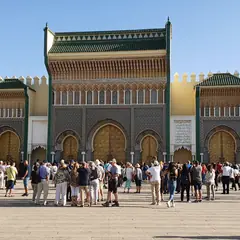
The contrast begins in the street. Opposite the main door, on the Tala’a Kebira, the façade of Dar al-Magana still stands, a hydraulic clock finished in 1357 that told the time by dropping iron balls into copper bowls. It has been stopped for generations, its mechanism is lost and attempts to rebuild it have come to nothing: the madrasa has students again, while the clock opposite stays silent.
Highlights
- Dar al-Magana clock — a façade of 1357 with cedar corbels where the copper bowls once rang
- Marble courtyard — central fountain, zellige, carved plasterwork and cedar up to the eaves
- Wadi Lamtiyyin channel — a branch of the Fez river that crosses the courtyard under two small bridges
- Green zellige minaret — the sign of its rank as a Friday mosque, visible from Bab Bou Jeloud
- Side classrooms — great cedar doors carved with stars and wooden domes
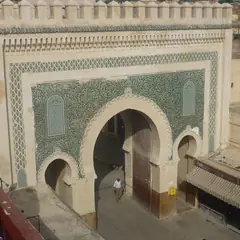
At the top of the Tala’a Kebira, the great street that descends through the medina of Fez from Bab Bou Jeloud, a horseshoe arch framed in plasterwork opens the most ambitious madrasa of the Marinids. The history of the Bou Inania Madrasa starts with a sultan who had come to the throne in 1348 by rebelling against his own father: Abu Inan Faris ordered work to begin on 28 December 1350 and saw it finished in 1355. Other sources date it between 1351 and 1356, or give it as inaugurated in 1357, and the debate remains open.
What sets it apart from the other madrasas of the city is its double status. It was a school and a student residence, but also the only Marinid madrasa raised to a Friday mosque, with its weekly sermon, its minbar and its minaret. A branch of the Fez river crosses its courtyard and separates it from the prayer hall. Its fortunes have changed over the centuries: an earthquake in the 17th century forced its restoration, the Alaouite sultan Moulay Sliman (1792–1822) rebuilt entire sections of walls and the 20th century renewed its plasterwork, woodwork and zellige. Since 2017 it has housed students again. Followed with the audio guide, the visit begins in the street, before a silent clock, and ends beside the water.
Its minaret can be made out from Bab Boujloud, a little over a hundred metres away, and deeper into the medina the Al Quaraouiyine Mosque completes the story of learning in Fez.
The clock that stopped striking on the Tala’a Kebira
Dar al-Magana
Summary of this stop
Before crossing the door, the eye is drawn to the other side of the street. There the façade of Dar al-Magana survives: a row of small windows framed in plasterwork on carved cedar corbels, now empty, and protruding beams that held up a vanished little roof. It was a hydraulic clock, finished on 6 May 1357 and designed by the muwaqqit Abu al-Hassan ibn Ali Ahmed el-Tlemsani to serve the madrasa and its mosque, although one source attributes its origin to an earlier sultan.
Its workings were as easy to read as they were hard to maintain. Every hour an iron ball fell into one of the copper bowls and rang, and the small window above stayed open: whoever passed along the Tala’a Kebira knew the time by counting windows. The hours were unequal, tied to sunrise and sunset, so the timekeeper had to readjust the mechanism every night. Even the number of bowls is unclear: some descriptions speak of twelve and others of thirteen.
The clock has been stopped for generations. In 2004 the bowls were removed to try to rebuild it under the management of ADER-Fes, without success to date, although the façade was restored in the early 2000s. The medina, for its part, did not put its silence down to lost parts: according to a tradition still told in the early 20th century, behind it lies a duel of magicians, and another version speaks of a sorcerer’s revenge. Which of the two is told before the empty corbels, and why, is revealed by the narration on the spot.
A marble courtyard for a rebel sultan
Marble courtyard with central fountain
Summary of this stop
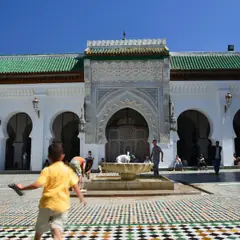
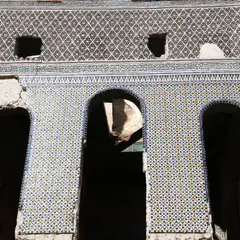
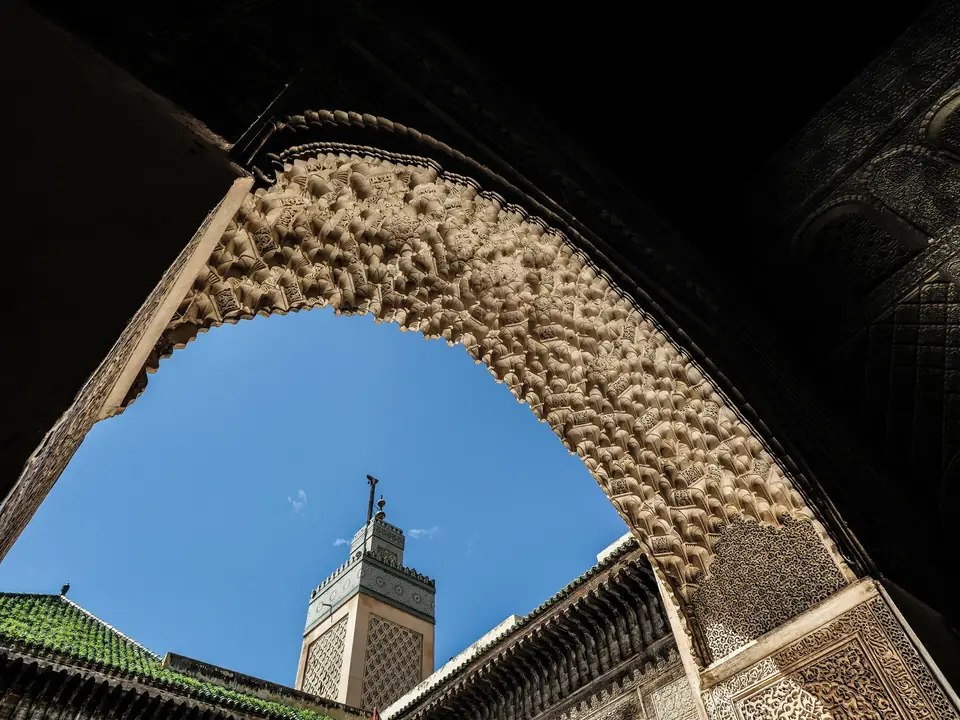
Beyond the vestibule, covered by a muqarnas dome of cedar, a rectangular courtyard paved in marble opens, with the remains of the fountain basin in the centre and galleries with wooden lattices between the pillars. The decoration reads from the bottom up: dados of geometric zellige, a band of tiles with inscriptions, carved plasterwork and, at the very top, cedar wood up to the eaves on corbels.
So much beauty was born quickly. Abu Inan Faris, who had proclaimed himself sultan against his father Abu al-Hasan, saw the madrasa finished in 1355 and was strangled on the orders of his vizier on 10 January 1358, less than three years later. The foundation inscription in the prayer hall fixes the date work began and also lists the assets of the pious foundation that was to sustain it.
Part of what shines today, however, is not of the 14th century. The 17th-century earthquake, the rebuilding of walls under Moulay Sliman and the 20th-century restorations have left their mark on the courtyard. What is Marinid and what is repair, and what that mixture says about the sultan who commissioned it, is better understood with the narration beside the fountain.
Cedar doors and students with free clothes
Side classroom with cedar door
Summary of this stop
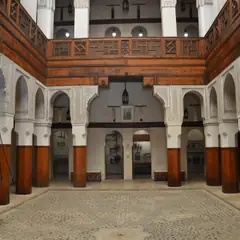
To the east and west of the courtyard open two square classrooms about five metres on a side, with muqarnas arches, great cedar doors carved with geometric stars and wooden domes with radial ribs. They were the heart of a genuine study machine: the foundation paid professors good salaries and exempted each student from the cost of his clothing for seven years. The work was directed by Abu al-Hasan ibn Ahmad ibn al-Husayn ibn Ahmad ibn Askar.
Ambition was not enough to dethrone the Qarawiyyin, larger and older. The Bou Inania functioned autonomously for a time, but never came to rival it as a centre of study.
The twist comes in the present. Rehabilitated since 2017 and reopened as a student residence linked to the Qarawiyyin University, the madrasa houses students again in its 40 rooms, which coexist with the tourists who walk through the courtyard. What separates those students with paid clothes from today’s is part of the story of this stop.
A river that divides school and mosque
Water channel and its two small bridges
Summary of this stop
On the south side of the courtyard runs a channel of the Wadi Lamtiyyin, a branch of the Fez river, which separates the courtyard from the prayer hall; two small bridges at the corners give access to it. From the courtyard one sees a hall of two aisles divided by an arcade on columns of marble and onyx, with a decorated mihrab and coloured glass in plaster lattices. Non-Muslims may not enter.
That channel marks the border between school and Friday mosque. The most visible sign of that rank is the brick minaret at the north-west corner, with its square shaft covered on all four faces by the darj wa ktaf motif filled with zellige; some sources present it as the only minaret of a madrasa in Fez, although the Seffarin and other Marinid madrasas also have one, less prominent. The hall’s minbar is a replacement: the original, of 1350–1355, in wood inlaid with ebony and ivory, is in the Dar Batha Museum, and its design did not allow the imam to climb it.
In the early 16th century, the Granadan al-Hasan al-Wazzan, known in Europe as Leo Africanus, described this courtyard and its stream, and recorded what was then said in the city about an account book and the water of the channel. Historians consider that episode apocryphal, like other tales about the madrasa’s origin; what exactly the sultan in the story said is heard at the edge of the channel.