Woodwork museum
Nejjarine Museum Audio Guide (Musée Nejjarine)
A merchants’ inn of 1711 in the carpenters’ square of Fez, which was the sultan’s warehouse, a police station and a ruin before becoming a museum of woodwork that is smelled before it is seen.
- 60 min of audio
- Carved cedar and zellige
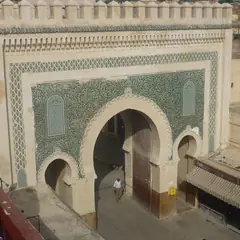
The Nejjarine fondouk was commissioned in 1711, under the Alaouite sultan Moulay Ismail, on the initiative of Abd al-Khaliq Adiyil, amin of the souks of Fez. It takes its name from the carpenters’ souk that has surrounded the square since Marinid times, and its portal is one of the few monumental façades in the medina that can be seen whole from the street. Since 1998 it has housed the museum of the arts and crafts of wood.
For two centuries itinerant merchants stored and sold their goods on the ground floor and slept on the upper floors, while the building also safeguarded precious goods of the Makhzen. In the 20th century came the fall: a colonial police station in the 1940s, an ill-judged refurbishment in 1944 and abandonment in the 1970s, until a six-year restoration rescued it.
Highlights
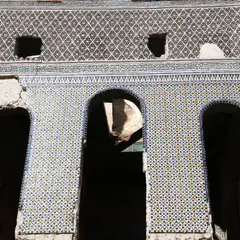
- Nejjarine fountain — eight-pointed star zellige under a blind stucco arch
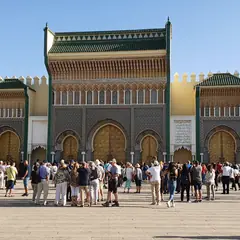
- Monumental portal — 5 x 3 metres of stucco, zellige and a carved cedar canopy
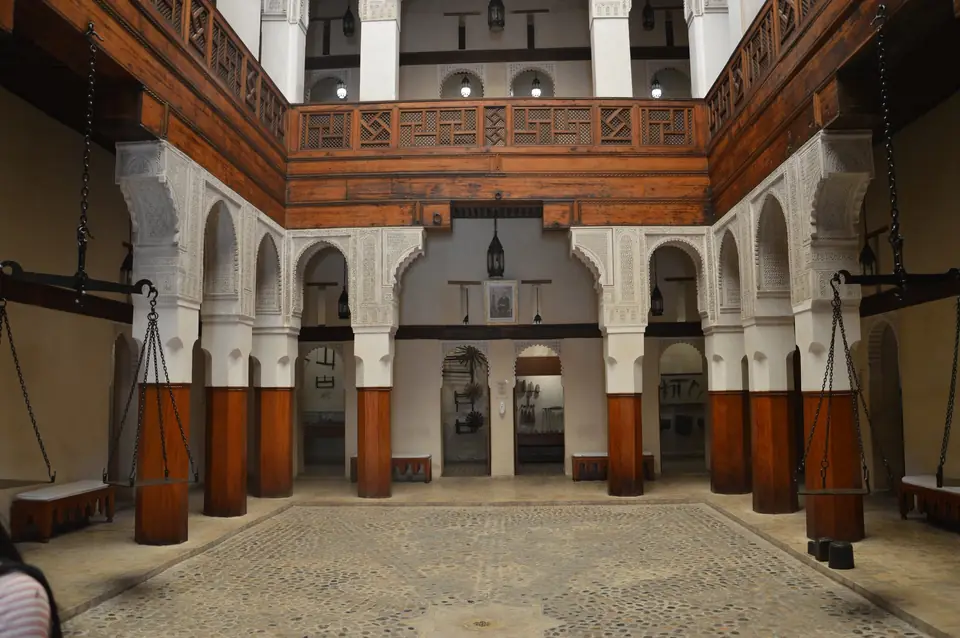
- Three-storey courtyard — galleries with cedar lattices and the fondouk’s original weighing scale
- Star-pattern cedar ceilings over the former guests’ rooms
- Rooftop — views over the medina’s roofs towards the Qarawiyyin and Jbel Zalagh
For centuries Fez had one of the greatest concentrations of trading inns in the Islamic world: under the Almohad caliph Muhammad ben Yaqub (1199–1213), 467 funduqs were taxed in the city. The Nejjarine, commissioned in 1711 under Moulay Ismail, and its twin the Funduq Sagha, of the same year, continue that tradition. Its patron, Abd al-Khaliq Adiyil, was a merchant, amin of the souks and later governor of Fez during the first reign of Abdallah ben Ismail (1729–1734); at his death, in 1747, his house, Dar Adiyel, passed to the Alaouite state.
The history of this building is one of a descent and a rescue. Declared a national historic monument in 1916, it served as a police station under French colonial authority, housed students, fell into ruin in the 1970s and reopened on 23 May 1998 as a private museum of the arts and crafts of wood, run by the Mohammed Karim Lamrani Foundation. In 2025 it received the first “Musée du Maroc” label awarded in the country. Its façade and fountain had already posed, in the midst of the First World War, for the camera of Lucien Vogel, the editor who would end up as artistic director of Vogue France: his plate illustrates plate XCVIII of Les monuments mauresques du Maroc (1922), with a caption that dated the fountain to the 18th century.
What to see at the Nejjarine Museum begins outside, in the square, and ends on the rooftop. The audio guide goes through its architecture and history in four stops, from the zellige fountain to the cedar courtyard, with the sound of the souk’s carpenters in the background.
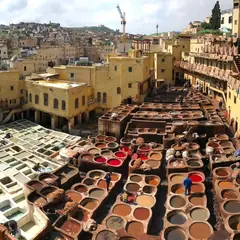
From the rooftop the Al Quaraouiyine Mosque can be made out, a few steps away, and another trade of the medina, that of leather, is still alive in the vats of the Chouara tannery.
The fountain re-tiled piece by piece
Fontaine Nejjarine
Summary of this stop
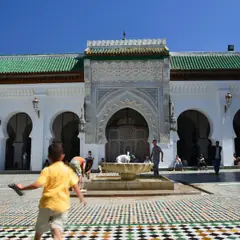
Opposite the fondouk, set against a wall of the square, stands the saqayya or public fountain that forms an integral part of the ensemble: a geometric zellige composition with eight-pointed stars, a blind stucco arch, two engaged columns and a carved cedar canopy. In the 1920s, at the request of the newly installed French colonial governor, the master zellige-maker Ahmad Benslimane retiled it; his son Muhammad later repaired it by taking down, one by one, the tiles worn by use and setting them back.
Who built it and when is a disputed matter. Some sources attribute it to the sultan Abd al-Rahman, in the 19th century; the Fassi chronicler Driss el-Jay links it, along with the fondouk, to Abd al-Khaliq Adiyil and the commission of 1711; another reference calls it a 17th-century fountain. Between the fountain and the fondouk there also operated, in the 19th century, the Fez post office, in a small shop on the square.
The city’s memory credits its water with virtues: according to a documented tradition, it was held to be blessed water, able to stand in for the sanctity of the water of Moulay Idris, the patron saint of Fez. And the name by which the street knows it is not that of the person who paid for it. What that name is, and how it came to cover the whole neighbourhood, is told by listening to the narration before the spout.
A door built to a camel’s measure
Musée Nejjarine
Summary of this stop
The fondouk’s portal measures 5 metres high by 3 wide and brings together in a single front carved stucco, zellige and Arabic epigraphy under a great cedar canopy. In a medina of blind walls, it is one of the few monumental buildings in Fez with its outer façade fully in view from the street.
The great double door has its logic: its leaves opened wide to let in a traveller on a camel or on horseback, and two smaller leaves opened for those on foot. It is the architecture of a caravan inn, designed for goods and animals before visitors.
The building’s name also has its debate. The most widespread explanation links it to the carpenters’ souk, najjarin, which has occupied the square since Marinid times (1244–1465); another attributes it to the decorative carpentry of the fondouk itself. Even the date of 1711, which is the consensus one, coexists with a reference that places its opening in the 12th century. How this door fits into the long Fassi tradition of trading inns is unfolded in the narration.
From weighing bales to police station
Scale and courtyard galleries
Summary of this stop
The central courtyard is surrounded by three-storey galleries with balustrades of wooden arches and cedar lattices, above zellige dados and white stucco spandrels. In the centre stands the great metal scale with which the fondouk’s goods were weighed. A glazed roof, added later, now closes what was a courtyard open to the sky.
From 1711 to the early 20th century the building worked as an exchange, an inn and a warehouse: merchants stored and sold their goods on the ground floor, slept on the upper floors, and the fondouk also safeguarded precious goods of the Makhzen, the royal power. Before the French Protectorate of 1912, some of its rooms were owned by Jewish merchants of Fez. Above them, coffered cedar ceilings with a geometric interlace centred on a star.
Then came the fall. In the 1940s the French colonial authority turned the building into a police station and foundations, ceilings, floors and walls began to decay; in 1944 it suffered an ill-conceived redecoration and in the 1970s it was abandoned. Legend says that the lower rooms, where merchants had kept their bales, then served as cells. What those rooms hold today is left for the narration.
From ruin to 1,400 pieces
Rooftop terrace
Summary of this stop
The rooftop opens the horizon after the half-light of the halls: a café above the roofs of the medina, with views towards the Qarawiyyin and Jbel Zalagh, and the tapping of the carpenters rising from the square. From here the scale of the rescue can be understood: the restoration, between 1990 and 1996, covered the fondouk, the fountain, the mosque and the dwellings above the shops of the square, with an estimated budget of 25 million dirhams.
The museum was born without a collection. Mohammed Karim Lamrani gathered nearly 1,400 old objects from all over Morocco: woods such as cedar, thuya or walnut, carpenters’ tools, Quranic tablets, musical instruments and objects of worship. The age of the oldest pieces is disputed: some sources place it at the end of the 17th century and others speak of the 14th. On 19 May 2025 the National Foundation of Museums awarded it the country’s first “Musée du Maroc” label.
Not everything exhibited here belonged to the museum. In 2016, 81 pieces left that the Ministry of Culture had lent to the foundation in 1997, from museums in Meknes, Marrakech, Fez and Rabat, some of them previously exhibited at the Louvre. What was taken and where it ended up is told at the end of the tour.