Former Jewish quarter
Mellah of Fez Audio Guide
A quarter with a name of salt, pressed against the royal palace wall, which lent that name to all the Jewish quarters of Morocco. Hardly any Jews remain today, but its balconies, two rescued synagogues and a hillside of white tombs still tell its story.
- 60 min of audio
- Jewish heritage of Fez
The Mellah of Fez occupies the southern end of Fès el-Jdid, between the inner and outer walls, pressed against the royal palace. The district was first called Hims and housed the sultan’s Syrian archers; its other name, Mellah, “salt” or brackish ground, passed to the Jewish quarter and from here to all those of Morocco. It is structured by Derb al-Souq, the almost straight market street that crosses it from Bab Semmarine to Bab al-Amer, with jewellers and workshops on the ground floor.
The paradox is plain to see: the balconies open to the street, which look like the quarter’s oldest hallmark, are boutiques built by the French in 1924 in imitation of Jewish houses, while the old houses were closed to the street, like Muslim ones. In the late 1940s some 15,150 Jews lived here; in 1997 about 150 remained in all of Fez, and today a Muslim family looks after its synagogues.
Highlights
- Ibn Danan Synagogue — a 17th-century temple with a ritual bath rediscovered in 1997 under the bimah
- Slat al-Fassiyin — the prayer hall of the Fassis, reopened in 2013 after being a prison, a workshop and a gym
- Jewish cemetery — some 12,000 white tombs and the blue tomb of Solica Hachuel
- Rue des Mérinides — balconies of 1924 facing the royal palace wall
- Stopped-clock arch — the old main gate and the start of Derb al-Souq
The history of the Mellah of Fez begins with a discovery in the old medina. In 1437 the body of Idris II appeared in its mosque, the surroundings were declared horm, a sanctuary closed to non-Muslims, and the main transfer of Jews from Fès el-Bali to the new royal city is linked to that moment. Many families preferred to convert, at least officially, so as not to abandon their houses and businesses: from them came the bildiyyin, Muslims of Jewish origin who kept Jewish surnames. The date remains debated: part of the historiography fixes the transfer in 1438, while other authors, such as Hicham Rguig and Susan Gilson Miller, argue for a gradual move across the Marinid period, since the founding of Fès el-Jdid in 1276.
Proximity to the palace, sought as protection, was not always enough. The quarter was attacked in 1465, banished between 1790 and 1792 and sacked in 1912, and even so it was for centuries the centre of a living community: around 1516, according to documented tradition, two Jewish printers who had come from Lisbon, Samuel ben Isaac Nedivot and his son Isaac, founded among the Jews of Fez the first Hebrew press in Africa. Weddings processed through the Mellah, with the veiled bride covered in gold carried in a chair on a man’s head, and on Saturdays the shops closed and no outsider entered. The memory of the quarter also keeps the tradition of Rabbi Yehuda ben Attar, jeweller and judge, before whom, it is said, lions sat down to listen.
What to see in the Mellah of Fez is, above all, learning to read absences: a clock that no longer tells the time, balconies that imitate what never existed, synagogues brought back to life after impossible uses and a square that covers a cemetery. The audio guide goes through the history of the Mellah in five stops, from the entrance arch to the blue tomb, documented and checked against historical sources.
On the other side of the wall lies the Royal Palace of Fez, and a little over a kilometre away Bab Boujloud marks the entrance to the old medina.
The clock that stopped when the last ones left
Stopped-clock arch
Summary of this stop
The tour starts under the great arch that was the Mellah’s main entrance coming from Bab Semmarine, a gate that guards watched at night. High up hangs a large modern clock, a rarity in a Moroccan medina, stopped since shortly after the last group of Jews left the quarter. Beneath it begins Derb al-Souq, the main street and former market.
The name of the quarter is older than its Jewish community. This southern district of Fès el-Jdid was called Hims and was occupied by the sultan’s Syrian mercenary archers, disbanded around 1325 under Abu Said; its other name, Mellah, alludes to salt, from a brackish spring or an old salt warehouse. Popular etymology says something else, that the Jews had to salt the heads of the executed displayed on the gates, and another hypothesis looks to Hebrew; the consensus settles on the neutral place name.
This corner also had a sentinel. Until the late 1980s, to the right of the entrance, an ironmonger called Solica sat smoking in front of her shop of nails, chains and pliers, chatting in Arabic and French with the accent of the Jews of Fez. She is remembered as the only Jewish woman who stayed clinging to her shop when the others left. Who she was and why her name resonates at the end of the tour is told by listening to the narration on the spot.
Balconies of 1924 facing the sultan’s wall
Rue des Mérinides
Summary of this stop
The Rue des Mérinides runs in front of the south wall of the royal palace, and its row of façades with wooden and wrought-iron balconies and stucco is the most photographed image of the quarter. It is also the most misleading: in 1924 the French demolished shops and stables on the northern edge of the Mellah to open this street, then Boukhessissat, and flanked it with new boutiques that imitate Jewish houses. The quarter’s old houses were, like Muslim ones, closed to the street.
The wall opposite explains the Mellah’s location: closeness to the palace was sought as a shield. It did not prevent the attack of 1465, during the revolt of the shurafa against the Marinid sultan Abd al-Haqq II and his Jewish vizier Harun ibn Battash, in which thousands of Jews died; sources disagree on the scale, and some claim that almost all the Jews of Fez died.
Nor did it prevent the Tritl. On 17 April 1912, when the Treaty of Fez became known, mutinous Moroccan soldiers attacked the quarter, the French general Brulard ordered it shelled with artillery and between forty and fifty Jews died. Documented tradition recalls that thousands of residents took refuge in the palace of the sultan Moulay Hafid, who sent them bread and olives, and that the cages of the menagerie had to be emptied to fit everyone: a photograph shows the sultan’s lions in one cage and Jewish families squeezed into the next.
Prison, carpets and boxing: the prayer hall of the Fassis
Al Fassiyine Synagogue
Summary of this stop
Slat al-Fassiyin, the “prayer hall of the Fassis”, holds a hall of three aisles with two rows of pillars and pointed arches, two octagonal skylights, zellij, star stucco and a raised, richly decorated women’s gallery. Until the 20th century it kept the rite of the toshavim, the Jews of Fez from before the Sephardic arrival of 1492; that is why it is considered earlier than that date, although others date it to the 17th century.
Its biography seems impossible. Moulay Yazid turned it into a prison in 1790, when he forced the whole community to move next to the Kasbah Cherarda, stationed troops in the Mellah, replaced its synagogue with a mosque and rebuilt the quarter’s wall with a much smaller perimeter, the one that stayed for good. It closed in 1970, was a carpet workshop and then a boxing gym, and was reinaugurated in February 2013 with funds from the German government.
Documented tradition preserves the darker side of that 22-month banishment: huts of reed and mud, the bones of the dead that could only be collected on Fridays and a fire on the eve of Simchat Torah. After the sultan’s death, the qadi of Fez returned the quarter to the Jews and had the mosque pulled down. What was built on its site, and why that house bears a name still pronounced with pride, is left for the narration.
A ritual bath hidden under the bimah
Ibn Danan Synagogue
Summary of this stop
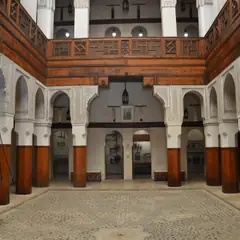
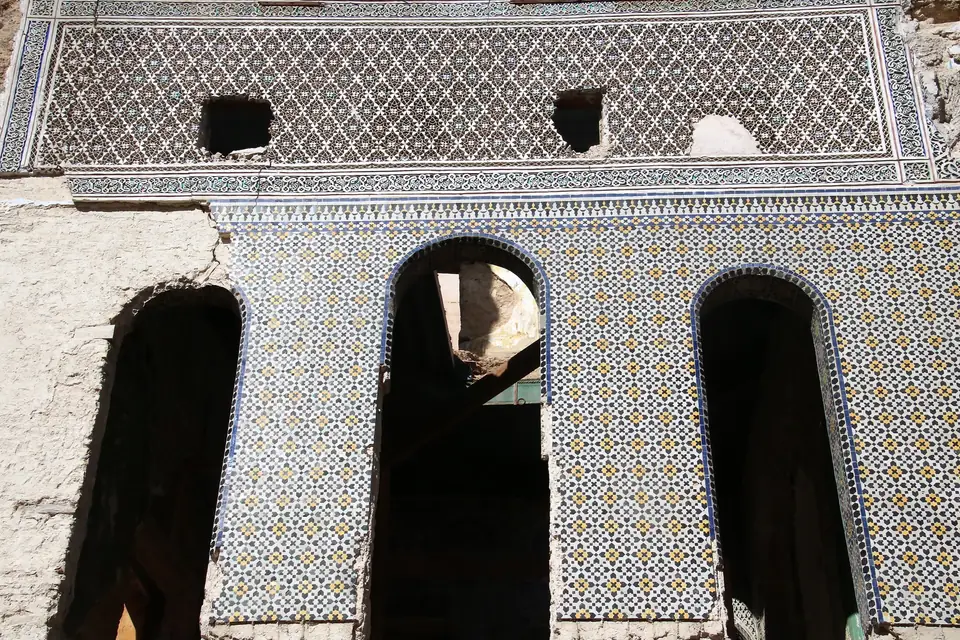
The entrance to the Ibn Danan Synagogue is a simple portal, identical to those of the neighbouring houses, and a short staircase. Upstairs, the contrast: a Torah ark of carved wood that takes up a whole wall beneath plasterwork, a dado of blue tiles, a painted wooden ceiling and a cantilevered bimah with a wrought-iron canopy. It was built in the 17th century by Mimon Boussidan, a toshavim merchant of Fez, set against the outer wall and conceived from the start as a temple, not as a converted house; its exact dating is disputed.
From 1812 until its closure in the 1960s, all its rabbis belonged to the Ibn Danan family, which takes its name from Rabbi Shlomo Ibn Danan. In 1996 it entered the World Monuments Watch with collapsed ceilings and rotten beams; it was restored with funds from American Express, in collaboration with the Moroccan Ministry of Culture, and reopened in 1999.
In the middle of the works, in 1997, there appeared under the bimah a vaulted chamber with a staircase going down to a mikveh, a small ritual bath fed by an underground channel. Today, with hardly any Jews left in Fez, a single Muslim family, the Majdoubi, has looked after this synagogue and that of the Fassis from father to son. What that staircase reveals about the life of the quarter is better understood by listening to the audio guide beside it.
Twelve thousand white tombs and one blue
Cimetière juif de Fès
Summary of this stop
At the far end of the quarter stretches the Jewish cemetery: some 12,000 whitewashed semi-cylindrical tombs, repainted in 2019, forming a white hillside with an entrance at the north-west corner. It existed from the early 19th century, although some attribute a founding in 1883 to it, and only reached its present extent in the 20th century; an old synagogue at its north-east end works as a small museum.
Among them all one painted blue stands out, with three small turrets, a horseshoe arch and an epitaph in French and Hebrew. It is that of Solica Hachuel, born in Tangier in 1817 and beheaded in Fez in 1834, aged 17, falsely accused of having embraced Islam and of apostasy. She is venerated by Jews and also by Muslim women, who call her Lalla Suleika.
This burial ground is the second. The first occupied land donated in the 15th century by the Marinid princess Lalla Mina beside the palace gates; it was moved in 1894 by order of the sultan, or after 1912 according to other sources, and in 1912 the French opened the Place du Commerce over it, adjoining the present Place des Alaouites. There, according to a single source, Stoke, the Indian elephant that Queen Victoria gave to Hassan I, was also buried. The full story of that esplanade without a trace, and of the blue tomb everyone looks for, is heard in the narration.