Living craft of the medina
Chouara Tannery Audio Guide (Tannerie Chouara)
A honeycomb of stone vats beside the Fez river where hundreds of artisans still tan hides by hand, with lime, pigeon droppings and dyes. Behind the colourful postcard lies a trade of water, sweat and family inheritance that the city decided not to drive out of the medina.
- 40 min of audio
- Traditional craft
Chouara is the largest of the three tanneries that survive in the medina of Fez, in Fes el-Bali, beside the Oued Fes and near the Saffarin madrasa. Its origin is associated with the founding of the city by Idris II in the early 9th century, although the date remains open: the first tannery in Fez with a certain written mention is the neighbouring Sidi Moussa, in the early 12th century. The site covers some 7,200 m², with 193 workshops and more than 600 artisans, according to the most quoted figures.
The most famous image of Fez hides a guild with a reputation for being untameable. In 1873, when Hassan I had just been proclaimed sultan, the tanners rose against the taxes on markets and the gate tolls, sacked the tax collector’s house and forced him to take refuge in the shrine of Moulay Idris, according to a documented tradition. The humblest trade in the medina made a newly crowned sultan tremble.
Highlights
- White vats — up to two weeks of hides in lime and pigeon droppings
- Honeycomb of coloured vats — the red of the rose and the brown of cedar
- The yellow vat that does not exist — the saffron of the slippers is rubbed on by hand
- Leather-shop terraces — the work seen from a bird’s-eye view
- House of the tannery, house of gold — a leather that reached Baghdad
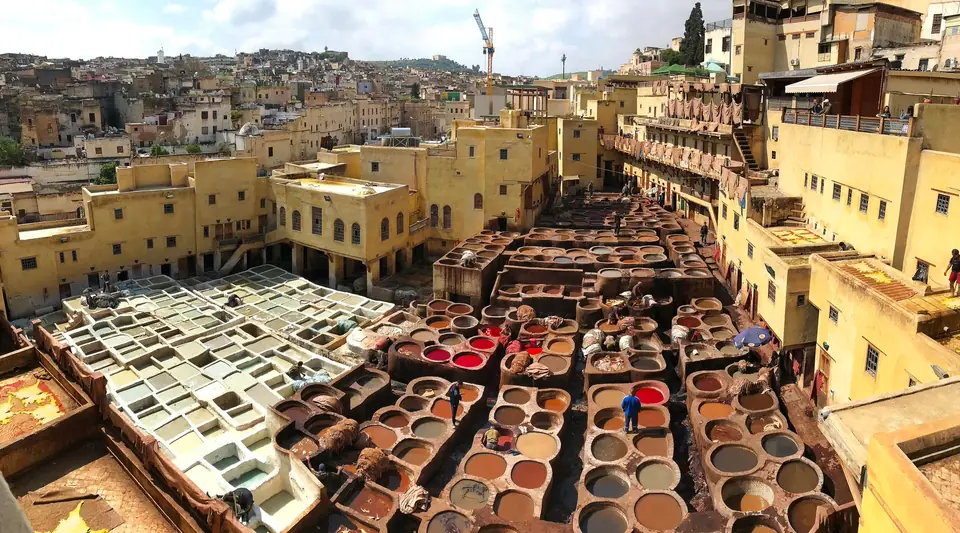
The Chouara tannery is the most recognisable image of Fez: a grid of round stone pools, white, red and brown, in which barefoot men tread and turn hides in liquid up to their thighs. It stands in Fes el-Bali, on the banks of the Oued Fes, also called Oued Bou Khrareb, because every stage of tanning needs large quantities of water. From the upper floors of the houses around it, turned into leather shops with balconies and terraces, the work is seen from a bird’s-eye view.
The history of the Chouara tannery is told in very different ways. Some link it to the founding of Fez by Idris II, some date it to the 11th century and call it the oldest in the Arab world, and some place the city’s tanneries in operation from the 14th century; historians firmly document only the neighbouring Sidi Moussa in the early 12th century. What nobody disputes is its weight in the medina: under the Almohads Fez came to have 86 tanning workshops, and today only three remain, Chouara, Sidi Moussa and Ain Azliten.
What to see at the Chouara tannery goes well beyond the photo. The audio guide goes through it in four stops, from the entrance alley to the highest terrace, with a documented account checked against historical sources that makes full sense up there, with the smell of leather and the sun on the rooftops.
Two hundred metres away rises the Al Quaraouiyine Mosque, and another trade of the medina, that of carved wood, has its own museum in the Nejjarine Museum.
A sprig of mint and a river that explains everything
Leather-shop alley
Summary of this stop
The visit begins in the alley of the leather shops, where visitors are handed a sprig of mint to hold under the nose. The smell is the first lesson: the tannery is here because of the water. Beside the Oued Fes and near the Saffarin madrasa, the river feeds a trade that cannot be understood without it.
Hides from all over Morocco pass through these streets. After every Eid al-Adha, the Feast of the Sheep, the skins of the animals sacrificed across the country are collected and sent to the tanneries of Fez, Marrakech or Salé. The origin of the place, which tradition links to Idris II, is one of those questions that the documentation has not managed to close, and the narration explains at this point why.
Thigh-deep in lime and pigeon droppings
White vats
Summary of this stop
From the first terrace the sector of the white vats is overlooked. Raw hides arrive from the Aïn Nokbi market and spend up to two weeks here in a mixture of lime and pigeon droppings that softens them and loosens the hair and remnants of tissue. The tanners work inside the pools, without machinery, treading and shaking each hide by hand.
The scale is impressive. The most quoted figures speak of some 7,200 m², 4,000 of them covered, 193 workshops and more than 600 artisans producing between 3,000 and 5,000 hides a day, although sources differ widely on the count of men and vats. Chouara gives work to more than 300 families, and most of its tanners enter the trade because their father already was one: without the recommendation of someone in the guild it is hard to start.
That guild has a turbulent past. In 1873, shortly after the proclamation of Hassan I, the tanners took to the streets against the non-Quranic taxes and the gate tolls, and sacked the house of the leaseholder of those levies, who had to take refuge in the shrine of Moulay Idris. How that revolt ended, with minarets turned into firing posts, is the episode the audio guide reserves for this terrace.
Rose, cedar and the missing vat
Honeycomb of coloured vats
Summary of this stop
The upper terrace opens the view over the honeycomb of coloured vats, the emblematic image of Chouara. The palette has its own logic: red is obtained from the rose and brown from cedar wood, while yellow comes from saffron, the shade of the famous ziwania slippers of Fez.
The postcard of “all natural” dyes that many guides repeat has nuances. Since the 19th century chromium has been a main ingredient of tanning at Chouara, some tanners speak of chemical products and some call the natural account a myth. The dyes are renewed roughly every 25 days, and the water from hundreds of vats ends up in the river.
A local custom turns looking into a game: finding the yellow vat. Popular belief says it does not exist, because saffron is too expensive to dissolve in a pool and is rubbed by hand onto the hides once softened. Where the most famous colour of Fez then appears is the answer the narration gives from this viewpoint.
House of the tannery, house of gold
Hides laid out on the rooftops
Summary of this stop
At the far end of the upper terrace, hides laid out in the sun cover rooftops and railings. A proverb of Fez sums up what this trade meant for the medina: “Dar Dbagh, Dar Edheb”, house of the tannery, house of gold. In the Middle Ages the leather of Fez had such prestige that it was exported as far as Baghdad, some 4,000 km away. The golden nickname admits another reading: one shopkeeper maintains that the name came from the gold jewellery made there.
Of the 86 workshops of the Almohad period and the roughly one hundred of the Marinid period, although the dating of that count is disputed, only three survive. For years there were plans to take tanning out of the medina, but in 2010 the government announced public funds to renovate Chouara in place, and in February 2016 the site was a building works with two large cranes and 240 workers labouring day and night to rebuild all the dye vats and add a wastewater system.
These hides also leave an echo in the languages of Europe. From the 16th century Moroccan leather entered European markets as “maroquin”, the origin of the word for fine leather goods in French and Spanish. The irony of that story, which has to do with where the finest Moroccan leather actually came from, closes the tour in the audio guide.