Royal palace
Royal Palace of Fez Audio Guide (Dar el-Makhzen)
A royal citadel founded in 1276, of some 80 hectares and still used by the king of Morocco, which can only be seen from outside: golden doors, a former lion courtyard and a wall that kept the night Morocco lost its independence.
- 20 min of audio
- Marinid and Alaouite architecture
In 1276 the Marinid sultan Abu Yusuf Yaqub founded this palace and Fès el-Jdid at the same time, a fortified royal citadel separate from the old medina of Fès el-Bali, which took over from the Kasbah Bou Jeloud as the seat of power. Its official name was al-Madina al-Bayda, the White City, although people called it New Fez, and it was raised so quickly that the court moved into the palace barely a year later. Today the compound covers some 80 hectares and includes a mosque, a parade ground and a Marinid madrasa of 1320 absorbed by the palace. It was also the seat of government and justice: the qadi judged behind the entrance of the Old Mechouar, and beyond the first courtyards the sultan’s private residence began.
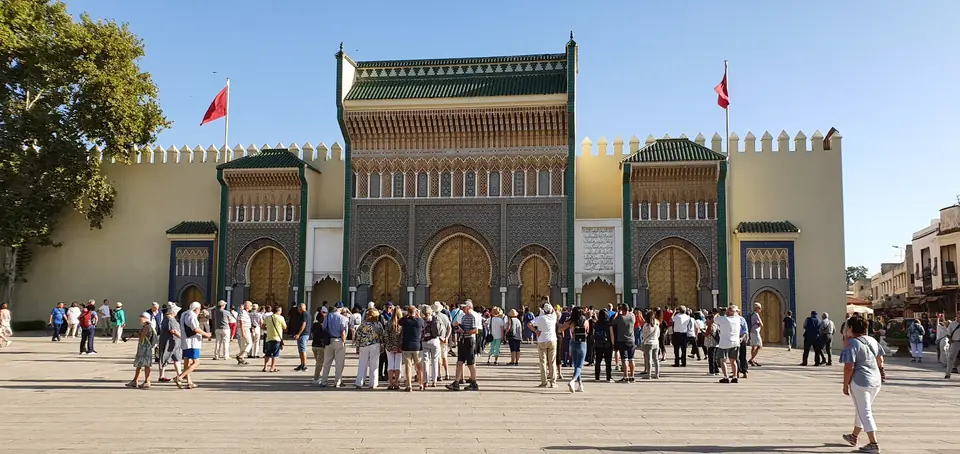
The most photographed façade in Fez is the youngest face of a very old power. The doors of the Place des Alaouites were built between 1969 and 1971, when Hassan II turned the palace entrance towards the modern city. On the other side of that wall there were the sultan’s lions, a treaty signed under the pressure of French troops and, according to a tradition of the court itself, a room with a talisman that nobody dares touch.
Highlights
- Golden doors of the Place des Alaouites — 1969-1971, with zellige and carved cedar
- Brass knockers with interlaced stars, the work of local artisans
- Minaret of the Lalla Mina mosque, beside the former lion courtyard
- Place des Alaouites, laid out over the old Jewish cemetery of the Mellah
- Wall of a compound of some 80 hectares founded in 1276
Dar el-Makhzen is a palace that nobody visits inside and which nevertheless has the most photographed façade in Fez. Its history begins in 1276, when the Marinid sultan Abu Yusuf Yaqub decided to separate power from the old medina and raised, beside a new palace city, a residence that the king of Morocco still uses today. Under Moulay Hassan I (1873-1894) the compound grew northwards to the Old Mechouar: the old north gate of the city, Bab al-Qantara, became the palace’s main gate, and the main street of Fès el-Jdid had to be diverted. The authorship of the mechouars, though, is disputed: some sources attribute them to Mohammed ben Abdallah, in the 18th century, and other studies to Moulay Hassan I a century later.
With the protectorate of 1912 the capital moved to Rabat and never returned to Fez, but the palace remained a royal residence and is closed to the public. That is why its history is read from outside, in the architecture of its doors and its wall, in the esplanade that opens in front and in the street that separates it from the Mellah. Walking that perimeter with the audio guide turns a postcard façade into a story of lions, treaties and tombs.
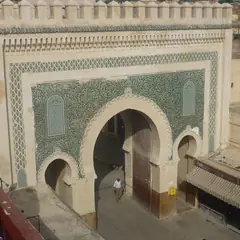
Pressed against its wall stretches the Mellah, the old Jewish quarter, and the Protectorate of 1912 left its mark the following year at the other end of the city, with the gate of Bab Boujloud.
Doors of 1971 for a palace of 1276
Palais Royal de Fès
Summary of this stop
Facing the façade on the Place des Alaouites, visitors find a battery of golden metal leaves covered in geometric interlace, with great circular brass knockers decorated with interlaced stars. Above, panels of zellige with the darj-wa-ktaf diamond motif, muqarnas niches and canopies of sculpted cedar. Sources do not agree on the metal of the doors: some speak of gilded bronze, others of copper and others of brass.
The doors are much younger than the palace. In the 1960s Hassan II turned the entrance from the Old Mechouar, to the north, towards a new south access facing the Ville Nouvelle, and between 1969 and 1971 the square was laid out and the gates built. They were designed by the Fassi architect Mohammed Tazi, of the Fine Arts and Historic Monuments Service of Morocco, and chiselled by a local artisan; around 1972 Tazi received the Wissam Sharaf for them.
In the square there is also a popular explanation of the number of doors, which makes them a sort of calendar of Hassan II’s reign and places a date carved somewhere on the façade. What that count says and where to look for the date is what the narration reveals before the knockers.
The house of the lions beyond the wall
Lalla Mina mosque minaret
Summary of this stop
At the end of the façade, beneath the minaret of the Lalla Mina mosque, the wall hides the memory of the palace’s old menagerie: a large square courtyard with arched cages for lions and other wild animals, photographed in 1913. Those lions descended from the royal collection, which was supplied by cubs sent as tribute by the Atlas tribes, and in the late 1960s they were moved to a zoo built for the purpose in Rabat.
The story of that courtyard has an almost comic-opera tone. According to a documented tradition, in the time of Moulay Hassan I some tame leopards wandered loose through the reception rooms, and his son Moulay Hafid, more fearful, ended up shutting them away and putting guinea pigs in his salon. The same sultan commissioned his Spanish dentist to buy animals in Hamburg, and the deal ended in a memorable lawsuit after the abdication.
The courtyard also holds dark episodes. In 1909 the sultan Abd al-Hafid, after capturing the rebel pretender Bou Hmara, had him thrown to the lions, although accounts of his death differ: one maintains that the well-fed beasts did not kill him and that the sultan ordered him shot. It is also told that during the mutinies of April 1912 Jews of the Mellah took refuge in the palace and were housed in the menagerie, with women and children crowded beside the lions’ cage; another version holds that the sultan had already left Fez for Rabat. How the dispute between the sultan and his dentist ended is the finale the audio guide reserves for this corner.
A square over tombs and a midnight treaty
Place des Alaouites
Summary of this stop
At the mouth of the Rue des Mérinides, the esplanade of the Place des Alaouites reads as an absence. It occupies the site of the old Jewish cemetery of the Mellah, laid out in the 15th century on land donated by the Marinid princess Lalla Mina; after 1912 the French administration opened the Place du Commerce there, the origin of the present square. When the tombs were moved remains debated: some authors attribute it to an order of the sultan in 1894 to enlarge the palace and others to the French works after 1912. Beside the square rises Bab al-Amer, and along the other flank runs the avenue opened in 1924 between the palace wall and the balconies of the Mellah.
Behind that wall the Treaty of Fez was negotiated in March 1912, turning Morocco into a French protectorate. The decisive session between Abd al-Hafid and the diplomat Eugène Regnault, on 29 March, lasted six hours, from 18:00 to midnight, with French troops surrounding the city, and the text was signed on the 30th. Where and how the signature was set down is another disputed matter: some place it in the Mnebhi palace, and part of the Moroccan press maintains that no testimony of that moment exists. Before leaving for exile, the sultan broke the insignia of the throne and the royal parasol.
The stop closes with the palace’s most intimate legend: a documented tradition of the court itself speaks of a very old room, in the women’s quarter, with a walled-up talisman that was said to protect sultans from dying in Fez. What is told of its candles, its ceiling and the staircase that nobody removes is left for the narration, before the wall that hides it.