Medina gate
Bab Boujloud Audio Guide
The most photographed gate in Fez is a colonial work of 1913: a triple arch of blue tile born of a boycott, which walled up its medieval sister and still decides where the medina is entered.
- 20 min of audio
- Gate of 1913
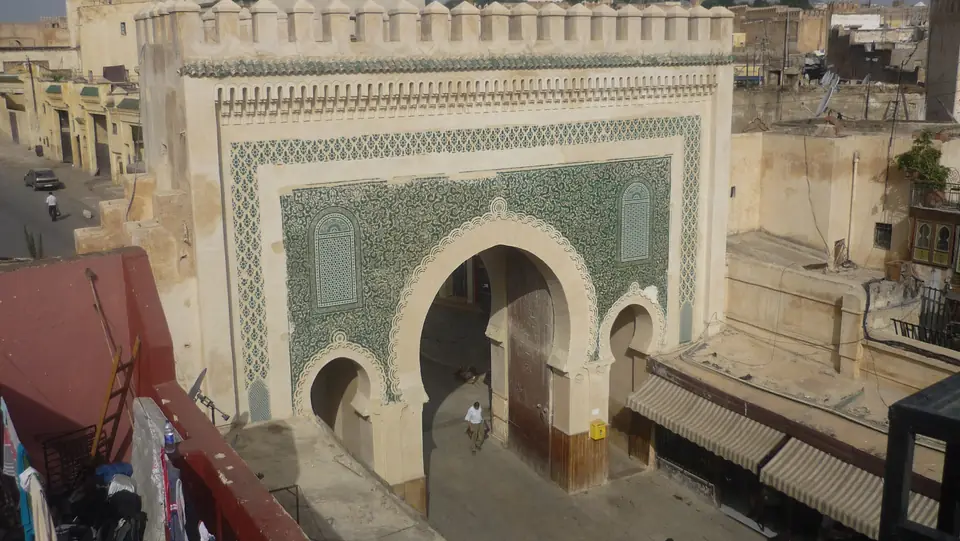
Bab Boujloud, the Blue Gate, is the western entrance to Fès el-Bali and the point where cars end and the city on foot begins. It was built in 1913, at the start of the French Protectorate, as a gala entrance to the old city: three horseshoe arches crowned with merlons that imitate the scheme of an ancient triumphal arch, faced in blue tile outside and green inside. With it, the old Bab Mahrouk lost its role as the medina’s great western gate.
Beside the monumental arch the medieval Bab Bou Jeloud still stands, walled up, a plain gate probably of the 12th century whose bent passage ran parallel to the wall. And the Blue Gate was not the first attempt: according to a disputed account, an earlier French gate was boycotted by almost the whole city and pulled down, which is why this one was meant to be so native and so large.
Highlights
- Three horseshoe arches — a triumphal arch of 1913 crowned with merlons, inspired by Bab El Khemis in Meknes
- Blue façade and green façade — blue tile towards the square and green towards the medina
- Walled-up medieval gate — the original Bab Bou Jeloud, probably of the 12th century, with its bent passage
- Framed minarets — Bou Inania and Sidi Lazzaz, seen through the central arch
- Bou Jeloud esplanade — a former parade ground and stage for the festival’s free concerts
For almost everyone arriving in Fès el-Bali, the medina begins here, under an arch of blue tile. Bab Boujloud looks as old as the walls around it, but it is a work of 1913. In December 1912 Captain Mellier, head of the municipal services of the newly established French Protectorate, drew up the plan to open a new entrance in the wall, and the following year the monumental gate that now serves as the city’s postcard was built. Beside it, walled up and almost invisible, stands the medieval gate of the same name.
That double identity explains why many guides date Bab Boujloud to the 12th century: they mix the present gate with its medieval neighbour, and some popular sources give 1912, the year of the plan rather than of the work. Nor is there agreement on authorship, which is attributed to Mellier’s municipal administration while others consider the architect unknown, probably French. The history of Bab Boujloud, what to see in it and why its architecture tells of a tug of war between a city and those who governed it is what the audio guide unfolds in four stops and twenty minutes, from the esplanade to the little inner square.
A few steps away, already inside the medina, the Bou Inania Madrasa shows its minaret through the central arch. At the other end of the city, in Fès el-Jdid, the Royal Palace of Fez holds the memory of the treaty of 1912 that opened the Protectorate, beside the Mellah, the old Jewish quarter.
Troops, caravans and concerts in the street
Bou Jeloud esplanade
Summary of this stop
The great esplanade that opens to the west of the gate gave Bab Boujloud its name long before it existed. Bou Jeloud would derive from Abu al-Junud, “father of the troops”, the name of the Almohad kasbah where soldiers lived and of the adjoining parade ground, which today is Bou Jeloud square. It is not the only reading: Būjlūd literally means “father of skins”, like the Amazigh festival of lambskins after Eid al-Adha, and the military explanation is presented as just one of the possible ones.
Under the Marinids and Saadians, part of this space became a campsite for the trading caravans that reached Fès from all over the country. To the west, the esplanade is closed off by the wall of Fès el-Bali and by Bab Mahrouk. And for centuries, besides being a parade ground, it was where Fassis strolled and amused themselves as evening fell.
That custom is still alive. Since the official concerts of the Festival of World Sacred Music were too expensive for most people in the medina, the festival created the “Festival in the City”, with free concerts beside Bab Boujloud: the Malhoun Orchestra of Fès and Harlem’s Arc Gospel Choir have played here, and in 2025 the streets around the gate filled with zaouli masks from Ivory Coast and stilt walkers. Since 2026 the square also hosts a weekly programme of Andalusian, Sufi and Amazigh music. What this soldiers’ field says about the city around it is revealed by listening to the narration on the spot.
The little sister that was walled up
Walled-up medieval gate
Summary of this stop
To the left of the monumental gate, seen from outside, a low, modest passage appears, now closed. It is the original Bab Bou Jeloud, a plain gate, probably of the 12th century. Its passage was bent: it ran parallel to the wall and came out sideways into the Tala’a Kebira. The work of 1913 replaced it with a straight opening cut through the wall, and the contrast in scale between the two entrances sums up the change of era.
Opening that gap was not simple. The municipal administration had to buy and demolish a stable and three shops whose rents belonged to a pious foundation, a waqf, which required delicate negotiations before work could begin.
On the arches, the swung-back wooden leaves hold a detail that usually goes unnoticed: they close and are barred from outside the medina, not from within. Some interpret this as a French tool for controlling or locking in the population at night, although that reading is a hypothesis and not a documented purpose; the audio guide raises it in front of the bolt itself.
A triumphal arch framing two minarets
Bab Boujloud
Summary of this stop
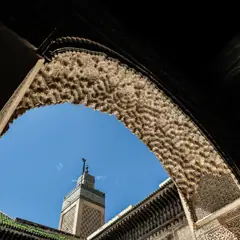
Facing the central arch, the staging takes over. The three-bay scheme deliberately imitates an ancient triumphal arch, resolved with one large pointed horseshoe arch, two smaller side ones, an alfiz and a crown of merlons. The decoration keeps no trace of the old gate of Fez: its main model is the gates of Meknes, in particular Bab El Khemis. And from outside, the central arch frames, like a postcard, two minarets, that of the Bou Inania madrasa, of the 14th century, and that of the more recent Sidi Lazzaz mosque.
So much effort to look native has an explanation, according to an account that historians still debate. In the first years of the Protectorate another gate was raised in the outer wall, beside the sultan’s garden in Fès Jdid, deliberately enormous and christened “Bab Boujloud, Porte des Français”. It is said that the ulema of the Qarawiyyin preached against it in the Friday sermon, that almost all of Fès boycotted it and that a revolt was feared.
According to that same account, Lyautey ordered it pulled down and commissioned the Fassi master builder Bouzouba to make a new one in the style of the native gates, much larger and set right against the wall of Fès el-Bali. What exactly the preachers warned of and what the marshal meant to do on passing through it is left for the narration in front of the arch.
The green face and the trade that changed street
Green inner façade
Summary of this stop
From the inner square, with its shops and restaurants, the gate is seen from behind: here the tile is green. A widespread reading, recorded in popular guides, says that the blue of the outer face refers to the traditional ceramics of Fès and the green to Islam, although no source documents that the author of 1913 conceived it that way. Over time, the colour ended up naming the gate: the first French one was “the gate of the French”, but this one is for everyone the Blue Gate, “Porte Bleue” or “Blue Gate”, a nickname that competes with the official name.
The main historic western gate of Fès el-Bali was Bab Mahrouk, built in the early 13th century under Muhammad al-Nasir in Almohad style, and Bab Boujloud took that role from it. From this little square the Tala’a Kebira and the Tala’a Seghira climb towards the heart of the medina, and tradition recalls that when the new gate opened, the trade that lived on the “big slope” shifted within a short time to the “small slope”, which began to fill with merchants, diplomats, settlers, adventurers and tourists.
More than a century later, the gate is still the main western entrance to the medina and marks the limit beyond which cars no longer enter the historic city. How a single arch was enough to move money from one street to another is the last thing the audio guide tells before leaving the visitor at the gates of the medina.