Shinto shrine
Dazaifu Tenmangu Audio Guide
Before it was a shrine it was a tomb: that of Sugawara no Michizane, the exiled minister whom the Kyoto court feared as a vengeful spirit and whom Japan ended up venerating as the god of study.
- 90 min of audio
- God of study
Dazaifu Tenmangu stands in Dazaifu, a town neighbouring Fukuoka, on the site where Michizane was buried, dead in exile in 903. His disciple raised a mausoleum there in 905 and, by order of Emperor Daigo, in 919 a worship hall was completed to appease a spirit blamed for epidemics, deaths in the imperial family and even a lightning bolt that struck the palace. The present honden, of 1591, has just emerged from its greatest restoration in 124 years.
Contrast is the thread of the whole visit: a precinct born of fear that today celebrates a sage. That is why visitors rub the heads of the bronze oxen, cross three red bridges representing past, present and future and pause before a plum tree that, according to legend, flew in a single night from Kyoto so as not to be parted from its owner.
Highlights
- Honden of 1591 — roof remade with about 300,000 pieces of cypress bark and about 800 re-gilded fittings
- Tobiume — the white plum tree that, according to legend, flew from Kyoto
- Shinji-ike pond — three red bridges over a pond shaped like the character “heart”
- Rōmon gate — two roofs from the bridge, only one from the honden
- 11 sacred oxen lying down, their heads polished by visitors' hands
The history of Dazaifu Tenmangu begins with a fall from grace. In 901, Sugawara no Michizane, a scholar and senior minister of the Kyoto court, was exiled to Dazaifu through the work of his rival Fujiwara no Tokihira. He died there in 903, and in 905 his disciple Umasake no Yasuyuki raised a mausoleum over his tomb, within the grounds of the Buddhist temple Anraku-ji. What came after turned an exile into a god: Tokihira died in 909 at the age of 39, the capital suffered epidemics, between 909 and 931 an emperor, two crown princes and a minister tied to his downfall died, and in 930 lightning struck the imperial palace. The court raised a hall for him here to appease his spirit and in 923 rehabilitated him as a minister.
Today, in Dazaifu, on the outskirts of Fukuoka, that same place receives those who come to the god of study. The history of Dazaifu Tenmangu is read in its stones, its bridges and its wood: a Buddhist temple erased in the Meiji era, a honden of 1591 raised after a wartime fire and newly restored, fire rituals and processions that repeat every year. The audio guide covers the shrine in five stops, with a documented narration checked against historical sources that carefully separates what is verified from what only tradition tells.
Back in Fukuoka, Sumiyoshi Shrine recalls the Dazaifu officials who shot arrows from its precinct in 878, and Fukuoka Castle shows, beneath a baseball stadium, the Kōrokan where Asia’s embassies were received.
A lying ox chose this tomb
Dazaifu Tenmangu
Summary of this stop
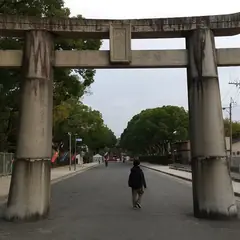
The entrance walk greets visitors with a bronze ox lying on the ground, its head shiny from so much rubbing. It is not the only one: around the precinct there are 11 statues of sacred oxen and all of them are lying down. They recall the ox that pulled Michizane’s funeral cart and that, it is said, lay down on the ground just where the tomb was dug. Rubbing their heads is associated with wisdom, and the one resting to the right of the rōmon gate is protected as a cultural property of Fukuoka Prefecture.
That gesture holds the key to the place: here a man was buried long before a god was worshipped. The mausoleum of 905 predates any shrine, and the tomb remains the centre of the whole precinct.
On the access street umegae mochi is sold, a rice cake filled with red bean paste with a plum blossom branded on it. Its origin, according to legend, lies with an old woman called Jōmyōni, who brought rice cakes skewered on a plum branch to the exile when he was starving. What is curious about that sweet, starting with what it does not contain, is one of the details the narration keeps for this point of the route.
Three bridges over a heart and a revenge
Shinji-ike pond and its three bridges
Summary of this stop
Over the Shinji-ike pond, whose shore and islet draw in cursive the character 心, “heart”, three red bridges are crossed: two arched and a flat one in the middle. They represent past, present and future, and their climb and calm set the rhythm of the arrival at the shrine. No shrine rule forbids pausing or looking back while crossing them.
From the flat bridge it is understood why this place became a shrine. By order of Emperor Daigo, the minister Fujiwara no Nakahira raised a worship hall over the tomb, finished in 919, while the capital associated epidemics and deaths with Michizane’s spirit. In June 930, lightning struck the Seiryōden hall of the palace during a meeting chaired by Daigo, who abdicated and died that same year.
The date of founding remains open to debate: some place it in 905, with the disciple’s mausoleum, and others bring it to 919, with the imperial hall. There is even the hypothesis that Nakahira’s work is a later invention and that the shrine was born almost as a private initiative. The audio guide presents both versions without closing the discussion.
The gate that survived the erased temple
Rōmon gate
Summary of this stop
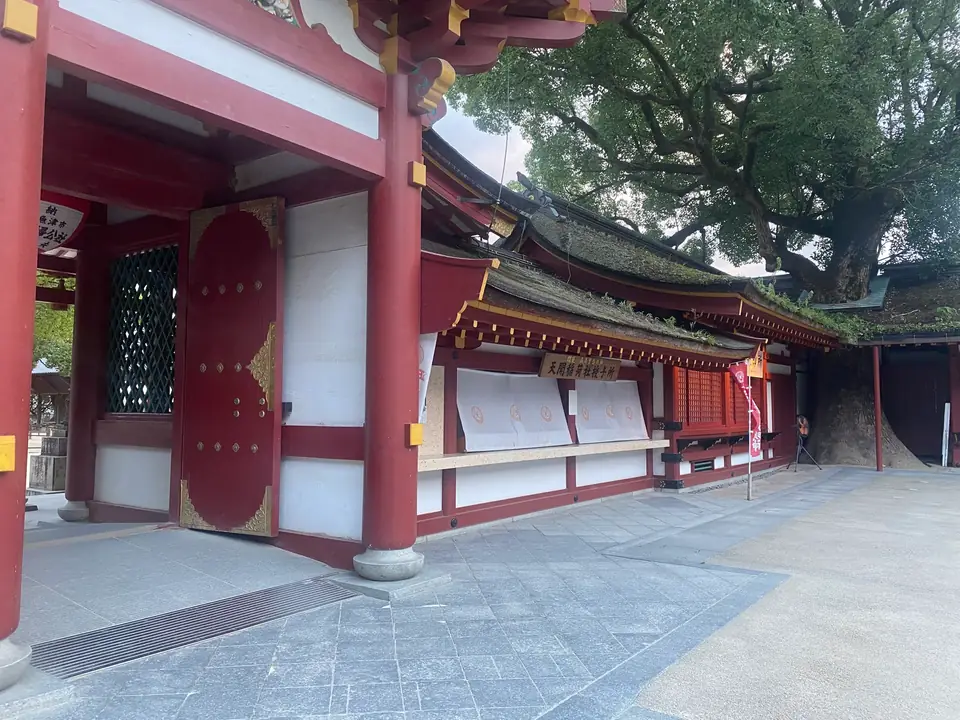
The great vermilion rōmon gate marks the passage into the heart of the precinct. It was founded by Sugawara no Sukemasa, Michizane’s great-grandson; after a fire it was rebuilt with a donation from Ishida Mitsunari in the Sengoku period, and its present form dates from 1914. From the bridge side it shows two overlapping roofs; from the honden, only one. How that optical trick works is revealed on crossing it.
For centuries, this shrine lived within the Buddhist temple Anraku-ji. Since the Middle Ages, when fear of his spirit faded, Michizane came to be venerated as the god of study, and the renga poet Sōgi described the Anraku-ji shrine in his travel diary after visiting it in 1480.
The separation of Shinto and Buddhism in the Meiji era ended that coexistence. The teaching hall, the Niōmon gate and the Hokkedō were destroyed or sold, the temple was abolished and the most sacred object of the place burned: the Lotus Sutra hand-copied by Michizane himself. In 1871 the shrine was renamed Dazaifu Jinja and did not recover the name Tenmangu until 1947.
A honden of 1591, newly re-gilded
Restored honden
Summary of this stop
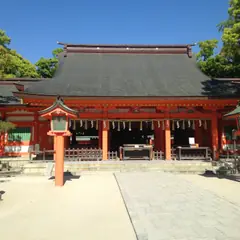
On the other side of the gate rises the honden, the main shrine. In 1578 the troops of Akizuki Tanezane burned the previous one, and Kobayakawa Takakage rebuilt it in 1591: it is the building seen today. The architecture of Dazaifu Tenmangu reaches its peak here: five bays in nagare-zukuri style, a curved cypress-bark roof, a front porch with karahafu gable and a gallery joining it to the rōmon. Its polychromy and Azuchi-Momoyama-period ornament break with the sobriety of the earlier buildings. It has been an Important Cultural Property since 1950.
The building has just emerged from its most ambitious restoration in 124 years, begun in May 2023: the roof was remade with about 300,000 pieces of cypress bark, relacquered, and about 800 decorative fittings were repaired and re-gilded. The spirit of Tenjin returned to the honden on 16 May 2026, and worship before its facade resumed on 19 September 2026.
According to tradition, the work of 1591 nearly came to a halt because of a hornet’s nest, until a flock of bullfinches finished it off. Since then that bird, the uso, has been held to be Tenjin’s messenger, and its name hides a pun that explains one of the busiest rites of the year at the shrine.
The plum tree that flew from Kyoto
Tobiume
Summary of this stop
To the right of the honden, fenced in, grows the Tobiume, a white plum of the Iro-tamagaki variety. Tradition says that, before leaving for exile, Michizane dedicated a farewell poem to the plum tree in his Kyoto garden, and that the tree, unable to bear his absence, flew in a single night to Dazaifu. Hence its name: “the plum that flew”. It is said to be the same tree, and every June its fruits are gathered in a ceremony; in 2026 drought left only 8, the minimum in ten years, against 61 in 2025.
It is often read that the Tobiume is the first plum tree to flower in all Japan. What is true is that it flowers before any other within the precinct, around the end of January, among some 6,000 plum trees of about 200 varieties.
The esplanade around it also holds a recent memory: between 2023 and 2026 the temporary pavilion of the architect Sou Fujimoto stood there, with a floating forest of about 60 species on its roof, where the god resided during the works. No trace of it remains, and the shrine now looks to 2027, when its great ceremony, held every 25 years, will mark 1,125 years since Michizane’s death. The end of the route joins those pieces into a single story.