Shinto shrine
Sumiyoshi Shrine Audio Guide (Sumiyoshi-jinja)
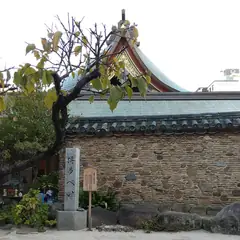
Three gods of navigation have been worshipped here for more than twelve centuries, on an old seafaring cape that the sea abandoned. Today, in the middle of Hakata and with no salt water in sight, the sacred grove holds a honden of 1623 with completely straight lines.
- 30 min of audio
- Sea gods
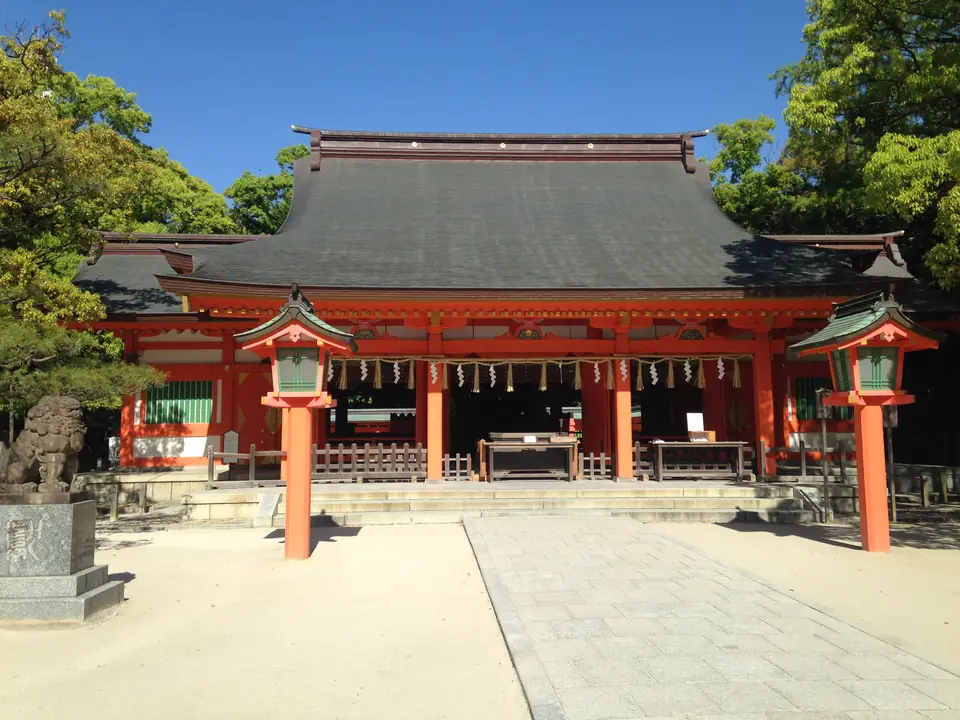
Fukuoka's Sumiyoshi Shrine appears in writing in 737, when the Nara court sent it offerings together with the shrine of Ise. It presents itself as the first of the more than 2,000 Sumiyoshi shrines of Japan, although that primacy is disputed. Its honden, rebuilt in 1623 by Kuroda Nagamasa, follows the sumiyoshi-zukuri style, one of the oldest shrine forms in the country, and has been an Important Cultural Property since 1922.
The shrine of the sea gods no longer has a sea: the cape that overlooked the mouth of the Naka river ended up inland, and the procession that once sailed by boat now walks the streets. In exchange, the precinct prays with bows, sumo and theatre: ritual arrows shot since 878, the ring-entering ceremony of the yokozuna and a Noh stage of 1938 with jars buried under the floor.
Highlights
- Honden of 1623 — sumiyoshi-zukuri style, an Important Cultural Property since 1922
- Nōgakuden of 1938 — a Noh theatre with ceramic jars buried beneath the stage
- Statue of the ancient wrestler — the character 力, “strength”, drawn in the palm of his hand
- Ichiya-matsu pine — the legend of the trunk that straightened in a single night
- Tenryū-ike pond — a memory of the seafaring cape the sea left behind
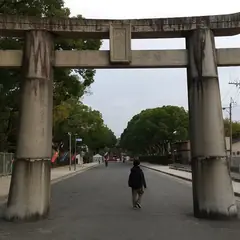
A few minutes from Hakata station, a torii and a gate separate the street from a sacred grove dedicated to Sokotsutsu-no-o, Nakatsutsu-no-o and Uwatsutsu-no-o, the three Sumiyoshi gods, protectors of sailors and travellers. The history of Sumiyoshi Shrine (住吉神社) begins in the chronicles: in April 737 the Shoku Nihongi records that the court sent offerings to the “Sumiyoshi of Tsukushi”. Since then the precinct has gone through glory, ruin, the loss of its archives and the rebuilding of 1623 that gave it the honden preserved today.
The shrine proclaims itself the first of Japan’s Sumiyoshi shrines, whose number varies by source between a little over 2,100 and more than 2,300. Its own engi places here the spot where the three gods were born; other sources, however, regard the Sumiyoshi Taisha of Osaka as the head of the network, and an old chronicle puts the first shrine upriver, in present-day Nakagawa. It was also the ichinomiya, the first shrine of Chikuzen province, a mention that appears in a text of 1334 and which it later came to share in the documents with Hakozaki-gū.
What to see at Sumiyoshi Shrine goes well beyond the main hall: ponds that recall the lost coast, a pine surrounded by legend, a statue of a sumo wrestler that is touched to gain strength and a Noh theatre that was the finest stage in western Japan. Following it with EarGuide’s documented audio guide makes it possible to read each corner of the precinct in its place, from the entrance to the stage.
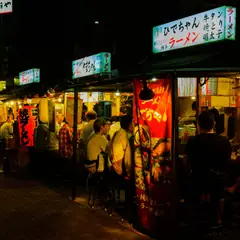
Its ichinomiya rank it later shared in the documents with Hakozaki Shrine, and the officials who shot their arrows here in 878 came from Dazaifu, the town where Dazaifu Tenmangu stands today. A short walk away, beside the Naka river, the Nakasu Yatai are set up every evening.
A seafaring cape stranded inland
Sumiyoshi Shrine
Summary of this stop
The route begins at the entrance torii and beside the Tenryū-ike pond, also known as the “seawater pond”. The name is no accident: on the medieval map “Hakata kozu” the shrine appears on the Reizei-tsu cape, a point of land that jutted into the sea between the mouths of the Hie and Naka rivers. It was the ideal site for worshipping the gods of navigation. Today salt water is nowhere to be seen: streets and buildings occupy what was coast.
That loss shows in the Shiohi-sai festival, every 3 April, devoted to safety at sea and to fishing. When the shrine looked out on a deep inlet, the sacred palanquin boarded a boat, rounded the Ōchikushi and Kochikushi islets and sailed to the cape of Aratsu, today’s Nishi-kōen park. The same procession now walks the streets by land.
The three gods were born, according to the mythical account, when Izanagi purified himself in the water on returning from the land of the dead. The shrine maintains that the word tsutsu in their names means “star”, a guide for sailors, but the etymology is far from certain and other very different readings circulate. What they are, and what each says about those who prayed here, is revealed in the narration in front of the pond.
The gate of a shrine the court listened to
Sumiyoshi Karamon
Summary of this stop
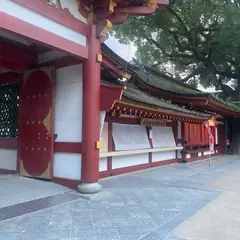
In front of the karamon, the ornamental Edo-period gate protected by the city of Fukuoka since 2010, and before the copper-roofed haiden, where prayer is made with two bows and two claps, the history of Sumiyoshi is condensed. In 737 the Nara court turned to this shrine, together with Ise, to inform the gods of the affront by the Korean kingdom of Silla: the place weighed in affairs of State.
Centuries later came the fall. Takezaki Suenaga’s scroll of the Mongol invasions already painted its vermilion torii, but in 1480 the master of linked verse Sōgi found the precinct ruined by wars and wrote it down in his travel diary, the “Tsukushi michi no ki”. In 1551 came another blow: the shrine’s old documents, sent to Yamaguchi to the warlord Ōuchi Yoshitaka, were all lost in the coup of Taineiji temple, in which Ōuchi fell.
Behind the gate there remains thus a shrine that speaks with the court and then loses almost all its written memory, a contrast the audio guide follows on the ground.
A honden of 1623 and the one-night pine
Honden and Ichiya-matsu pine
Summary of this stop
From the side, and through the karamon, the honden can be seen. In 1623 Kuroda Nagamasa, first lord of the Fukuoka domain, donated two thousand pieces of silver and the timber to rebuild the shrine, and the hall preserved today is the product of that work. The architecture of Sumiyoshi Shrine follows the sumiyoshi-zukuri style, one of the oldest shrine forms in Japan alongside the shinmei and the taisha: a plan of four by two bays, a gabled roof of hinoki cypress bark, chigi and three completely straight katsuogi, vermilion pillars and white walls. It has been an Important Cultural Property since 13 April 1922; some tourist website calls it a “national treasure”, but that is not its official category. Every 25 years the shrine holds a go-sengū, the ritual renewal of its buildings.
The domain’s protection had its reverse. In the Tenpō era, the high priest Yokota Orie travelled to Kyoto with those of Hakozaki and Umi Hachiman to ask the noble Ichijō house for the restoration of some Shinto rites banned by the Fukuoka domain. They made him return, arrested him and in 1833 sentenced him to retire and to be confined to a cell at home.
To the left of the main shrine grows the Ichiya-matsu, the “one-night pine”. A documented tradition tells that in the Eikyō era, in the 15th century, the tree leaned over the buildings and hindered the works, so it was decided to fell it; in a single night the trunk straightened and the pine was saved. Why it ended up as the precinct’s charm for descendants and long life is told right there, with the tree in front.
The hand that writes “strength” on the palm
Statue of the ancient wrestler
Summary of this stop
Beside the shrine stands the statue of the ancient wrestler, a muscular figure made jointly by the Hakata doll masters Nakamura Shinkyō and his son Nakamura Kōhō. The lines in the palm of its right hand draw the character 力, “strength”, and visitors touch it to receive it: the wear on the hand proves it. Beside it is the dohyō, the precinct’s sumo ring.
At Sumiyoshi, sumo and archery are forms of prayer. The great annual festival, from 12 to 14 October, is called Sumōe-taisai, “sumo festival”, and recalls that Empress Jingū gave thanks to the Sumiyoshi gods with sumo and mounted archery; today it includes yabusame and children’s sumo. Every year, before the Kyushu sumo tournament, the Japan Sumo Association holds the yokozuna ring-entering ceremony here.
The bow has a precise date. In 878, facing the threat of foreign pirates, Emperor Yōzei sent Taira no Suenaga with offerings, and the officials of Dazaifu shot arrows towards the southwest from the precinct as a sign of gratitude. From that gesture comes the Hosha-sai, the ritual archery of every 7 November, whose full story is heard beside the ring.
Jars buried beneath the Noh stage
Sumiyoshi Nōgakuden
Summary of this stop
On the south side of the precinct stands the Nōgakuden, the Noh theatre opened in autumn 1938 with donations from the industrialists Yasukawa Keiichirō and Matsumoto Kenjirō. It is a wooden building with an irimoya roof and a gable-end entrance; inside, the stage has its own cypress-bark roof and pines painted by Mizukami Taisei. Until the Ōhori prefectural theatre opened in 1986 it was regarded as the finest Noh stage in western Japan, and actors from all over the country trod its boards.
The most singular thing cannot be seen. Beneath the stage floor eight ceramic jars were buried, of which seven remain, and three more beneath the hashigakari, the actors’ entrance bridge. The hidden roof structure mixes Japanese carpentry with bolted Western-style trusses.
Behind the wood there is also a family. According to testimony given by one of them in 1998, the theatre was built by the Ishimura brothers, carpenters and heirs to a line of Fukuoka master builders, and two of them did not return from the war. Who they were and what part of the theatre each one drew is told in front of the stage, at the close of the visit.