Street food
Nakasu Yatai Audio Guide
Every evening a row of pavement kitchens is set up by hand beside the Naka river, and before dawn no trace of it remains. It is the postwar tradition that Fukuoka came close to letting die and ended up protecting with Japan's first yatai ordinance.
- 60 min of audio
- Postwar street food
The Nakasu yatai were born around 1946, in the chaos of the postwar years, as temporary, dismountable food stalls. In 1950 their owners formed a guild, and thanks to it they survived the sanitary clean-up before the 1964 Tokyo Games, which wiped street stalls from almost all of Japan. Fukuoka once exceeded 400 yatai; today about 100 operate, and since 2013 they have been covered by a law made for them alone.
Nothing on view is fixed: each stall occupies at most 3 by 2.5 metres, may stand on the street only from 17:00 to 4:00 and is assembled and dismantled entirely every night. Beneath that improvised look there is a tap, power and a grease trap installed by the city, a menu without raw dishes that was the price of a reprieve and, since 2024, a bare bulb that signals on LINE that the stall is open.
Highlights
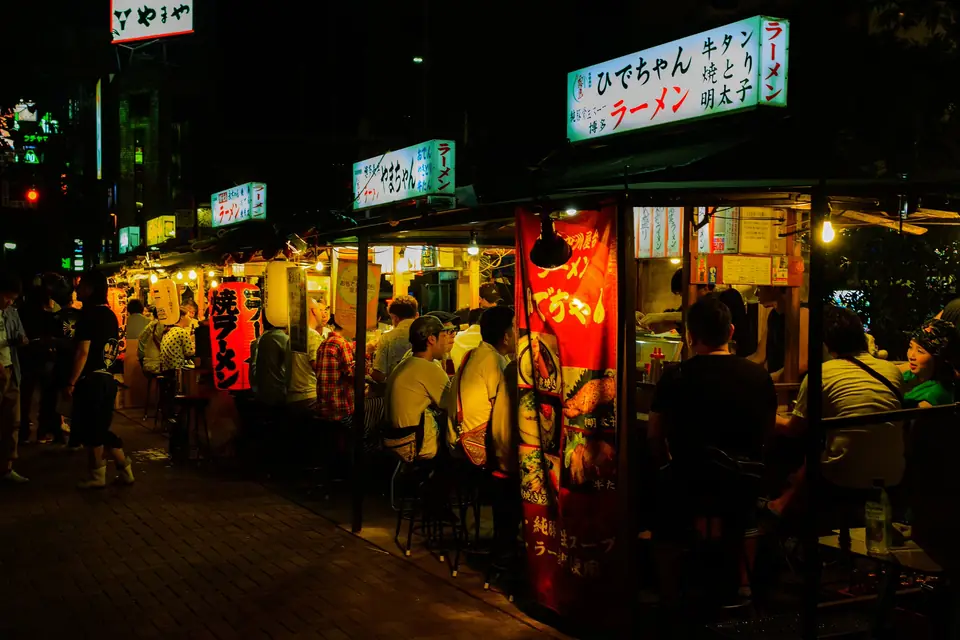
- Row of yatai on the bank of the Naka river, with Nakasu's neon reflected in the water
- The 2013 Basic Yatai Ordinance, the first in Japan
- Stalls of 3 x 2.5 metres that occupy the street only from 17:00 to 4:00
- Connected bulb that marks each stall as open on LINE since 2024
- Yatai Mori, open since 1973, beside stalls awarded by competition
By daylight, the pavement on Nakasu’s western bank gives nothing away: not a stool, not an awning, not a grease stain. As evening falls a whole street of tiny kitchens appears, each with its counter, its curtain and its lantern, and before four in the morning everything disappears again. The history of the Nakasu yatai is that of a city assembled by hand every night since around 1946, which was condemned to fade out with the generation of its owners and which in 2013 became the first in Japan with an ordinance of its own for these stalls.
Behind every counter lie almost eight decades of tussles with health inspectors, police and city hall: a guild founded in 1950, a reprieve that left everything raw off the menu, a number of stalls that fell from more than 400 to about 100 and a system of competitions that now renews the row. The audio guide walks the row from the Fukuhaku Deai bridge to one particular counter, with a documented account checked against historical sources, so that the history of the Nakasu yatai is understood right there, amid the steam of the pots and the reflection of the river.
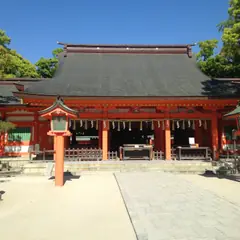
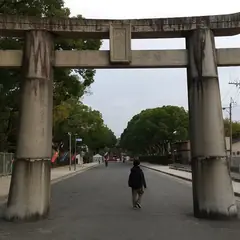
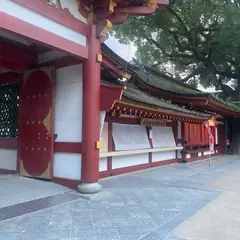
The stalls are a short walk from Kushida Shrine, guardian of merchant Hakata, and from Sumiyoshi Shrine, dedicated to the gods of navigation.
An island, a river and Hakata’s first broth
Fukuhaku Deai Bridge
Summary of this stop
From the middle of the Fukuhaku Deai bridge the geography of the place makes sense: Nakasu is an island between the Naka and Hakata rivers, and its yatai line up on the bank of the Naka, whose surface returns the lights of the stalls and the neon of the buildings. It is the classic view of Fukuoka’s night, and its origin is much less glamorous than it looks: around 1946, in the thick of the postwar years, temporary, dismountable food stalls began to be set up in the city’s streets.
Those carts also hold a part, still disputed, of the origin of the city’s ramen. According to one version, in the early 1940s a Nakasu yatai served pork-bone ramen with a clear broth and flat noodles, very far from the white, milky broth now associated with Hakata; in 1946 another clear-broth stall, Hakata-sō, opened in Nakasu and is still open on the district’s main street. The white colour would have arrived by other paths, and the very cradle of tonkotsu is claimed by other cities of the prefecture.
The most curious episode of that transformation, in which a lapse in the kitchen plays a part, is reserved for the narration on the bridge, with the row of lights ahead.
The reprieve that left out everything raw
First stall in the row by the Naka
Summary of this stop
At the start of the row, beside the Naka, the story moves from the kitchen to resistance. In 1950 Fukuoka’s vendors formed a yatai trade association, and that organisation was key to surviving the sanitary offensive before the 1964 Tokyo Olympics, which made street stalls disappear from almost all of Japan. At their peak, between the mid-1960s and mid-1970s, the city counted more than 400 yatai, although some sources place the maximum earlier and raise it to about 450.
The account of how they were saved is not entirely unanimous. It is said that, after the war, the occupation authorities pressed for the stalls to be suppressed on hygiene grounds and that Fukuoka’s owners collected signatures and negotiated until they obtained permission to continue. Another version speaks of a ban, a lost lawsuit and an abolition revoked at the last minute thanks to a prefectural assemblyman who counted how many families lived off the yatai and travelled to Tokyo with the cooks.
The terms of that reprieve, according to the same tradition, are still written today on every menu in the row; what exactly was given up and what nickname that politician earned is part of what is heard in front of the first stall.
Condemned to a single generation
Tap and fixed connections of a site
Summary of this stop
Beside the side of a stall, next to its fixed connection, the most drastic turn in this story becomes clear. In the mid-1990s the prefectural police made it clear that no new yatai would be admitted and that each stall would live only as long as its holder; sources differ on the exact date and form of that rule, but not on its effect. About 220 stalls remained then, and by 2010 there were about 150.
The course changed in June 2011, when Mayor Takashima declared that he wanted to keep the yatai, and in September of that year a study group was created on their coexistence with neighbours. In July 2013 Fukuoka passed the Basic Yatai Ordinance, the first in Japan, in force from September: the stalls stopped being a tolerated custom and became authorised for their public value.
The ordinance brought something very visible: electricity, water and sewer connections at every site, with its own tap and power and a grease trap, plus a ban on serving raw dishes such as sashimi or salads and on selling takeaway food. Those connections explain why each stall returns every night to exactly the same spot on the pavement.
Ten stools and a bulb that signals
Counter with bulb at a yatai
Summary of this stop
In front of a yatai counter the true narrowness of the trade is plain. The rules limit each stall to 3 metres of frontage by 2.5 deep, counting seating, kitchen, storage and enclosure, and allow the street to be occupied only from 17:00 to 4:00, set-up and take-down included. In that space about ten stools fit, with customers elbow to elbow facing the owner who cooks and serves.
In the same row, veterans and newcomers live side by side. Yatai Mori opened in Nakasu in 1973 and still serves skewers, tempura and highballs under Mr Mori; beside it are stalls born of the public competitions that have awarded the sites since 2016, with licences of a maximum of ten years, a system chosen among the Good Design Best 100 of 2025. Above each counter hangs a bare bulb that, since 2024, is an IoT device: when it lights up, the stall appears as open on the official LINE account “FUKUOKA GUIDE”.
The night here is lived from stall to stall, according to a documented tradition that locals call “hashigo-zake”: no reservations, in order of arrival and giving up the stool after a while. How that ritual works, and what the one rule every regular knows is, closes the route in front of the counter.