Hachiman shrine
Hakozaki Shrine Audio Guide (Hakozaki-gū)
A Hachiman shrine built facing the bay by which the Mongols arrived: the invasion of 1274 reduced it to ashes and its gate still displays, in four enormous gilded characters, the plea “Surrender of the enemy country”.
- 45 min of audio
- Mongol invasions
Hakozaki Shrine was born, according to the version spread by the shrine itself, from an oracle: in 921 Emperor Daigo ordered it built facing the Genkai sea and in 923 the kami Hachiman moved here from Daibu-gū, inland. It burned in the first Mongol invasion of 1274, and what is seen today is a sum of rebuildings with names attached: the honden and haiden raised by Ōuchi Yoshitaka in 1546, the rōmon of Kobayakawa Takakage of 1594 and the stone torii bearing the name of Kuroda Nagamasa, first lord of Fukuoka, in 1609.
The gate has a tiny footprint, barely 12 tsubo, and carries on triple-projecting brackets a cypress-bark roof of more than 83 tsubo. On its facade, the letters that asked heaven to subdue the invader are visible metres up, although the original the shrine keeps as its first treasure is written in gold on dark blue paper, on sheets about 18 centimetres square. In 1945 that slogan ended up on a wartime postage stamp, and in 1947 its postal use was banned.
Highlights
- Rōmon of 1594 — gilded plaque “Tekikoku Kōfuku” beneath a cypress-bark roof
- Mongol anchor — a stone of over 2 metres and about 250 kilos found in Hakata harbour
- Stone ichi-no-torii — erected in 1609 with the name of Kuroda Nagamasa
- Haiden and honden of 1546 — Buddhist sutras every 11 January since 1242
- Path to the sea — the oshioi sand with which Hakata is purified
In the Hakozaki district, north of Fukuoka, a Hachiman shrine faces the Genkai sea, and not by chance. By those waters came in 1274 the Mongol fleet that burned it; after that fire, the retired emperor Kameyama offered anew the calligraphy “Tekikoku Kōfuku”, “Surrender of the enemy country”, and an enlarged copy of that text has presided over the great two-storey gate since the late 16th century. The history of Hakozaki Shrine is that of a place that turned a wartime plea into an emblem, and which centuries later still sends all of Hakata to purify itself with the sand at the end of its path.
The shrine places its origin in an oracle and in two dates, 921 and 923, although it admits other theories; it is also usually counted among the three great Hachiman shrines of Japan, a trio in which recent reference works put Tsurugaoka in its place. On that base are piled first-rank names: Ōuchi Yoshitaka, Kobayakawa Takakage, Kuroda Nagamasa, Toyotomi Hideyoshi, who camped here in 1587, and the tea master Sen no Rikyū. The audio guide covers the place in five stops, from the path that descends towards the bay to the unpainted wooden haiden, with a documented account checked against historical sources.
The memory of the Mongols is spread across the city: at Kushida Shrine some stones are on display that are presented as anchors of their fleet, and Sumiyoshi Shrine shared with Hakozaki the ichinomiya rank of Chikuzen. The torii of 1609 also bears the name of Kuroda Nagamasa, the lord of Fukuoka Castle.
The path that points to the Mongols’ bay
Hakozaki Shrine
Summary of this stop
The route starts on the path that runs straight out of the precinct towards Hakata bay. The orientation is deliberate: the shrine was raised facing the Genkai sea, the same one by which the invaders would arrive centuries later. At the end of this straight there waited a beach famous for its white sand and its pines, which the harbour works of 1936 left boxed in between quays and warehouses. Even so, from that stretch of sand the oshioi is still gathered, with which houses are purified at the spring and autumn shanichi and the Yamakasa bearers in July.
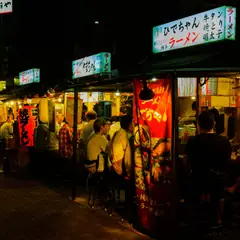
From 12 to 18 September, this same road is transformed by Hōjōya, a festival of more than a thousand years born of an oracle that asked for living beings to be freed because of the many deaths of the war. It is one of Hakata’s three great festivals and draws around a million visits in seven days and nights. The stalls then fill with young ginger with its leaves, a traditional amulet against evil at the change of season.
Another origin is also told for that custom, tied to the Kuroda, lords of Fukuoka, and to a bunch of ginger brought as a modest gift. Who offered it and for what outstanding debts is a story of gratitude between enemies that the narration reserves for the path itself.
A disputed stone torii and the pine of the box
Stone ichi-no-torii
Summary of this stop
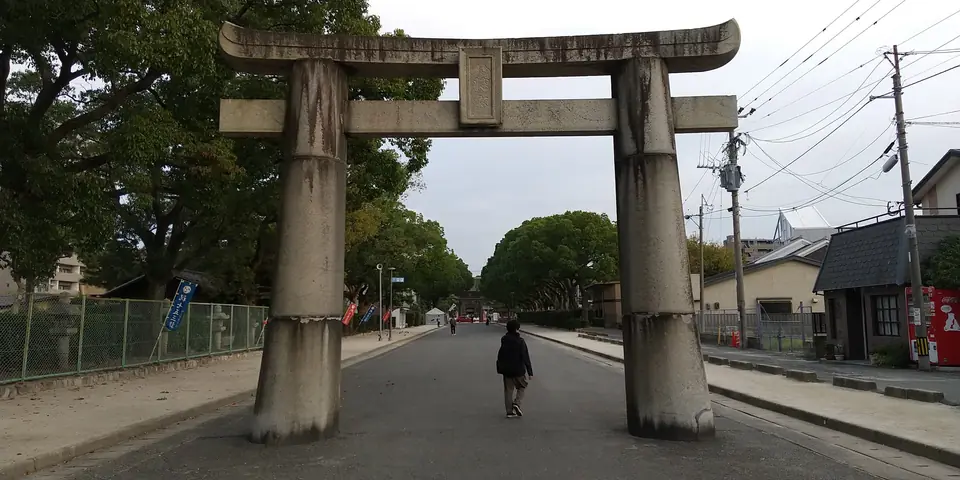
Beside the rōmon stands the ichi-no-torii, of dark stone, with pillars made in three sections that thicken towards the base and an upper lintel and a second lintel carved from a single block, with the tips turned upward. Its inscription attributes it to Kuroda Nagamasa, first lord of Fukuoka, in 1609, and its form has given its name to a type of its own, the “Hakozaki torii”.
That attribution, however, is not settled. In 2023 it was argued that this is a Hizen-type torii paid for and carved by the lord of Saga, Nabeshima Katsushige, as thanks to Kuroda, and there is even disagreement about what it should be called. It is an open debate, without a verdict, that adds an unexpected layer to a stone more than four centuries old.
A few steps away, surrounded by a vermilion fence from which hang large ema of the Fukuoka SoftBank Hawks and Avispa Fukuoka, grows the sacred pine Hakomatsu. A documented tradition links it with the birth of Emperor Ōjin and with a box buried on a cape of white sand, and from that the district’s name would come. Why that same name is written in two different ways, one at the shrine and another at the subway station, is one of the details revealed at this stop.
Surrender of the enemy country, in giant letters
Rōmon and Tekikoku Kōfuku plaque
Summary of this stop
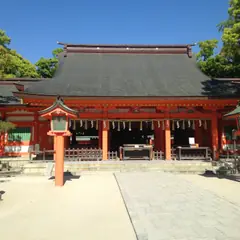
The rōmon, raised in 1594 by Kobayakawa Takakage, lord of Chikuzen, is a lesson in balance: it covers only 12 tsubo of floor plan, yet carries with triple-projecting brackets, the mitesaki-gumi system, a cypress-bark roof of more than 83 tsubo. On the leaves of the gate appear reliefs of Hideyoshi’s paulownia, attributed to the sculptor Hidari Jingorō. Only at New Year and during Hōjōya is it permitted to cross it to pray inside.
On the facade hangs the plaque with the four gilded characters 敵國降伏, which earn it the nickname Futekimon, “gate of the subdued enemy”. It is an enlarged Bunroku-period copy of the calligraphy the shrine attributes to Emperor Daigo and which Kameyama offered again after the fire of 1274; prefectural tourism, by contrast, presents it as the work of Kameyama himself. The original, the shrine’s first treasure, takes up 37 sheets of dark blue paper written in gold, about 18 centimetres square.
The slogan had an unexpected second life in 1945, when the Post Office put it on an ordinary stamp to raise morale in the midst of the Pacific War. The war ended before it reached every office, and in 1947 its postal use was banned for its militarist symbolism. How an imperial plea went from a single sheet to a gate, and from the gate to a stamp, is the thread the audio guide untangles in front of the plaque.
A Mongol anchor pulled from the harbour
Mongol anchor
Summary of this stop
In the precinct rests an elongated block of stone of more than 2 metres and about 250 kilos, attributed to the anchor of a ship of the Mongol fleet. It turned up in 1940 northeast of the central pier of Hakata harbour and is one of nine “Mongol anchors” protected by Fukuoka Prefecture: the invasion, turned into an object that can be contemplated at close range.
Very close by, a small shrine holds the wooden carving, about 6 metres tall, of the emperor Kameyama that the Fukuoka sculptor Yamazaki Chōun made as a model for the bronze statue finished in 1904 in Higashi Kōen park. It is the figure of the retired emperor tied to the plea on the gate, at monumental scale and in its original material.
The shrine’s account joins its cult of victory to the “divine wind” that would have undone the Mongols, but that a typhoon decided the battle of 1274 remains under debate, and the evidence of a storm is much firmer for the second invasion, that of 1281. How much of that legend may have been a self-serving tale is the question left hanging before the anchor.
Buddhist sutras before a haiden of 1546
Haiden and honden
Summary of this stop
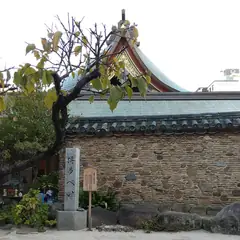
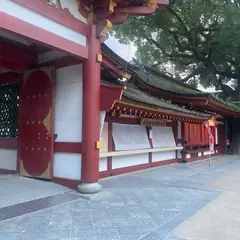
The unpainted wooden haiden and, behind it, the lacquered honden were raised in 1546 by Ōuchi Yoshitaka, after centuries of fires and wars. The honden, of 46 tsubo, is a nine-bay nagare-zukuri with a cypress-bark roof, and a long wooden wall of several dozen metres closes the complex. Nearby, the Wakide-ishi stone receives the hands of the faithful: it is said to rise to the surface when the country goes through a great crisis.
This Shinto shrine also keeps a surprising Buddhist continuity. In 1241 the monk Enni, founder of Jōten-ji temple, was returning from China when a storm nearly sank his ship and he entrusted himself to Hakozaki; since his thanksgiving visit of 1242, the monks of Jōten-ji come every 11 January to recite sutras over the haiden, without interruption for more than 770 years.
In 1587 Toyotomi Hideyoshi camped at the shrine after subduing Kyūshū and from here ordered the new layout of Hakata. A stone lantern with an inscription of 1350, attributed to the offering of Sen no Rikyū at the Hakozaki tea ceremony, is shown only during Hōjōya and the Satsuki Taisai. And tradition preserves a tea scene so austere it seems invented, with a kettle, a beach pine and a very particular fire: the last prize of the route.