Castle of the Kuroda
Fukuoka Castle Audio Guide (Fukuoka-jō)
The hill where the name of Fukuoka was born: stone walls of the Kuroda, towers that come back home, a baseball stadium over the house of Asia's embassies and the base of a keep that perhaps was never seen.
- 75 min of audio
- Edo-period walls
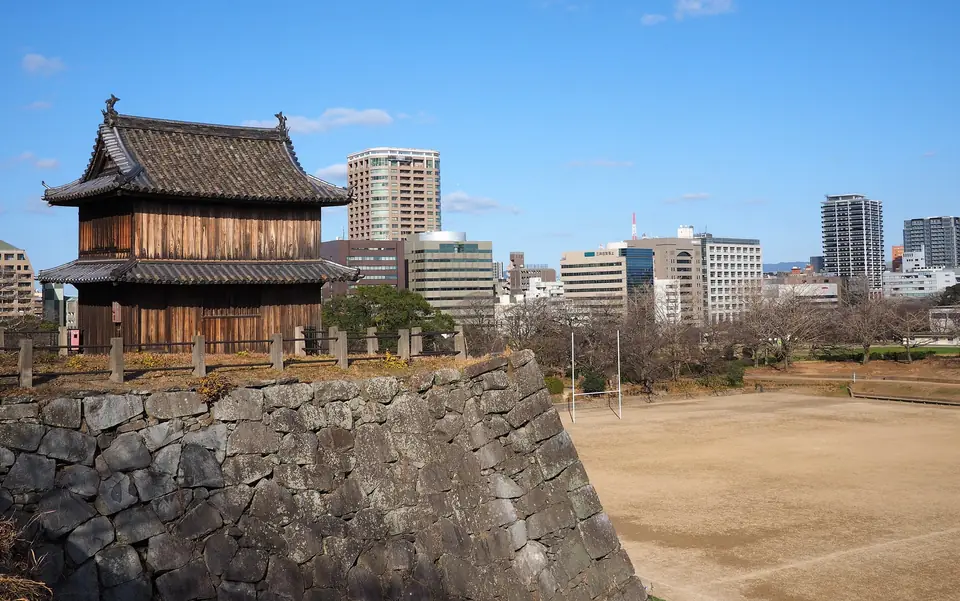
Kuroda Nagamasa began the castle in 1601, newly rewarded after Sekigahara with the province of Chikuzen, and finished it in 1607. It was also the last castle of his father, Kuroda Kanbei, the famed strategist of Toyotomi Hideyoshi. It had three keep bases and 47 watchtowers (yagura), and its great outer moat is today Ōhori Park's lake. Of that complex there remain the almost intact walls, one gate and one tower in their original place and an enormous empty base.
What is missing counts as much as what still stands. Beneath the third enclosure the Kōrokan appeared in 1987, the guest house where Japan received the embassies of the Tang and Silla, the only one of the three to have been located; on top there was a baseball stadium, champion of Japan. And over the keep, letters of the time and a 2025 excavation reopened a question still without a closed answer: whether it was ever raised and why it disappeared.
Highlights
- Keep base — about 25 × 22 m, 40 pillar foundation stones and a lookout over the city
- Kōrokan — the only diplomatic guest house located in Japan, with Chinese and Islamic ceramics
- Shiomi-yagura — the watchtower that spent decades as a Buddhist hall and returned in 2025
- Tamon-yagura — the only tower of the castle still on its original site
- Shimonohashi-gomon — the daimyō's gate, restored as a two-storey gate tower
The ruins of Fukuoka Castle (福岡城跡) occupy a hill in the city centre, between Ōhori lake and the Naka river, and at first sight look like little more than a park with stone walls. Its history, however, explains the very name of the city. Kuroda Nagamasa began to build it in 1601 on Fukusaki hill and finished it in 1607; he renamed the place “Fukuoka” after the Bizen village tied to his clan, and that name is borne today by the city and the whole prefecture. The inner enclosure alone covered 413,900 m², with three keep bases and 47 yagura. The park’s signs also call it Maizuru, “dancing crane”: it is said that, seen from the sea, the castle looked like a crane spreading its wings.
The history of Fukuoka Castle does not end with the samurai. After 1871 it housed the prefecture and from 1874 an Army barracks, which dismantled or destroyed almost all its Edo-period buildings. Later, a baseball stadium was raised over the guest house where, between the late 7th and the 11th century, the embassies of China and Korea were received. Each layer covered the one before. What to see at Fukuoka Castle is, therefore, as much what still stands as what is missing, and the audio guide walks those layers on the ground, in five stops documented and checked against historical sources.
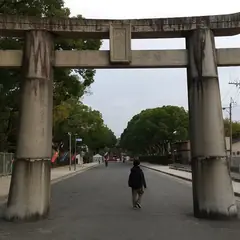
The Kuroda who raised these walls have their pantheon at Tochoji Temple, and Kuroda Nagamasa left his name carved on the stone torii of 1609 at Hakozaki Shrine. Outside the city, Dazaifu Tenmangu holds the tomb of the exiled minister Sugawara no Michizane.
The daimyō’s gate and the name of a city
Shimonohashi Gomon
Summary of this stop
The route begins at the Shimonohashi-gomon, on the north side, beside the moat: a two-storey gate tower on walls of over 8 m. It was the entrance used by the daimyō and the one opened for official ceremonies, and it is the only gate of the castle still in its original place. It was probably lowered to a single storey in the Meiji era; in August 2000 it suffered an arson fire and between 2006 and 2008 it was restored with its two storeys, keeping pieces bearing an inscription of 1805. Along the north front the moats chain together, with lotus and water lilies; the great outer moat, the old Kusagae inlet, became Ōhori Park in 1929.
The name Nagamasa brought from Bizen came close to being lost. According to the documented tradition, when the municipality was born in 1889 the council split between the Fukuoka camp, the city of the samurai, and that of Hakata, the merchant city across the Naka river, which wanted to call it “Hakata”. It is said the vote was decided by a single vote. That is why anyone arriving by train gets off at Hakata station in a city called Fukuoka.
Attached to the south of the gate stands a two-storey tower that for decades was presented under a name that is no longer its own. Which tower it really is remains unknown, and the reason links directly to the next stop.
The watchtower that came back from the temple
Shiomi Yagura
Summary of this stop
In the northwest corner of the third enclosure, on a 7 m embankment, stands the Shiomi-yagura, a tower of about 10 m that watched over Hakata bay and the Genkai sea. It was one of the castle’s 47 towers, and its story is one of a long exile. In the early 20th century it was sold to Sōfuku-ji temple, which used it as a Buddhist hall under the name “Tsukimi-yagura”, tower for moon viewing.
In 1991 a construction tablet (munafuda) turned up in its attic and revealed its true identity. In March 2025 the tower returned to its corner with 40% of its original timber, and in the attic the old tablet and the new one now sit together. The consequence was unexpected: the tower that since 1956 had been displayed as the Shiomi-yagura beside the Shimonohashi gate was left without a name, and some suggest it may have been the Taiko-yagura.
Baseball over thirteen hundred years of embassies
Kōrokan Museum
Summary of this stop
The great esplanade of the third enclosure was the Heiwadai stadium, home of the Nishitetsu Lions, who with Inao Kazuhisa and Nakanishi Futoshi won three Japan Series in a row between 1956 and 1958, and later of the Daiei Hawks between 1989 and 1992. It closed in 1997 and was demolished the following year. Ten years earlier, in 1987, when its outer stands were being renovated, the remains of the Kōrokan had appeared, the official guest house that received embassies from the Tang and Silla and saw off the Japanese missions to China. Of its three sites (Heian-kyō, Naniwa and Tsukushi) it is the only one located, with Chinese ceramics, Islamic ceramics and glass from western Asia, and it has been a National Historic Site since 2004. A pavilion protects the excavated foundations, and in the neighbouring square the layout of buildings, fences, latrines and moat is marked on the ground.
Before the excavation, the discovery already had a forerunner. Nakayama Heijirō, a professor of medicine at the Imperial University of Kyushu, deduced from poems of the Man’yōshū that the Kōrokan stood on this hill. As it was a closed barracks, he entered during the two days of the Dontaku festival, when it opened to the public, collected old tiles and published his thesis in 1926. The excavation of 1987 proved him right.
The Dontaku itself belongs to the castle’s history: it began as the New Year visit of the Hakata Matsubayashi to the lord Kuroda, with three gods of fortune on horseback and children dancing before the daimyō’s family, and owes its name to a Dutch word. The audio guide tells at this stop which word that is and how the festival survived its prohibition.
The only tower nobody moved
Tamon Yagura
Summary of this stop
On the southwest side, on a high wall, extends the Tamon-yagura of the Minami-ninomaru: a two-storey corner tower joined to a gallery of 30 ken in wood and white plaster, divided into 16 rooms that served as storehouses, with eaves resting on brackets. Renovated in 1854, it is the only yagura of the castle still on its original site without having been dismantled or moved, and it has been an Important Cultural Property since 1971.
Its survival is an exception. After the abolition of the domains in 1871 the castle housed the prefecture, and from 1874 it passed to the Army, which dismantled almost all the Edo-period buildings: a few were moved and most were destroyed. The Bugu-yagura, taken to a Kuroda villa, burned in the bombing of Fukuoka in 1945.
The barracks also saw the castle’s last combat as a fortress. According to the documented tradition, in the early hours of 28 March 1877, in the midst of the Satsuma war, former samurai of the Kuroda domain rose in support of Saigō Takamori and assaulted the garrison, almost empty because the troops were at the front. The defence, with a platoon, police officers and even band musicians, and the end of the rebels form one of the darkest episodes told at this stop.
The keep that perhaps was never seen
Keep base
Summary of this stop
The last stop is the keep base (tenshudai), a stone platform of about 25 m east to west and 22 m north to south, with the medium and small bases chained on to the east. Inside it, 40 pillar foundation stones surface, and its top, at about 36 m above sea level, is a lookout over Ōhori Park and the city. The southeast corner has a slope of 35-40°, the gentlest in the castle: a letter from around 1640-1650 says that the first walls were made with stones from Najima castle and, lacking professional stonemasons, were raised by amateurs, so they came out “nuruku”, soft.
What nobody knows for certain is whether a keep was ever raised on this platform. The traditional view holds that it was never built, out of prudence towards the shogunate, and rests on the silence of the Kuroda’s official chronicle and on an old plan with no keep. Against it weigh several letters: around 1602 Nagamasa was ordering its pillars raised before the end of the month, and in 1620, a year after the shogunate punished Fukushima Masanori for repairing his castle without permission, Hosokawa Tadaoki wrote that he had heard Nagamasa had reported to the shogun the demolition of the keep, although that letter is described in two different ways. The 2025 excavation, the first inside the base, found a foundation of stones of at least 50 cm, forged nails and tiles with the paulownia crest, tied to the Toyotomi, which probably come from Najima castle. The city government says only that there are remains tied to a building, and considers it difficult to reconstruct for lack of documentation.
Meanwhile, the city revives it in its own way. Every spring, the castle’s Cherry Blossom Festival includes a parade in which the mayor and celebrities dress as Kuroda Kanbei, Kuroda Nagamasa and the 24 Kuroda generals, and in 2024 a temporary keep-shaped structure was lit up over the empty base as a “phantom keep”. The audio guide gathers all the clues of the case here, and lets each visitor draw their own conclusion.