Kūkai's Shingon temple
Tochoji Temple Audio Guide (Tōchō-ji)
A temple that tradition attributes to Kūkai, squeezed between an avenue and the Hakata subway. Behind its gate wait a 10.8-metre wooden Buddha, a vermilion pagoda without nails and the tombs of lords who took their vassals, and a whole neighbourhood, with them in death.
- 30 min of audio
- Temple and daimyō pantheon
According to tradition, Kūkai (Kōbō Daishi) founded the temple in 806, on his return from Tang China, and named it Tōchō-mitsu-ji: may esoteric Buddhism be transmitted far to the East. It was born by the sea, in Gyōnochō, took refuge for a time in Shito during the wars of the Northern and Southern Courts and, after burning in the late 16th century, became tied to the Kuroda house, lords of Fukuoka, who endowed it with 300 koku of income and 150,000 tsubo of forest and made it their pantheon.
Its highest-ranking piece is also the smallest: a Heian-period Senju Kannon, carved from a single block of maki, less than a metre tall and with 42 arms, an Important Cultural Property of the State and almost always hidden behind the doors of the hondō. A few steps away, the Fukuoka Daibutsu, carved between 1988 and 1992, weighs 30 tonnes and rests above a pitch-dark passage.
Highlights
- The Fukuoka Daibutsu — a seated hinoki Shaka of 10.8 metres and 30 tonnes, with a carved halo of 16.1 metres
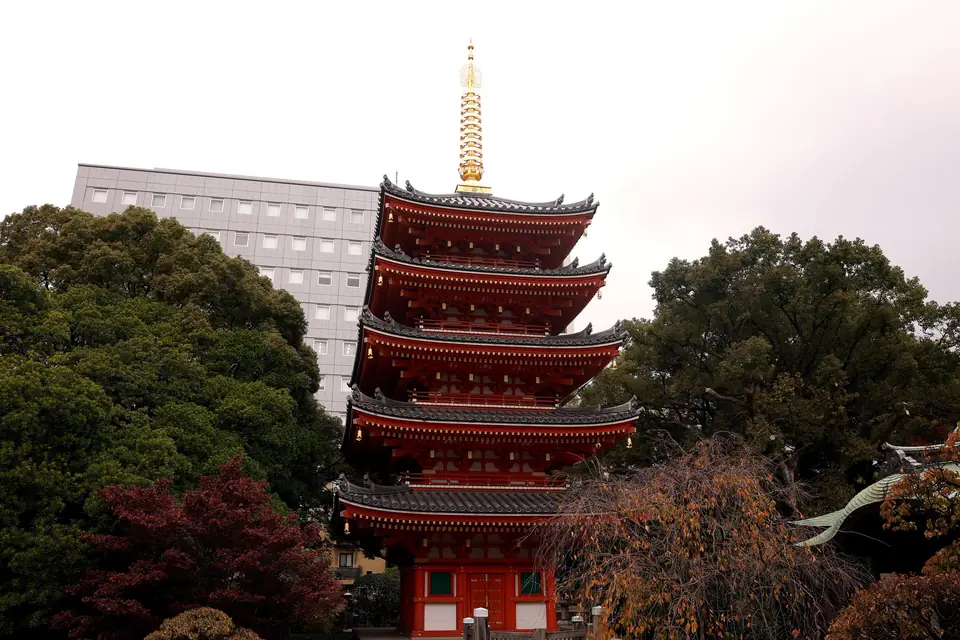
- The five-storey pagoda — 25.9 metres of vermilion hinoki, assembled without nails and finished in 2011
- The tombs of the Kuroda daimyō — granite gorintō of over 5 metres, each surrounded by 49 stelae
- The Rokkakudō — a hexagonal hall of 1842 with a revolving shrine and gyōki-buki tiles, open on the 28th of each month
- The gate on Taihaku-dōri — where the Hakata Gion Yamakasa floats turn at a run every 15 July
The history of Tōchō-ji begins, according to the temple’s tradition, in 806, when Kūkai landed at Hakata on his return from Tang China with the esoteric Buddhist doctrine he had learned in Chang’an. Other sources push the founding back to 809, and there is no agreement on its primacy either: the city presents it as the oldest temple founded by Kōbō Daishi in all Japan, while other references limit it to being the oldest Shingon temple in Kyushu. What is not disputed is what came next: the temple moved from the seashore to its present site, became the pantheon of the Kuroda lords and, since 1910, has been giving ground to the tram, the subway and the city itself, while the tombs of its daimyō have not moved an inch.
Today the precinct is a compendium of eras in very little space: a Heian-period Kannon that almost nobody sees, a hexagonal hall of the 19th century paid for by a merchant, a pagoda of 2011 and a giant Buddha of the 1990s. Every autumn the temple also opens at night, with the hondō turned into a screen of light, as part of the illuminated walk through Hakata’s temple district. The route with the audio guide, documented and checked against historical sources, links these pieces in five stops, from the traffic of Taihaku-dōri to the darkness beneath the Daibutsu.
Its gate is part of the Yamakasa route, the race that sets out from Kushida Shrine, and the tombs of the Kuroda lords complete the story of the family that built Fukuoka Castle.
The gate where the Yamakasa turns
Tochoji Temple
Summary of this stop
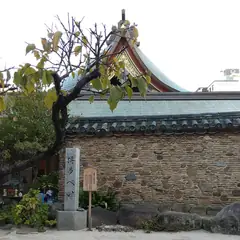
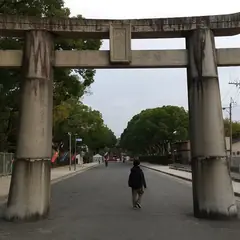
The gate of Tōchō-ji, with the plaque “Nangakuzan”, opens directly onto the Taihaku-dōri avenue. At the sides, stelae proclaim it the first temple on the route of the 88 sacred sites of Kyushu, and a stone commemorates the 1,200 years since its founding. The rest of the year, the stretch of road in front of the gate is just asphalt and traffic.
Every 15 July, however, that asphalt becomes one of the key points of Hakata’s great festival. In the Oiyama of the Hakata Gion Yamakasa, floats of over a tonne turn at a run around the second seidōki, the route flag planted right in front of the gate. The link is no coincidence: in the age of syncretism, the temple was the bettō, the Buddhist administrator, of Kushida Shrine.
The gate also tells the story of a temple that the city has been squeezing. Tied to Kuroda Tadayuki, the second lord of Fukuoka, as its great patron, the precinct retreated eastward with the tram of 1910, again with the subway, and in the early Shōwa era sold more than 3,000 tsubo. The narration on site explains the one thing that did not move in all that time.
A Kannon hidden beneath a new pagoda
Hondō and five-storey pagoda
Summary of this stop
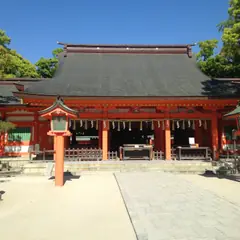
In the courtyard, the hondō and the pagoda sum up the two extremes of the temple. Inside the great wooden hall, normally closed, is kept the highest-ranking piece of Tōchō-ji: a standing Heian-period Senju Kannon, carved from a single block of maki, barely 82 to 87 centimetres tall depending on the source and with 42 arms. It is a hidden image (hibutsu), was declared a national treasure in 1904 and is today an Important Cultural Property of the State.
Beside it, the hondō keeps a seated image of Kōbō Daishi and a standing Fudō Myōō. Tradition says that Kūkai spent several months in Hakata between 806 and the following year, and that in that time he carved the Fudō Myōō that was the temple’s first object of worship and even his own portrait; the image of the Master kept in the hondō, also hidden, is held to be the work of his own hand.
Against so much hidden antiquity, the five-storey pagoda is the newest thing in the precinct. Finished in May 2011 for the 1,200th anniversary, it measures 25.9 metres with the finial and is made of hinoki, assembled without nails using the traditional technique. At the top, beside the dharma wheel, appear the Kuroda wisteria crest and the paulownia crest, and beneath the gilded bronze hides a very modern answer to earthquakes.
A merchant’s hexagonal whim
Rokkakudō
Summary of this stop
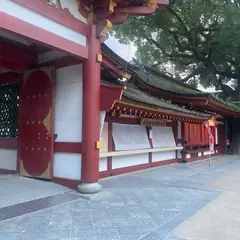
The Rokkakudō breaks with everything around it: it is a six-sided hall, raised in 1842, with a revolving shrine inside and a pair of komainu in front. It was not paid for by a lord but by Bungoya Eizō, a Hakata merchant also known as Banzairō Sodehiko, who gathered funds from merchants from Nagoya westward and called in the Nagoya temple carpenter Itō Heizaemon.
Its two-tier roof has gyōki-buki tiles, an old and rare system, laid at the patron’s express wish, as the carpenter himself left in writing. The doors of the hexagonal shrine carry carved calligraphy and drawings by scholars of the time, among them the monk Sengai of Shōfuku-ji.
The hall, a municipal cultural property since 1988, opens only on the 28th of each month, when the shrine is left in view. The audio guide tells how to look at that roof to understand the whim of a merchant who wanted to leave his signature in a temple of daimyō.
Five vassals before their lord’s tomb
Tombs of the Kuroda daimyō
Summary of this stop
In the temple cemetery stand the tombs of three Kuroda lords: Tadayuki, Mitsuyuki and Harutaka. They are granite gorintō of about 5.4 to 5.8 metres, each surrounded by 49 granite sotoba evoking the 49-storey palace of Maitreya’s Tushita heaven; the whole is a cultural property of the city of Fukuoka since 1995.
Kuroda Tadayuki died in 1654 and before his tomb are lined up the five gorintō of five vassals who took their own lives by junshi to follow him; beside them, the gravestone of a sixth, a yamabushi who also accompanied him in death. The tombs also remade the neighbourhood: the neighbouring temple Tenpuku-ji was moved across the street to make room for Tadayuki’s, and in 1707, for Mitsuyuki’s, 14 of the 19 houses of Shōfukuji-maemachi moved away and the name of that neighbourhood disappeared.
The paradox lies in Tadayuki himself. According to the documented tradition, his father, Kuroda Nagamasa, wanted to disinherit him and even offered him in writing to become a monk and found a temple; once lord, he was the protagonist of the Kuroda Sōdō, one of the great crises of daimyō houses in the Edo period, in which his own right-hand man denounced him to the shogun. How that lawsuit ended, and how that turbulent lord came to be this temple’s great patron, is revealed in the narration beside his tomb.
Thirty tonnes of Buddha above the darkness
Great Buddha of Fukuoka
Summary of this stop
The route ends on the upper floor of a concrete building, the Daibutsu-den. There is the Fukuoka Daibutsu, a seated hinoki Shaka carved between 1988 and 1992: it is 10.8 metres tall, in allusion to the 108 worldly desires, weighs 30 tonnes and has behind it a halo of 16.1 metres with carved buddhas, before a wall of about 5,000 small buddhas. The figures are often confused, and more than one source gives the Buddha the height of the halo. Photography is not allowed in the hall.
Beneath the pedestal opens the Jigoku-Gokuraku passage, from hell to paradise. It is entered on the left of the Buddha, passes reliefs of Enma, the judge of the dead, and of red and blue demons, and reaches a stretch of total darkness. According to local custom, whoever manages to touch the “Buddha’s ring” by feel in the pitch black will go to paradise. The audio guide accompanies that last stretch and closes the visit just where the light returns.