Shinto shrine
Kushida Shrine Audio Guide (Kushida-jinja)
The guardian shrine of merchant Hakata, rebuilt on top of a razed city, hides a 112-metre track in its courtyard: the one the Yamakasa floats race down every 15 July at 4:59, timed to the hundredth of a second.
- 40 min of audio
- UNESCO festival
According to tradition, the kami Ōhatanushi was enshrined here in 757 and Susanoo arrived in 941; today they share the prayer hall with Amaterasu, which is why three bells hang in a row. After the clan wars of the 16th century, which left Hakata scorched, the present buildings went up in 1587, when Toyotomi Hideyoshi directed the rebuilding of the city.
Among office blocks and shopping arcades, the precinct keeps a ginkgo said to be about a thousand years old, a wall made of stones and tiles from the fires of the war and a decorative float of about 13 metres on show almost all year: the survivor of Hakata's long fight against the telegraph and electricity cables.
Highlights
- Kushida no ginan ginkgo — 20.8 m tall, about a thousand years old and a prefectural Natural Monument
- Haiden of the three bells — one for each kami, with Fūjin and Raijin carved on the gable
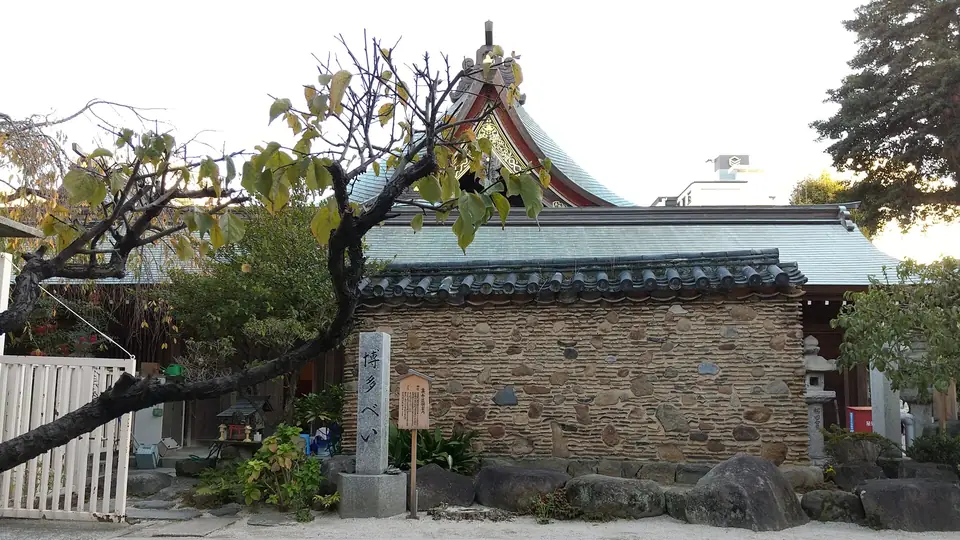
- Hakata-bei wall — a 1587 earthen wall with stones and tiles burned in the war
- Seidō of the Kushida-iri — 112 m that the Yamakasa covers in about 30 seconds
- Kazari-yamakasa — a decorative float of about 13 m, renewed every 1 July
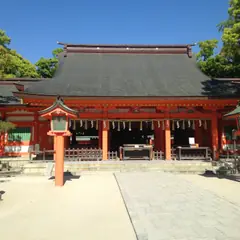
A few steps from the shopping arcades of Hakata, Fukuoka’s merchant district, Kushida Shrine seems an oasis of calm: a two-storey gate, an enormous tree and a gravel courtyard. The calm is deceptive. Tradition places its founding in 757, the city around it burned in the wars of the 16th century and Toyotomi Hideyoshi laid it out afresh in 1587, and from that layout were born the seven neighbourhoods that carry their floats to this precinct every July. The Hakata Gion Yamakasa, the festival offered to this shrine from 1 to 15 July, has been on UNESCO’s intangible heritage list since 2016.
The history of Kushida Shrine and its architecture can be read in the details: three bells in the prayer hall, a wall with burned tiles, a banner that put an end to the fights between neighbourhoods and a minute of head start on the festival’s clock. The audio guide, documented and checked against historical sources, covers the precinct in five stops and connects every corner with the city that has sustained it for centuries.
The race does not end in the courtyard: the Yamakasa floats turn at the gate of Tochoji Temple, and a few steps away, beside the Naka river, the Nakasu Yatai are set up every evening. Its stone anchors also link to Hakozaki Shrine, the great stage of the memory of the Mongol invasions.
A thousand-year-old tree and anchors of disputed origin
Kushida Shrine
Summary of this stop
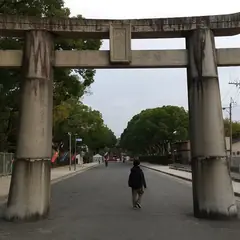
Once past the rōmon, the two-storey entrance gate, the commercial noise of Hakata is left behind. From the gate’s ceiling hangs a coloured disc with the twelve zodiac signs and an arrow that is turned every New Year’s Eve towards the year’s lucky direction. Beside it stands the sacred ginkgo Kushida no ginan: 20.8 metres tall, 598 centimetres around, attributed about a thousand years and ranked as a prefectural Natural Monument. Even the Hakata Iwai-uta, the city’s celebration song, names it, and in autumn it covers the ground with yellow leaves.
At its foot rest some large elongated stones presented as “Mongol anchors”, remains of the fleet that tried to invade Japan. Not all sources agree: some consider them more likely to be anchors of Chinese merchant ships. Which of the two versions weighs more is one of the questions the audio guide leaves open right there.
Three bells, three gods and a well of long life
Haiden of the three bells
Summary of this stop
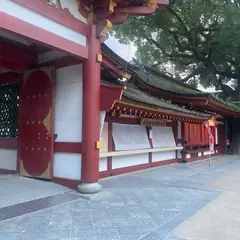
The prayer hall, the haiden, has something unusual: three bells in a row. Each one corresponds to a kami, and each kami arrived in a different era. According to the shrine’s tradition, Ōhatanushi was enshrined in 757 by an oracle in the time of Empress Kōken, and Susanoo arrived in 941, brought by Ono no Yoshifuru as thanks for putting down the rebellion of Fujiwara no Sumitomo. Today Ōhatanushi occupies the centre, Amaterasu the left and Susanoo the right. On the gable, Fūjin, the wind god, flees with his tongue pulled out by Raijin, the god of thunder.
This coexistence of gods also has an administrative history: during the Edo period the shrine was managed by the Jingo-ji, which depended on the Buddhist temple Tōchō-ji. It became independent only with the 1868 decree separating Shinto and Buddhism, and in 1891 it received the rank of prefectural shrine.
To the right of the haiden, three cranes surround the Tsuru no Ido well. Popular belief holds its brackish water to be water of longevity, and custom said to drink it in three sips: one for oneself, another for the family and the third for loved ones. Today it can no longer be drunk, but the gesture is still alive.
A wall raised with the rubble of war
Hakata-bei wall
Summary of this stop
In the 16th century, the wars between the Ōtomo, Mōri and Shimazu clans left Hakata reduced to a scorched field, and the shrine burned with it. The present buildings date from 1587, when Toyotomi Hideyoshi directed the rebuilding of the city, although some municipal guide moves that date forward to 1585.
From that rebuilding came the Hakata-bei, an earthen wall that, instead of being an ordinary one, has stones and tiles burned in the fires of the war embedded in it. The stretch preserved in the precinct is a restoration, but it leaves the embedded fragments in view: the city rebuilt with its own rubble.
Hideyoshi’s new layout, between the Mikasa river to the east and the Hakata river to the west, grouped the city into blocks of neighbourhoods. From them descend the seven nagare that organise the Yamakasa today: Daikoku, Higashi, Nakasu, Nishi, Chiyo, Ebisu and Doi. How that urban plan became the backbone of the festival is told in front of the wall itself.
The timed track of the Kushida-iri
Seidō of the Kushida-iri
Summary of this stop
The central esplanade, the seidō, looks like a simple courtyard. In July stands are set up for some 1,800 people and it becomes the track of the Kushida-iri: about 112 metres from the start, round the banner and out of the precinct, covered in a little over 30 seconds and timed to the hundredth. In the 2026 Oiyama, Nishi-nagare clocked 30.07 seconds, the best time of the seven neighbourhoods.
The banner, the seidō-ki, was installed in 1848. Before that there was no marker, each neighbourhood turned at a slightly different point and disputes were frequent; since then it has been kept and planted by the Shimo-Higashi-machi neighbourhood. The festival clock has its logic too: the race starts on 15 July at 4:59 and not at 5:00, because that minute allows the first yamakasa to stop behind the banner and sing the Hakata Iwai-uta with the crowd. Under the lunar calendar, the start coincided with the setting of the full moon.
In 2020 the pandemic forced the festival to be postponed for the first time since the war, and in 2021 the floats were not carried either. Even so, both years, at exactly 4:59, a group of volunteers entered this courtyard without a yamakasa. What they did in 2021 so that the offering would not be interrupted is one of the moments the audio guide reserves for the centre of the esplanade.
The giant float that survived the telegraph
Kushida Kazari-yamakasa
Summary of this stop
Until 1687 the yamakasa were carried slowly. That year, a wedding brawl between the young men of Doi-machi and a groom from Tate-machi, in the Ebisu neighbourhood, ended in the summer with Ebisu-nagare breaking into a run to overtake Doi-nagare while it was eating, and with Doi running so as not to be beaten. The success of that improvised race gave rise to the Oiyama. The origin of the festival itself is more disputed: the organising association dates it to 1241, when the monk Enni went through Hakata on a platform sprinkling holy water against an epidemic, but other sources propose 941 or 1432.
The floats grew to about 16 metres until, in 1883, the first telegraph lines were strung along the streets of Hakata. There followed years of low floats, of residents who paid for taller poles and, in 1897, with the arrival of electricity and telephone cables, a year without a race in which only one yamakasa was raised, to be viewed within this precinct. In the Meiji era the festival ended up separating the floats that run, the kaki-yamakasa, from those that are only displayed, the kazari-yamakasa.
The Kushida kazari-yamakasa, about 13 metres tall, is the only one that can be seen all year, except in June, and it is renewed every 1 July. The 2026 one shows on its front the Sanada in “Tenka wakeme Sekigahara” and on its back “Appare Kintarō”. How Hakata’s battle against the cables ended, and what it has to do with the motionless giant, closes the route.